
郑雅君 梁俊
https://doi.org/10.64053/CFEP3019
受访嘉宾:梁俊,曾在乌蒙山支教,用吉他谱曲,教孩子唱古诗,并将学生习作结集为《 乌蒙山里的桃花源 》。2018 年春节,他带着山里的孩子登上央视《 经典咏流传 》,一曲《 苔 》感动全国。十年来,他持续实践诗性教育,编著出版《 唱!童谣 》《 唱!古诗 》《 唱!宋词 》《 唱!诗经 》《 唱!乐府 》系列音乐绘本,并发起 “苔基金”,深耕乡村教育探索与实践。
访谈人:郑雅君
甘肃张掖人。毕业于复旦大学社会学系、复旦大学高等教育研究所,分别获得法学学士、教育学硕士学位。香港大学教育学院博士研究生。主要研究方向为文化社会学视角下的教育公平与学生发展。著有《 金榜题名之后 —— 大学生出路分化之谜 》。
一 从教室出发,走进一个族群
雅君:你在石门坎教书,那片土地在你心中,是怎样的一个地方?
梁俊:我曾在贵州威宁县石门乡的一所村小教书,从 2012 年到 2015 年,为期两年。石门乡旧称石门坎,地处滇黔交界的乌蒙山深处,海拔 2200 米,是典型的高寒凉山地区。
无论是官方文书,还是民间歌谣,都记录着乌蒙山的艰险与贫瘠:
“羊肠小道,十倍蜀道”
“三月方暖,九月飞雪”
“种一坡来收一锅”。
这些话不仅是石门坎生活的写照,也是我对那片土地的切身感受。
雅君:你当初去石门坎支教,带着怎样的目标和期望?
梁俊:去石门坎之前,我读了几本书:张坦的《 窄门前的石门坎 》,宣教士柏格里的日记《 在未知的中国 》,还有沈从文的孙女沈红写的《 石门坎文化百年兴衰 》等。这些书让我对石门坎的百年历史有了初步想象,也让我开始关注大花苗这个族群漫长又坎坷的迁徙与流亡史。慢慢地,我对石门坎和大花苗的好奇越来越强,不只是想去那里当一名老师,更是想看看,现在的石门坎是什么样?如今的大花苗,又过着怎样的生活?
虽然我的身份是老师,但我真正的兴趣,其实是石门坎与大花苗这个社区。我希望,我的教学不仅仅停留在课堂上,而是建立在对社区、对族群的理解与尊重之上。那时候,我想:如果可以的话,我愿意在这个村庄待上十年,陪伴这些孩子十年。因为我相信,人的成长需要时间的浸润,无论是学生,还是老师。
二 乡村教育,是人与人的相遇
雅君:你教的孩子们是谁?他们的处境如何?
梁俊:我当时任教的 “新中小学”,是由民间团体与政府合作建立的学校,专门为乌蒙山深处的山顶苗族孩子而设。学生来自 “新营” 和 “中寨” 两个苗寨,属于苗族的大花苗支系。学生大部分是大花苗,还有一些彝族、汉族人。
大花苗的族群古歌里说,他们的祖先蚩尤战败后中原的余部,千年流亡、迁徙,最终隐入乌蒙山,成为彝族人为佃农,寄居其地。支教那年,很多村民还住在茅草屋,以农耕为生。除了必要的生活,他们几乎不与外界接触。能说简单汉语的年轻人,开始外出打工,多数在城市的建筑工地干最苦最危险的活,或者成为流水线上的一员。孩子们在入学前基本不讲汉语。大部分村民没念过书,小学已是高学历。
他们的困境,不只是 “山高路远” 这么简单,也不只是经济上的贫困,更深层的,是族群历史的流亡与社会边缘化造成的文化隔阂。这种困境,压在孩子的成长之路上,也横在教育者的面前。
雅君:你如何看待孩子们所面临的困境?教育能够回应这些挑战吗?
梁俊:一方面,乌蒙山的大花苗的确和生活在城市里的不一样。我们住在交通便利、网络畅通的城市,有更高的收入、更好的医疗和教育资源,这是实实在在的差距。但另一方面,我们的困境也真实存在。他们被困在大山里,我们困在钢筋水泥的城市。他们出不去,我们也被房贷、车贷、升学压力、职场焦虑压得透不过气来。他们难以改变命运,我们也常感身不由己。
表面上我们身处 “现代社会”,但很多时候,只是活在另一种形式的 “围困” 中。他们的困境更多来自地理和历史的重压,我们的困境则藏在现实生活的焦虑和内心世界的闭塞中。我始终对教育是否真能回应这些困境,持保留态度。因为我知道,走出大山并不意味着真正走出困境。我自己就是从大山走进城市的人,深知城市未必就有答案。
所以我能做的,并不是去 “解决” 什么,而是回到大山,与大花苗社区一起,慢慢摸索一条可出困境的路。在这条路上,我不是谁的 “教导者”,而是一个同行的人。虽然我知道我无法回应所有困境,但在教育与陪伴上,我仍愿意回应一点、做一点。改变,总是从微小个体开始的,我愿意成为这个开始。这也是我离开城市,去往乡村支教的原因。
雅君:从村民的角度看,他们对孩子的教育有哪些期待?又对老师有什么期望?
梁俊:大多数村民的期望很朴素,他们希望孩子能学好普通话,有了语言能力意味着将来能走出大山,出去打工、挣钱,改善生活。有些受过小学教育的家长则盼望孩子多读书,在他们眼里,多读书意味着不再务农,能在城市里找到一份体面的工作。
至于对老师的期待,我有一次印象特别深刻。那次,我和几位老师步行四五个小时,雨夜中穿越峡谷,爬过崖壁,趟水翻山,去孩子们在云南彝良的老家家访。一路上我不禁想,为什么要吃这个苦?可当我们抵达那座从未有老师到访过的大花苗村庄时,一切都变得值得了。
整个村庄的村民都邀请我们到家里坐坐。一位学生的妈妈对我说:“我们家又脏又乱,但我孩子说你们对他很好,我们很想你们来坐坐。” 她目不识丁,却道出了许多大花苗家长最朴素的期待:希望老师真心对待、关爱他们的孩子。而他们感受到“爱”的方式也很简单 —— 只要老师愿意翻山越岭,到家里坐一坐,就是诚意,就是爱。
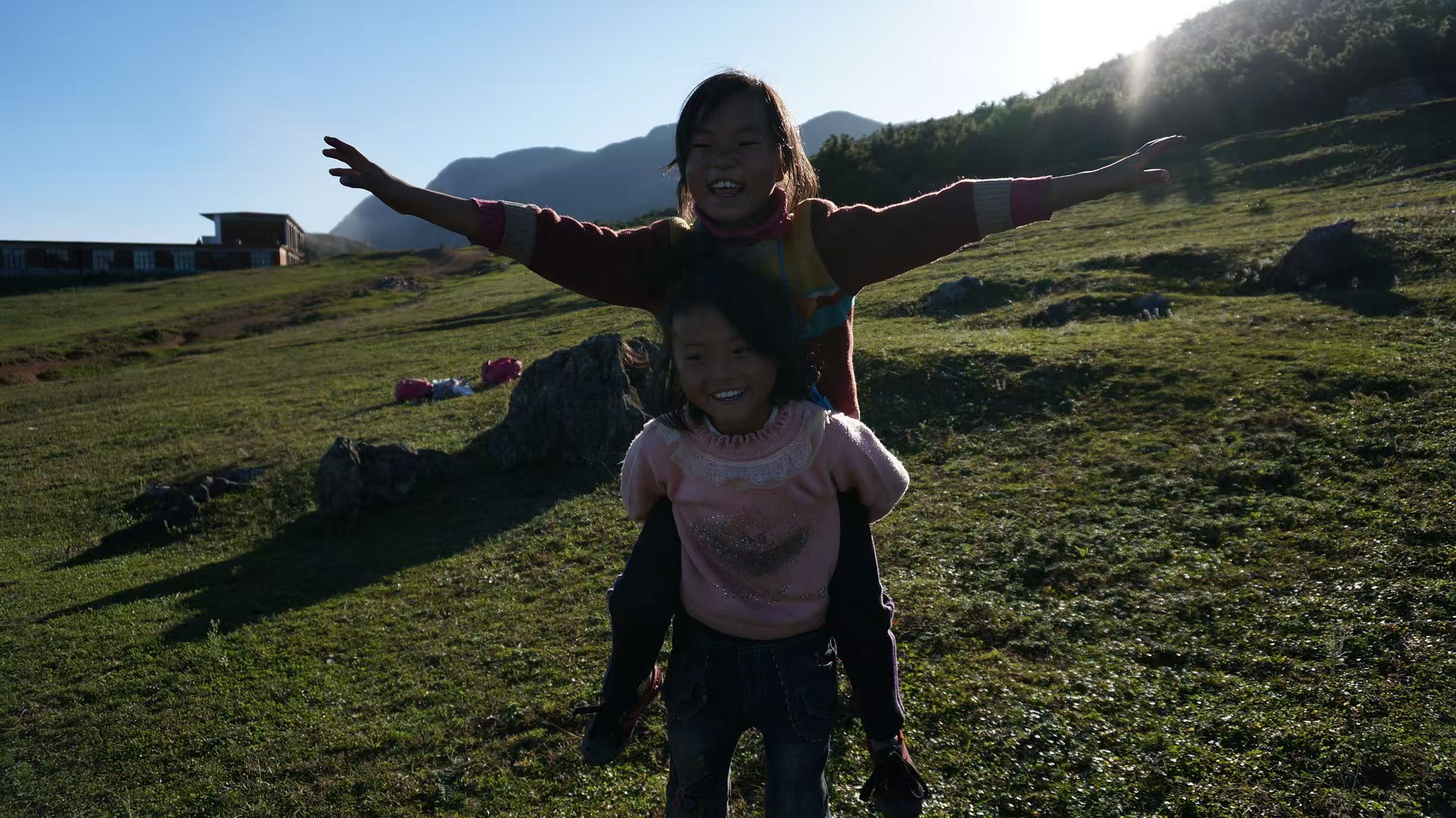
那两年,我们三天两头往寨子里跑,常常去老乡家——参加婚礼与葬礼,迎接新生命的诞生,用歌声送别逝去的灵魂,聆听长老口中的古老传说与歌谣,与孩子们在山间自由奔跑、放声歌唱。与村民、孩子交往过程中,我们彼此认识,彼此了解,彼此影响。这让我意识到,教育不是从讲台上开始的,而是从人与人之间的温暖往来中生长出来的。
三 自由教学的乌蒙山试验田
雅君:乌蒙山的教学经历给你留下了怎样的体会?
梁俊:在乌蒙山当老师,让我放下了对知识的优越感与控制欲,也促使我学习如何在文化背景迥异的大花苗群体中,与他们并肩同行。在这个过程中,我必须深深的面对两个问题:“怎样成为一名老师?” “成为一名怎样的老师?” 前者关乎专业能力 —— 如何用合适的方法,将知识有效地传递出去;后者其实关乎一个人的温度 —— 作为老师,我是一个怎样的人?我的世界观、想法、品格、行为,都会悄悄影响到和我接触的每一个孩子、每一位村民。我体会到,无论是专业能力的提升,还是作为 “怎样的人” 的自我成长,我意识到,我的每一点成长,都会悄悄带动孩子的成长。
雅君:现在很多老师说自己像 “教学流水线上的工人”,教书不快乐,你有这样的感受吗?
梁俊:在乌蒙山深处教书,是我人生中最快乐的一段时光。那里大概是全国最自由的教学试验田 —— 山高皇帝远,教育局鞭长莫及。我得以放手做教育实验,安心探索,尽情享受教学本身的乐趣。为师之乐,在于得享自由。
雅君:在你看来,乌蒙山是一片教育的自由之地。你在教学中享有哪些自由?具体做了些探索与实践?为什么教学自主权如此重要?
梁俊:乌蒙山是教师的桃花源,因为新中学校的老师真正拥有教育的自主权。
首先,我有权选择不教什么。以语文课为例,我删去教材中说教性强、不真实、无意义、不优美的篇目,去繁就简;也可以不上思想品德课,跳过那些空洞乏味的 “五星教育”。其次,我有权决定教什么。受交大附小丁慈矿老师的《 小学对课 》启发,我结合孩子的实际,自编诗教材料,用童谣、古诗、韵文、现代诗滋养童心,激发汉语语感。借鉴江浙名师顾舟群的经验,我开设 “读写绘” 课程 —— 每周一本经典绘本,从阅读、写作到绘画,提升孩子的学习兴趣与审美能力。我们还设有戏剧课,每学期排演一场经典剧目,在全校巡回演出。苗族孩子天生爱唱,我便为古诗谱曲,用歌声打开他们的诗性感受力。
再者,在乌蒙山缺乏老师,我被迫成为全科教师,因此,我得以自由地重构课堂。
我可以用一个月快速扫读教材,把自编的诗教和 “唱古诗” 融入日常训练,随时朗读,随性歌唱;也可以停课两周,专注排戏、演出;可以随时走进山林,在树影下读诗,在白云下唱歌。我还可以每日带着孩子们,自由且真实的阅读和写作。临近统考,我再帮孩子们收心刷题,帮孩子理解考试逻辑,提高分数。
在城市,教育系统像一套精密的机器,教师往往只是其中的一个执行零件。太多束缚让教师难以自主,受限于制度、受困于评价体系,渐渐失去了作为 “教育者” 的主动权,成了工具人。而在山里,在这片远离制度、社区干预的土地上,我既能设计课程,也能真正陪伴孩子成长。也正因为这份教学自由,孩子们即使身处资源匮乏的环境,依然保有想象力、情感和创造力。
雅君:你提到孩子们在山里依然保持着想象力、情感和创造力,这具体体现在哪些方面?在教学过程中,有哪些成果让你印象深刻?保持想象力、情感和创造力,是否与应试成绩产生冲突?
梁俊:两年的教学积累,有三点可以看见的成果:
第一,我们整理并出版了孩子们的文集,名为《 乌蒙山里的桃花源 》。这些文字见证了孩子们的想象力、情感与创造力。
第二,那首在没有灯光的教室里反复吟唱的古诗《 苔 》,后来登上了中央电视台《 经典咏流传 》节目,感动了无数人。
第三,我任教的两年里,孩子们的语文成绩在全乡统考中持续领先,尽管我们的教学方式并不应试。
这些成果并非我最初的目标,但它们见证了孩子们真实的成长,也印证了一种可能:乡村教育扎根于对社区和族群的理解与尊重,在此基础上,老师拥有自由与权利,探索合适的教学与陪伴方法,土壤自由、滋养得当,即使在乌蒙山这样的高寒之地,孩子们也能发芽、生长、开花、结果。
四 失去自由之后的离开与留恋
雅君:你原本打算在乌蒙山坚持十年教育,为什么最后只做了两年?背后有什么原因吗?
梁俊:国家推动 “撤点并校” 政策,许多乡村教学点被并入乡里的中心学校,我们所在的新中小学也在被撤并的名单之中。另一方面,这所学校最初是由民间筹资创办的 “私立学校”,虽然在教育局的监管下运行,但一直保有一定的自主权,比如可以自行招募老师、探索教学方式。但随着政府财政的增强、交通条件的改善,政策要求这类民办学校逐步转为公立。一旦公立化,我们将失去原本的教育自主权,很多教育实验也难以继续。在那样的制度环境下,留下也无法再做我们想做的教育,于是,我们只能选择离开。
雅君:你在乌蒙山的乡村教育刚有成效,却因客观原因被迫中止,这让你感到遗憾吗?回望这段经历,你有哪些感想?
梁俊:从教学的角度来说,我并不觉得遗憾。因为一旦失去了教学的自由,老师就像厨子没了刀、巧妇没了米、士兵没了枪 —— 即便拼尽全力,也难以真正教好书。在石门坎,我们曾拥有那份自由,而当这种自由不再,离开就成了必然的选择。
真正让我割舍不下的,是那两年与大花苗社区之间建立起来的深厚情感。在教室里和孩子们谈笑,在操场上一起奔跑,在傍晚去老乡家串门聊天……这种人与人之间的真实连接,是我最留恋的部分。
此外,在乌蒙山教书,我获得了一种从未有过的价值感。我们这个社会常讲 “学而优则仕”,鼓励人通过读书、工作、赚钱、在城市立足,来实现所谓的 “个人价值”。但就我个人而言,从大山出来、在城市里努力生活的那些年,反而很少感受到内心的满足。拼搏带来的不是意义,而是持续的焦虑。
直到我放下实现个人价值的疯狂追求,进入乌蒙山,在那个几乎被忽视的族群中工作与生活,我才第一次强烈地感受到:原来我的学识和能力可以直接服务一个真实的社区,并在这个过程中释放出真正的能量。这种价值感,不是对成就的夸耀,而是对生命的滋养。这份体验,改变了我,也成为我后续人生的根基。
五 支教回响:新的行动与使命
雅君:离开石门坎回到城市后,你在教育领域开展了哪些新的探索与实践?
梁俊:今年是我离开石门坎的第十年。过去十年里,我成了一个编书的人。我将当年保留下来的孩子们的课堂写作、绘画作品整理成册,出版了这本《 乌蒙山里的桃花源 》。这些来自大山深处的文字和图画,是一种真实的见证 —— 苔花如米小,也学牡丹开。对我而言,这是教育给予我的盼望:最微小的个体,也有他独特的价值,也值得被看见。
在乌蒙山没有灯光的教室里,我和大花苗的孩子们一起唱古诗。那些唤醒他们诗性的旋律,没有被时间埋没。这十年里,我慢慢把当年唱过的诗,重新选编、作曲,整理成一套 “和诗以歌” 的诗性教育教材 ——《 唱!童谣 》《 唱!古诗 》《 唱!宋词 》《 唱!诗经 》《 唱!乐府 》。希望用轻松的方式歌唱,让汉语的美走进更多孩子心里。
卖书所得的一部分资金,我投入了 “苔基金”,用这个平台来支持乡村教育。我也参与其中,走进城市和乡村的学校,带着老师和学生一起 “和诗以歌”,用歌声缓解孩子们的学习压力,也让他们在诗里找到轻松与喜乐。
雅君:这十年间,你有没有重访过石门坎?当年教过的大花苗孩子们,如今生活如何?回望在乌蒙山的那些时光,你的教育实践对大花苗孩子产生了怎样的影响?又有哪些值得反思的地方?
梁俊:这十年,除了疫情期间,我每年都会回石门坎,回到新营和中寨,住在老乡家里。有时我一个人去,有时一家人去。去的多了,我的女儿、儿子和我的学生成为了朋友,和他们的孩子玩耍,友谊正在延续,同行并未停滞。
总体来说,孩子们学好了语言,拥有了和更广阔的社会接触能力。大部分上了初中,有一位今年刚考上大学,读的是师范专业,他说以后想当老师。这是这个社区多年来唯一的一位大学生。也有若干学生读了职业高中,但不少人反馈 “什么都学不到”,觉得浪费了时间和学费,还不如早点进厂。更多人选择了进城务工。我做过调查,男性通常只有两种选择:一是在建筑工地搭高架,二是进沿海工厂上流水线,每天干十二个小时。受不了的,就干几个月挣点钱回村玩,没钱了再出去。能忍的,就在流水线上日复一日地重复同一个动作。很多女孩则早早结婚,留在村里带孩子。
十年来,我与大花苗社区的互动涵盖教学与生活。十年过去,孩子们的现状引发我反思:大山里少数民族真正需要的教育是什么?孩子们的生活改善了,也出了大山,但很多人依旧被困着:困在职业高中,困在大学,困在风情苗寨小洋楼,困在工地和工厂,困在婚姻里。从这个角度看,我们当初的教育,对他们的影响甚微。走出大山的他们,或许陷入了更深的困境。
经过多年的思考与沉淀,今年我开启了新的乡村教育探索 —— 与大山里的小农携手创业,以商业推动乡村教育。
雅君:你在大山里和小农一起创业,这与乡村教育有什么关系?
梁俊:因为支教,我与高山上的少数族群结下了深厚情谊。这些年,除了乌蒙山,我还走访了云南西部的许多山村,结识更多朋友,了解他们的生活与社区。老乡常对我说:“梁老师,要是您能帮我们把农产品卖出去,我就不用进城打工了,可以留在村里陪孩子。” 这句话反复提醒我:如果有出路,谁愿意去工地、工厂?如果能在村里挣钱,孩子就能得到父母的陪伴 —— 这,正是乡村教育的起点。
经过数年的社区考察,今年我在一个傈僳族村寨与村民共同创业。这里拥有优质的野生茶资源,能做出上乘红茶,但村民缺乏制茶技艺。我联合社区青年领袖和资深制茶师,在村里建立小型工坊,一边生产,一边培养青年掌握技艺,推动技艺在社区内部实现代际传承。同时,我发起了 “苔的发现” 品牌,旨在打造一家兼具社会价值与可持续盈利的企业。我们的使命是提升小农生产能力,将深山中的生态、健康、真实农产品推向市场。这是我乡村教育的新使命:未来十年,和老乡们一起赚钱,让外出打工的家庭减少,团聚的家庭增加;也希望村里的好产品、好手艺,在山寨里薪火相传。这是一项以商业实践为核心、采用师徒制的乡村青年职业教育实践。
这是我与高山族群新的一次携手同行。同行,是一种相互成全的教育,也是盼望本身。
<全文完>
Ten Years in the Wumeng Mountains: A Volunteer Teacher’s Reflections and Progress in Rural Education
Zheng Yajun Jun Liang
https://doi.org/10.64053/CFEP3019
Interviewer: Zheng Yajun
Hailing fFrom Zhangye, Gansu, Zheng Yajun. She graduated from the Department of Sociology and the Institute of Higher Education at Fudan University with a Bachelor of Laws and a Master of Education, respectively. She is a doctoral candidate at the Faculty of Education, The University of Hong Kong. Her main research interests are educational equity and student development from the perspective of cultural sociology. She is the author of After the Gold List: The Puzzle of Diverging Paths for University Students.
I. Starting from the Classroom, Entering an Ethnic Community
Yajun: You taught in Shimenkan. What are your personal impressions of that In your heart, what kind of place is that land?
Liang Jun: I taught at a village primary school in Shimen Township, Weining County, Guizhou, from 2012 to 2015, for a period of two years. Shimen Township, formerly known as Shimenkan, is located deep in the Wumeng Mountains on the border of Yunnan and Guizhou. At an altitude of 2,200 meters, it is a typical high-altitude, cold mountain region.
Whether in official documents or folk ballads, the perils and poverty of the Wumeng Mountains are well recorded: “The winding paths are ten times harder than the roads of Shu,” “It only warms in the third month, and snow flies in the ninth,” “Plant a whole slope, harvest just one pot.” These words are not only a portrayal of life in Shimenkan but also my own visceral experience of that land.
Yajun: When you first went to Shimenkan to volunteer, what goals and expectations did you have?
Liang Jun: Before going to Shimenkan, I read several books: Zhang Tan’s Shimenkan Before the Narrow Gate, the missionary Samuel Pollard’s diary In Unknown China, and A Century of Rise and Fall of Shimenkan Culture by Shen Hong, Shen Congwen’s granddaughter. These books gave me an initial picture of Shimenkan’s century-long history and also made me start paying attention to the long and arduous history of migration and exile of the Big Flowery Miao ethnic group. Gradually, my curiosity about Shimenkan and the Big Flowery Miao grew stronger. I didn’t just want to be a teacher there; I wanted to see what Shimenkan is like now. What kind of life do the Big Flowery Miao live today?
Although my role was that of a teacher, my real interest was the community of Shimenkan and the Big Flowery Miao people. I hoped that my teaching would not be confined to the classroom but would be built on an understanding of and respect for the community and its people. At that time, I thought: If possible, I would be willing to stay in this village for ten years, to walk alongside accompany these children for ten years. Because I believe that human growth requires a deep investment of time the immersion of time, for both students and teachers.
II. Rural Education is an Encounter Between People
Yajun: Who were the children you taught? What were their circumstances?
Liang Jun: The “Xinzhong Primary School” where I taught was established through a collaboration between a non-governmental organization and the government, specifically for the Miao children living on the mountaintops deep in the Wumeng Mountains. The students came from two Miao villages, “Xinying” and “Zhongzhai,” belonging to the Big Flowery Miao branch of the Miao ethnic group. Most of the students were Big Flowery Miao, with some from the Yi and Han ethnic groups as well.
The ancient songs of the Big Flowery Miao say that their ancestors were the remnants of Chiyou’s forces, defeated in the Central Plains. After a thousand years of exile and migration, they eventually hid in the Wumeng Mountains, becoming tenant farmers for the Yi people and settling on their land. During the year I volunteered, many villagers still lived in thatched huts and subsisted on farming. Apart from essential needs, they had almost no contact with the outside world. The young people who could speak simple Mandarin began to leave for work, mostly doing the hardest and most dangerous jobs on urban construction sites or becoming workers on assembly lines. The children basically did not speak Mandarin before entering school. Most villagers had never attended school; an elementary school education was considered a high level of education.
Their predicament does not simply stem from inaccessibility due to is not as simple as “high mountains and distant roads,” nor from is it merely economic poverty. On a deeper level, it is the cultural alienation caused by their ethnic history of exile and social marginalization. This predicament weighs heavily on the path of the children’s growth and stands as a barrier before educators.
Yajun: How do you view the difficulties faced by the children? Can education respond to these challenges?
Liang Jun: On the one hand, the Big Flowery Miao of the Wumeng Mountains are indeed different from those living in cities. We live in cities with convenient transportation and ubiquitous internet, with higher incomes, better medical care, and educational resources. This is a tangible gap. But on the other hand, our own predicaments are also real. They are trapped in the mountains; we are trapped in cities of steel and concrete. They can’t get out, and we are suffocated by mortgages, car loans, academic pressure, and workplace anxiety. They find it hard to change their destiny; we often feel that our lives are not our own.
On the surface, we live in a “modern society,” but much of the time, we are just living in another form of “siege.” Their difficulties come more from the weight of geography and history; our difficulties are hidden in the anxieties of real life and the confinement of our inner worlds. I have always remained reserved about whether education can truly respond to these predicaments. Because I know that leavingwalking out of the mountains does not mean truly leaving a lifewalking out of difficulty. I myself am someone who moved walked from the mountains into the city, and I know full well that the city does not necessarily hold the answers.
So what I could do was not to “solve” anything, but to return to the mountains and, together with the Big Flowery Miao community, slowly explore a path out of their predicament. On this path, I am not anyone’s “instructor,” but a fellow traveler. Although I knew I couldn’t respond to all their difficulties, in terms of education and companionship, I was still willing to respond a little, to do a little. Change always starts with small individuals, and I was willing to be that start. This is also why I left the city to volunteer as a teacher in the countryside.
Yajun: From the villagers’ perspective, what expectations do they have for their children’s education? And what do they expect from teachers?
Liang Jun: The expectations of most villagers are very simple. They hope their children can learn Mandarin well. Having language skills means they can leave the mountains in the future, go out to work, earn money, and improve their lives. Some parents with an elementary school education hope their children will study more. In their eyes, studying more means no longer having to farm and being able to find a decent job in the city.
As for their expectations of teachers, one experience left a particularly deep impression on me. That time, a few other teachers and I walked for four or five hours, crossing a valley in the rainy night, climbing over cliffs, and wading through water to visit the children’s old homes in Yiliang, Yunnan. Along the way, I couldn’t help but think, why are we enduring this hardship? But when we arrived at that Big Flowery Miao village, which no teacher had ever visited before, it all became worthwhile.
The entire village invited us into their homes. One student’s mother said to me, “Our home is dirty and messy, but my child says you are very good to him, and we really wanted you to come and sit for a while.” She was illiterate, yet she expressed the most simple expectation of many Big Flowery Miao parents: that the teachers would genuinely care for and love their children. And the way they felt this “love” was also very simple—as long as the teacher was willing to cross mountains and rivers to visit their home, that was sincerity, that was love.
During those two years, we went to the villages every few days, often visiting the homes of the local people—attending weddings and funerals, celebrating new birthswelcoming new life, sending off departed souls with songs, listening to ancient legends and ballads from the elders, and running freely and singing loudly with the children in the mountains. In our interactions with the villagers and children, we got to know each other, understand each other, and influence each other. This made me realize that education doesn’t begin at the teacher’s podium; it grows from the warm interactions between people.
III. The Wumeng Mountains: An Experimental Field for Free Teaching
Yajun: What kind of insights did your teaching experience in the Wumeng Mountains leave you with?
Liang Jun: Being a teacher in the Wumeng Mountains allowed me to let go of my sense of superiority and control over knowledge, and it also prompted me to learn how to walk alongside the Big Flowery Miao people, who have a vastly different cultural background. In this process, I had to deeply confront two questions: “How do I to become a teacher?” and “What kind of teacher should Ito become?” The former relates to professional ability—how to use appropriate methods to effectively transmit knowledge. The latter is actually about one’s personality a person’s warmth—as a teacher, what kind of person am I? My worldview, thoughts, character, and behavior all quietly influence every child and every villager I come into contact with. I realized that whether it’s the improvement of my professional skills or my self-growth as “what kind of person,” every bit of my growth would quietly drive the growth of the children.
Yajun: Many teachers now say they feel like “workers on a teaching assembly line” and find no joy in teaching. Do you also have this feeling?
Liang Jun: Teaching deep in the Wumeng Mountains was the happiest time of my life. That place was probably the freest experimental field for teaching in the entire country—“the mountains are high and the emperor is far away;” the central education bureau’s reach is limited. I was able to conduct educational experiments freely, explore with peace of mind, and fully enjoy the pleasure of teaching itself. The joy of being a teacher lies in enjoying freedom.
Yajun: In your view, the Wumeng Mountains were a land of educational freedom. What freedoms did you enjoy in your teaching? What specific explorations and practices did you undertake? Why is teaching autonomy in teaching so important?
Liang Jun: The Wumeng Mountains were a Peach Blossom Spring for teachers because the teachers at Xinzhong Primary School truly had educational autonomy.
First, I had the right to choose what not to teach. In Taking the Chinese language class, for as an example, I removed the preachy, unrealistic, meaningless, and unaesthetic texts from the textbook, thereby simplifying it. I could also skip the moral education class, bypassing those empty and boring “five-star education” lessons.
Second, I had the right to decide what to teach. Inspired by Teacher Ding Cikuang’s Primary School Couplets from Jiaotong University Affiliated Primary School, I compiled my own poetry teaching materials based on the children’s actual situation, nurturing their young hearts and stimulating their sense for the Chinese language with nursery rhymes, ancient poems, rhymed verses, and modern poetry. Drawing on the experience of the famous teacher Gu Zhouqun from Jiangsu and Zhejiang, I started a “read-write-draw” course—one classic picture book each week, covering reading, writing, and drawing to enhance the children’s interest in learning and their aesthetic ability. We also had a drama class, rehearsing one classic play each semester and touring it throughout the school. The Miao children have a natural love for singing, so I composed music for ancient poems, using song to open up their poetic sensibility.
Furthermore, due to the shortage of teachers in the Wumeng Mountains, I was forced to become an all-subject teacher. Therefore, I was able to freely reconstruct the classroom.
I could quickly go through the textbook in a month, integrating my self-compiled poetry teaching and “singing ancient poems” into daily practice, reading aloud and singing as we pleased. I could also suspend classes for two weeks to focus on rehearsing and performing a play. I could walk into the mountains at any time, reading poetry in the shade of the trees and singing under the white clouds. I could also lead the children in free and authentic reading and writing every day. When the unified exams approached, I would help the children focus on drilling questions, helping them understand the logic of the exams and improve their scores.
In the city, the education system is like a precision machine, and teachers are often just one of many cogsa cog within it. Too many constraints make it difficult for teachers to be autonomous. They are limited by the system, trapped by the evaluation system, and gradually lose their initiative as “educators,” becoming mere tools. But in the mountains, in this land far from the system and community intervention, I could both design the curriculum and truly encourage accompany the children’s growth. And it is precisely because of this teaching freedom that the children, even in a resource-poor environment, still retained their imagination, emotions, and creativity.
Yajun: You mentioned that the children in the mountains still maintained their imagination, emotions, and creativity. In what specific ways was this apparentwas this manifested? In the teaching process, what achievements impressed you the most? Did maintaining imagination, emotions, and creativity somehow run counter to achieving good conflict with exam scores?
Liang Jun: After two years of teaching, there were three visible results:
First, we compiled and published a collection of the children’s writings, titled A Peach Blossom Spring in the Wumeng Mountains. These words bear witness to the children’s imagination, emotions, and creativity.
Second, the ancient poem “Moss,” which we repeatedly sang in athe unlit classroom that lacked electricity, was later performed on the CCTV program Everlasting Classics, moving countless people.
Third, during my two years of teaching, the children’s Chinese language scores consistently ranked at the top in the township’s unified exams, even though our teaching methods were not exam-oriented.
These achievements were not my initial goals, but they bear witness to the children’s real growth and also prove a possibility: when rural education is rooted in understanding and respect for the community and its people, and on this basis, teachers have the freedom and right to explore suitable methods of teaching and partnershipcompanionship methods, if the soil is free and the nourishment is appropriate, even in a high, cold place like the Wumeng Mountains, children can sprout, grow, blossom, and bear fruit.
IV. Leaving and Lingering After Losing Freedom
Yajun: You originally planned to commit to ten years of education in the Wumeng Mountains. Why did you only stay for two? What were the reasons behind it?
Liang Jun: The state was promoting the “school consolidation” policy, and many rural teaching stations points were being merged into the central schools in the townships. Our Xinzhong Primary School was on the list to be consolidated. On the other hand, this school was initially a “private school” founded with private funds. Although it operated under the supervision of the education bureau, it had always maintained a certain degree of autonomy, such as being able to recruit its own teachers and explore its own teaching methods. But with the strengthening of government finances and the improvement of transportation infrastructureconditions, the policy required such private schools to gradually become public. Once it became public, we would lose our original educational autonomy, and many educational experiments could no longer continue. In that kind of institutional environment, staying meant we could no longer pursue do the kind of teaching education we wanted to do. So, we could only choose to leave.
Yajun: Your rural education work in the Wumeng Mountains was just beginning to show results, but it was forced to stop due to external factorsobjective reasons. Do you feel regretful about this? Looking back on this experience, what are your thoughts?
Liang Jun: From a teaching perspective, I don’t feel any regret. Because once you lose the freedom to teach, a teacher is like a chef without his knife, a clever housewife without rice, a soldier without his gun—even with all your effort, you can’t truly teach well. In Shimenkan, we once had that freedom, and when that freedom was no longer there, leaving became the inevitable choice.
What I truly couldn’t let go of was the deep emotional connection established with the Big Flowery Miao community over those two years. Talking and laughing with the children in the classroom, running together on the playground, visiting the homes of the local people in the evening to chat… This kind of real connection between people is the part I miss the most.
Furthermore, teaching in the Wumeng Mountains gave me a sense of value I had never experienced before. Our society often talks about how “he who excels in study can become an official,” encouraging people to achieve so-called “personal value” through studying, working, earning money, and establishing themselves in the city. But for me personally, during those years of striving in the city after coming from the mountains, I rarely felt inner satisfaction. The struggle brought not meaning, but continuous anxiety.
It wasn’t until I let go of the frantic pursuit of personal value and entered the Wumeng Mountains, working and living in that largely neglectedalmost-ignored ethnic community, that I had this strong realization:felt for the first time, so strongly: it turns out my knowledge and abilities can directly serve a real community, and in this process, generate true impactrelease true energy. This sense of value is not about boasting of achievements, but about nourishing life. This experience changed me and became the foundation for the rest of my life.
V. Echoes of Volunteer Teaching: New Actions and Missions
Yajun: After leaving Shimenkan and returning to the city, what new explorations and practices have you undertaken in the field of education?
Liang Jun: This year marks the tenth year since I left Shimenkan. In the past decade, I have become a book creator. I compiled the classroom writings and drawings of the children that I had kept from those years into a book, publishing A Peach Blossom Spring in the Wumeng Mountains. These words and pictures from deep in the mountains are a true testament—moss flowers may be as small as grains of rice, but they too bloom like peonies. For me, this is the hope that education has given me: the smallest individual has his unique value and deserves to be seen.
In the unlit classrooms of the Wumeng Mountains, I sang ancient poems with the children of the Big Flowery Miao. Those melodies that awakened their poetic nature were not buried by time. Over these ten years, I have slowly re-selected, composed, and arranged the poems we sang back then into a set of poetic education materials for “setting poems to music”—Sing! Nursery Rhymes, Sing! Ancient Poems, Sing! Song Dynasty PoemsCi, Sing! The Book of Songs, and Sing! Music Bureau Poems. I hope that by singing in a relaxed way, the beauty of the Chinese language can enter the hearts of more children.
A portion of the funds from selling the books I have invested in the “Moss Fund,” using this platform to support rural education. I also participate myself, going into schools in both cities and the countryside, leading teachers and students to “set poems to music” together, using song to alleviate the children’s academic pressure and also to let them find ease and joy in poetry.
Yajun: In these ten years, have you revisited Shimenkan? How are the Big Flowery Miao children you once taught doing now? Looking back at your time in the Wumeng Mountains, what impact did your educational practice have on the children? And what is worth reflecting on?
Liang Jun: In these ten years, except during the pandemic, I have returned to Shimenkan every year, back to Xinying and Zhongzhai, staying in the homes of the local people. Sometimes I go alone, sometimes with my family. After going so many times, my daughter and son have become friends with my students, playing with their children. Our The friendship continues is continuing; our the journey together has not endedstopped.
Overall, the children have learned the language well and have the ability to interact with the wider society. Most of them went on to junior high school. One just got into university this year, studying to be a teacher. He says he wants to be a teacher in the future. He is the only university student from this community to attend university in many years. Several others went to vocational high schools, but many reported that they “couldn’t learn anything,” feeling it was a waste of time and tuition, and that it would have been better to go to work in a factory earlier. More people chose to go to the city to work. I did a survey, and the men usually have only two choices: one is to erect scaffolding on construction sites, and the other is to work on an assembly line in a coastal factory, working twelve hours a day. Those who can’t stand it work for a few months, earn some money, and go back to the village to have fun, then go out again when they’re out of money. Those who can endure it repeat the same monotonous actions day after day on the assembly line. Many girls get married early and stay in the village to raise children.
Over the past decade, my interaction with the Big Flowery Miao community has spanned both teaching and life. Ten years later, the current situation of the children makes me reflect: what is the education that ethnic minorities in the mountains truly need? The children’s lives have improved, and they have left the mountains, but many are still trapped: trapped in vocational high schools, trapped in universities, trapped in small Western-style houses in scenic Miao villages, trapped on construction sites and in factories, trapped in marriages. From this perspective, our education back then had a minimal impact on them. Having left the mountains, they may have fallen into a deeper predicament.
After years of thought and reflection, this year I have started exploring a new ideaa new exploration in rural education—starting a business with small farmers in the mountains to promote rural education through commerce.
Yajun: You’re starting a business with small farmers in the mountains. What does this have to do with rural education?
Liang Jun: Because of my volunteer teaching, I formed a deep bond with the ethnic groups in the high mountains. Over the years, besides the Wumeng Mountains, I have also visited many mountain villages in western Yunnan, making meeting more friends and learning about their lives and communities. The local people often say to me, “Teacher Liang, if you could help us sell our agricultural products, I wouldn’t have to go to the city to work, and I could stay in the village with my children.” This sentence constantly reminds me: if there were a way out, who would want to go to construction sites or factories? If they can earn money in the village, their children can have the companionship of their parents—this is precisely the starting point of rural education.
After several years of studying these communities community investigation, this year I started a business with the villagers in a Lisu ethnic village. This place has high-quality wild tea resources and can produce excellent black tea, but the villagers lack the skills to grow and commercialize teathe tea-making skills. I collaborated with community youth leaders and experienced tea masters to establish a small workshop in the village, both producing tea and training young people to master the skills, promoting the intergenerational transmission of these skills within the community.
At the same time, I launched the brand “Discovery of Moss,” aiming to create an enterprise that has both social value and sustainable profitability. Our mission is to enhance the production capacity of small farmers and bring the ecological, healthy, and authentic agricultural products from the deep mountains to the market. This is my new mission in rural education: in the next ten years, to make money together with the local people, so that the number of families with migrant workers decreases and the number of reunited families increases. I also hope that the good products and craftsmanship of the village will be passed down in these mountainous regions from generation to generation mountains. This is a rural youth vocational education practice that aims for sustainability by utilizing with commercial practices as well as at its core, adopting a master-apprentice an apprenticeship system.
This is a new journey of walking together with the high-mountain ethnic groups. Walking together is a form of mutually fulfilling education, and it is hope itself.
