

宋映泉
摘要:在初步梳理中国大学在人才培养所面对各种挑战基础上,本文通过人类繁盛概念并回顾英国教育家约翰.亨利.纽曼的大学使命及博雅教育理念,提出大学应该回归以人的繁盛为核心目标。最后,本文提出大学与人的繁盛之问,即我们和我们的大学在多大程度上促进或限制了人的繁盛?
https://doi.org/10.64053/TPLV8210
高等教育与人的繁盛[i]:中国案例
“教育对各年龄段的人都至关重要。那么,教育的目的何在?当我们评估教育系统是否履行其承诺之前,必须提出一个根本性问题:教育的目标应该是促进人的生命繁盛还是满足‘经济人’需求?”—- 联合国教科文组织( UNESCO,2022 )
引言
过去二三十年,中国高等教育经历了前所未有的增长。 2024年中国各类大学在校生总规模达到 4846 万,高等教育毛入学率达 60.8% ( 中国教育部,2025 )。目前,全球每六个大学生中就有一个属于中国制造( Li, et al, 2023 )。 然而,中国高校包括精英高校的人才培养却面对各种批评和质疑。 这些批评和质疑大概可以分为三类。 一类是带有情绪的批评。比如, 中国人民大学教授张鸣在接受媒体采访时曾多次指出,“中国大学和中国足球相比, 中国足球更有希望”。第二类是一些知名人士对中国大学的观察与疑问。这些观察和疑问,从 “钱学森之问”,“钱理群之忧” 到 “空心病” 之说,似乎颇有权威,毋庸置疑 ;第三类是一些方法严谨的关于大学生发展的研究。 比如,近年有发表于顶尖学术刊物的研究揭示,中国大学生包括精英大学的学生,经过四年大学教育,批评性思考能力不升反降,理科学术能力停滞不前( Loyalka, et al. 2021 )。 对于第一类批评,人们似乎只是一笑了之。 对第二类质疑,人们纷纷进行解释、澄清、甚至提出破解方案,其中不乏知名学者、院士及大学行政领导( 钱颖一,2018;潘建伟, 2013, 施一公,2023;林建华[ii],2017 )。至于第三类研究,各种媒体大肆传播,似乎可以被当作投向中国高等教育的 “匕首”。我们当如何理解这样的批评与质疑究? 笔者认为,这些批评与质疑虽然看上去 “负面”,却体现了大家,包括从批判者、质疑者和研究者,对中国大学的爱与期待,体现了实事求是的科学精神。 我们可否从这些批评、质疑和令人不快的研究发现中找到某种内在一致性? 或者,我们是否可以尝试找到一些合适的概念框架,来透视中国高等教育人才培养的问题?事实上,中国大学人才培养所面对的种种挑战,也是全球高等教育人才培养临挑战的一部分[iii],尽管中国大学问题有独特的历史背景、政治、经济和社会文化因素。
过去三十余年间,人类繁盛 ( Human Flourishing ) 作为一个古老的哲学伦理概念,在心理学、政治学、经济学、法学、健康科学、公共政策、医学、甚至脑神经科学等众多领域引起广泛关注 ( Cebral-Loureda, et al, 2022;Alexander, 2019,VanderWeele, 2017,Seligman, 2012 )。 大量以人类繁盛为主题的研究、实践、政策倡导应运而生 ( Cebral-Loureda, et al, 2022.; VanderWeele & Johnson, 2025 )。世界知名大学纷纷设立和人类繁盛相关的中心或研究所或实验室。 比如,哈佛大学自 2016 年成立人类繁盛研究中心,近年来发表大量关于人类繁盛的高水平实证研究成果。 2025 年贝勒大学成立全球人类繁荣研究所[iv]。 宾西法尼亚大学 2000 年设立积极心理学研究中心;2014 年成立的人文科学与人类繁盛( Humanities and Human Flourishing )项目组。
人类繁盛概念[v]焕发生机,不仅给不同跨学科领域的学者带来如何看待人之为人的一个新视角,而且使人们对教育哲学的根本问题进行反思。 比如,教育的本质是什么?什么是教育的目的?什么是好的教育? 在某些学者那里,人类繁盛和古希腊哲学家亚里士多德的 Eudaimonia “至善幸福” 几乎是同义词。因此,在教育哲学领域,有很多欧洲学者提出,促进人的繁盛应该作为教育的目的,“根本目的”,或者 “核心目的” ( Kristjánsson, 2017; De Ruyter, et al., 2022; Materla, 2024;Curren et al. 2024 ); 联合国教科文组织近年组织出版系列 “为人类繁盛的教育” 专刊文章( UNESCO,2022 )。在英国出版的《教育哲学杂志》 2025年第一期专门发表了一组 5 篇文章,从不同角度阐述以人的繁盛作为教育目的观点 ( Olimpio, & De Ruyter, 2025 )。 在高等教育领域里,目前学者们也开始讨论把人的繁盛与大学使命相关联的可能性。 比如,哈佛大学人类繁盛中心主任 VanderWeele 教授和他和合作者提出大学学术繁荣与大学生发展,并提出测量框架( VanderWeele & Case,2025 )。 荷兰教育哲学家提出以人的繁盛为大学的目的(De Ruyter, 2025)。
把人的繁盛作为教育目的观念,很大程度出于对人力资本理论的反思。过去六七十年来,人力资本理论作为看待教育尤其是高等教育的默认框架:教育作为人力资本投入,是国家经济增长和个体收入影响因素的最重要来源。在这个框架中,人被作为工具和手段而非目的。该理论从来不缺少批判,已经有很多学者对此提出批评( 王蓉,2020;Tan , 2014; Easterlin, 1974)。比如,北大王蓉教授指出传统人力资本理论没有考虑制度的内生性, 并提出分配性人力资本和生产性人力资本概念。事实上,无论是分配性人力资本还是生产性人力资本,都还是把人作为工具和资本来投资。 尽管有很多的批评,目前似乎还缺少从人的繁盛角度思考教育目的的深入反思。
近年来,中国学者在积极心理学或大学生主观幸福感方面有实践和研究。 比如清华大学的彭凯平教授在公众中大力推动积极心理学或者幸福心理学实践;北京大学文东茅教授基于儒家圣贤思想,尤其是王阳明 “心学”,提出 “向上向善心安幸福教育论” ( 文东茅,2023 )。 同时,已有关于大学生主观幸福感的实证研究 ( Zhou, et al, 2025 ), 但几乎没有学者[vi]从人类繁盛角度来看中国大学所面对的各种挑战。因此,本文梳理中国大学在育人方面的各种挑战,通过人类繁盛概念及回顾英国教育家约翰.亨利.纽曼的大学使命及博雅教育理念,提出大学使命应该以人的繁盛为核心目标。 以中国为案例,笔者提出大学与人类繁盛之问,即,我们的大学在多大程度上促进或限制了人的繁盛?
本文分为五个部分。 第一部分是列举近年来中国大学在人才培养方面所面对的质疑和挑战。 第二部分简要介绍人的繁盛概念、特点及影响因素。第三部分回顾纽曼的大学使命及其博雅教育思想,并指出他的大学博雅教育愿景指向繁盛人生。 第四部分检视中国案例中的大学生发展挑战,并提出大学育人使命当以促进人的繁盛为目标,在人工智能时代的教育更应该以繁盛为目标。第五部分总结和讨论。
1.中国大学教育,面临挑战
中国高等教育高速发展,规模空前,从精英高等教育阶段达到高等教育大众化阶段。然而,近年来,中国高等教育在培养人才成效方面,面对各种质疑, 其中最著名的有 “钱学森之问”、“钱理群之忧”、“空心病” 之说。 同时,有实证研究发现,中国大学生评判性思维能力,经过大学四年,不升反降。 此外,还有大量研究表明,中国大学生心理疾病( 比如抑郁症 )查出率较高,有过自杀意念、计划和尝试比例不低,值得关注。
1.“钱学森之问”
“钱学森之问”,简单说来,就是中国著名科学家钱学森先生晚年对中国教育体系提出的一个大哉问:中国大学为什么老是培养不出杰出创新人才?2005 年,温家宝总理看望钱学森时,钱先生提出 “现在中国没有完全发展起来,一个重要的原因是没有一所大学能够按照培养科技技术发明创造人才的模式去办学,没有自己独特的创新的东西,老是冒不出杰出人才。这是一个很大的问题。” 这就是所谓 “钱学森之问”。该问题引起了教育界、科技界及社会各界的广泛讨论。 不少知名学者也纷纷参与,提出如何破解 “钱学森之问”, 比如清华大学经管学院院长钱颖一[vii], 中国科技大学教授潘建伟[viii],西湖大学校长施一公[ix]等。豪不夸张地说,关于 “钱学森之问” 及其破解,已经成为中国教育领域里的一个流行而热门的重要课题。
2.“钱理群之忧”
北大中文系教授钱理群先生自 2008 年开始多次发表对当代精英大学生的观察。 他指出:我们现在的精英大学教育正在培养出一批“绝对的精致的利己主义者”。 这位研究鲁迅的学者在多次座谈会、接受采访、公开发表文章发表类似观点[x]。 以下文字摘自《 北大读本 》中钱先生的文章《 大学要培养什么样的人才尖子?》。
……我现在恰好对这些尖子学生非常担心 —— 当然不是全体 —— 但是相当一部分尖子学生,也包括北大的尖子,让我感到忧虑。在我看来,真正的精英应该有独立自由创造精神,也是上次我在北大中文系演讲时所提出的,要有自我的承担,要有对自己职业的承担,要有对国家、民族、社会、人类的承担。这是我所理解和期待的精英。但是我觉得我们现在的教育,特别是我刚才说的,实用主义、实利主义,虚无主义的教育,正在培养出一批我所概括的 “绝对的、精致的利己主义者”,所谓 “绝对”,是指一己利益成为他们言行的唯一的绝对的直接驱动力,为他人做事,全部是一种投资。所谓 “精致” 指什么呢?他们有很高的智商,很高的教养,所做的一切都合理合法无可挑剔,他们惊人地世故、老到、老成,故意做出忠诚姿态,很懂得配合、表演,很懂得利用体制的力量来达成自己的目的。”
“我们的一些大学,包括北京大学,都正在培养一些 ‘精致的利己主义者’,他们高智商,世俗,老到,善于表演,懂得配合,更善于利用体制达到自己的目的。这种人一旦掌握权力,比一般的贪官污吏危害更大。”
钱理群先生描述他担忧的精英大学中为数不少的尖子学生培养中的品格问题,可以称为 “钱理群之忧”。 他所观察和忧虑的大学生 “自我中心” 品格问题应该有相当的代表性。
3.“空心病”之说
“北大学生中有接近四成的学生有 ‘空心病’”! 这是徐凯文博士,一位精神科医生,在 2016 年一次演讲中的一个论断。 徐先生拥有临床心理学博士,曾经在北大心理咨询中心服务超过 12 年。根据多年在北大对学生心理咨询和危机干预服务中的经验和观察,他指出北大学生中存在这种 “空心病” 现象。他指出, “空心病,这个词是比喻,但它确实是一种病,你可以称它为微笑抑郁。它和行为举止异常的严重精神病不一样,好像情绪上没什么大的问题,没有情绪低落、思维变迟缓或者睡眠障碍,各方面表现都正常。但严重的情况下,社会功能会严重丧失,使一个人失去了生活的方向,甚至陷入抑郁自杀的程度。空心病涉及到以往心理学研究的一个无人区,就是人有没有精神世界。当一个人理想信仰价值观缺失的时候,他的精神生活可能是崩塌的,不知道人生的价值和意义是什么,所以它也是个终极问题。”
徐博士所说的这种 “空心病”,可能不只在北大存在。
4.心理健康堪忧
如果说徐凯文博士指出的 “空心病” 现象只是一种个人观察,那么文献中大量研究发现大学生心理健康状况堪忧,也许可以作为某种印证。 一项研究发现中国大学生中抑郁症患病率高达 23.8% ( 95% CI: 19.9%-28.5%,n=32694 ), 该研究使用元分析方法对 1997-2015 的 39 个研究进行分析,得出这个发现( Lei et al. 2016 )。 另一项发表在《自然》( Nature )杂志副刊 《科学报告》( Scientific Report )的研究( Gao et al. 2022 )发现,中国大学生中抑郁症发病率28.4% ( 95%CI : 25.7 to 31.2%, n=185,787 )。 该研究也是使用元分析方法,综合分析 113 个研究。 最近的一项研究发现,在新冠疫情期间,中国大学生中的抑郁症发病率超过三分之一( 34.1% )( Huang et al. 2023 )。 这几项研究所揭示的中国大学生抑郁症发病率都在四分之一到三分之一之间。 这是一个可怕的数据,意味着三到四个中国大学生中,就有一个有抑郁症或者抑郁症倾向[xi]。
此外,还有研究显示,中国大学生中自杀念头的学生比例不低。比如,一项研究( Li, et al, 2014 )萃取分析了 2004-2013 的 41 项研究,发现中国大学生有过自杀意念学生的检出率为 10.92%( 95%置信区间: 8.41% to 13.28%, n=160,339 )。 这就是说大概十分之一学生有过自杀念头。另一项使用元分析方法的研究 29 个研究进行分析( n=88,225 )发现,过去 12 个月之内尝试过自杀的比例高达 2.9%( 95%置信区间:2.0%–3.8% )。( Yang, et al. 2015 ); 一个在上海某综合大学的问卷调查( n=6836 )显示( Wu, et al. 2021)发现 18% 有过自杀意念, 18.8% 有自杀计划,1% 尝试过自杀;有自杀念头学生中,超过六成( 61.4% )觉得生命没价值。当然,这些研究的样本量很大,但不一定有全国代表性。
5.批判性思维力下降
近年来有两篇关于中国大学生批判性思考力发展的学术文章令人关注 ( Loyalka, et al. 2021;Zheng, et al. 2023 )。 第一篇发现中国大学生评判性思考力显著下降,而是 STEM 领域的学术技能几乎没有增长。第二篇发现中国大学生批评性思考能力有增值,但精英高校并没有显著优势。
2021 年发表于《 自然 》杂志副刊《 人类行为 》的一篇研究引起广泛关注 ( Loyalka, et al. 2021 )。 这是一个由来自美国、中国、俄罗斯和印度近 20 位研究者超过 4 年的跨国跟踪比较研究。 该研究发现,在大学一年级时候,中国和美国大学生的批评思考能力水平处于类似水平,但随着在大学中时间增长,相对于美国,中国大学生在大学后两年的批评性思考能力显著下降,学术能力基本没有显著提高。
该研究团队比较了大学不同阶段,四个国家大学生批评思考能力的变化。中国的大一学生在批判性思维技能与美国大一学生水平相当,但远高于印度大一学生,也明显高于俄罗斯大一学生。大学二年级结束时,中国学生的批判性思维技能仍显著高于印度学生,略高于俄罗斯学生,与美国学生相当;然而,在四年级结束时,中国学生的得分仍显著高于印度学生,但与俄罗斯学生无显著差异,且远低于美国四年级学生。大学毕业时批判性思维技能的差距主要源于各国在大学后两年技能增长的差异。相比之下,中国精英高校的学生在前两年在批判性思维、数学和物理技能方面没有任何增长,而非精英高校的学生在批判性思维技能方面则出现了显著下降。中国精英和非精英高校学生学术能力的大幅下降 —— 与印度和俄罗斯的增长形成鲜明对比 —— 这令人震惊。研究者给出一个可能的解释是,中国学生很少因成绩不佳被迫退课或退学,因此学习动力较低。另一个可能的原因是,中国大学教师布置的课外作业和阅读量较少,这也可能限制了学生的学习成果。与此相反,印度和俄罗斯的学生可能因为面临定期评估和不及格的风险而更有学习动力。
南方科技大学沈红教授团队的文章( Zheng et al, 2023 )发现,超过 50% 的样本高校学生批判性思考能力有增值, 但这个研究发现,来自重点高校( 985、211高校 )的学生的批评性思考增值似乎并比普通院校显著。
6.劳动力市场表现与学业无关
大量实证研究显示,中国大学教育收入回报率很高相当高,平均来说,受一年大学教育工资收入会提高至少在 10%。 斯坦福大学的李宏彬教授等人近期一项研究( Li, et al, 2023 )发现,中国大学毕业生在劳动力市场上的工资收入差异, 似乎主要由是否党员身份以及是否毕业于精英高校这样的变量解释,而和大学期间学业成绩( GPA )、是否参与实习等因素没有显著关系。 该研究提示似乎信号筛选理论和社交网络理论比人力资本理论更能解释大学毕业生的劳动力市场表现。
7.亟需一个理解框架
我们当如何理解这些中国大学尤其是中国大学生发展的挑战?这些挑战有什么共同特征或者内在逻辑? 钱学森先生关注我国拔尖创新人才培养问题,是关心 “国家队” 队员,似乎和其余绝大多数普通大学生的发展无关; 钱理群先生指出精英大学生中的 “精致的利己主义” 现象是一个品格问题;徐凯文先生揭示北大学生中 “空心病” 是一种精神层面问题—–主要是大学生缺少目的和意义的现象;大学生中的较高精神心理疾病发病率和自杀意念查出率[xii] 也和生命意义缺少有关; 大学生批判性思考能力下降,或者即使有增值但精英大学影响并不显著是大学生认知发展的维度。
2.人类繁盛,一个新视角
1.人类繁盛:一个古老概念的复兴
人类繁盛是指人类个体一种全面、积极和充满意义、潜能得以充分实现的生命状态,指向个体生命各个方面在其环境中处于相对好的状态。 从词源上看,Flourish 源自拉丁语 florere,意为 “开花”, 带有与环境和谐共处,从环境中获得滋养的含义。它不仅仅是指个体 “过得好” 或 “成功”, 而且也暗示环境本身也处于良好状态,这是指一种全面而深层次的生命状态。在这种状态中,个体与其环境之间存在着和谐、成长与充满意义的互动。
人的繁盛首先是一个伦理学概念,可以追溯到古希腊哲学家亚里士多德( 公元前384-322年 )提出的 Eudaimonia,指一种幸福至善的生命状态,强调通过理性培养美德和发展个人潜能来实现幸福人生。 事实上,人的繁盛概念的古老程度远超过这位古希腊哲学家[xiii]。 在犹太希伯来经典中,人的繁盛概念随处可见。 比如,在《 诗篇 》中,就提到两种人生。 一种是蒙福的人生, “他要像一棵树,栽在溪水边,按时候结果子,叶子也不枯干”; 另一种是肤浅不蒙福的人生,“乃像糠秕,被风吹散”,在公义审判中 “站立不住”。这样的人生 “却必灭亡”。 此外,犹太人见面的问候语 Shalon “平安”,也有蒙福繁盛之意。
过去三十多年来,人的繁盛这个古老概念又焕发生机。 起初这个概念只是在哲学伦理学领域引起讨论。英国哲学家安斯康姆( 1919-2001 )批判了现代道德哲学误入歧途,提出伦理学应该回归亚里士多德的德性伦理,关注人的繁盛( Anscombe, 1958 )。加拿大哲学家 Meynell 认为人的繁盛的核心在于德性与理性,尤其是神圣理性的结合 ( Meynell, H. 1969; 1980 )。 最近 20-30 年来,该概念已经进入心理学,尤其推动了积极心理学的诞生与繁荣。 不仅如此,该概念进入公共健康、经济学、法学、生态学、环境科学、政治学、教育学、公共政策甚至进入脑科学与认知神经科学等学科领域 ( De Ruyter,et al. 2022 ),已经成为这些学科的重要概念。
人的繁盛概念之所以在众多学科领域迅速流行,可能是因为它提供了一种积极整合、关注个体及社群发展的新视角,回应了当代社会、教育、心理与公共政策等领域的深层需求。首先,人的繁盛提供了一个认识人之所以为人的新视角。 这个概念使人们对人的认识从问题导向转向潜能导向。 传统学科往往关注人类生活问题的一面, 如疾病、贫困、失败,而人的繁盛则强调人类生活的潜能和健康的一面。人的繁盛概念促使各学科的学者关注一些重要的基本问题。比如,人的繁盛意味着什么? 什么让人活得更好?如何实现人的潜能?如何构建有意义的生活?人类繁盛概念从带来的问题导向到潜能导向的转变,使之成为多个学科领域的新焦点。
其次, 人类繁盛概念试图回应后现代化社会的深层焦虑。 在全球化、技术化、竞争化背景下,个体面临各种心理健康危机,价值迷失,社交孤立,人们需要对 “成功” 与 “幸福” 等概念重新思考。 而人类繁盛似乎正好提供了一个积极有希望导向的生命愿景;它帮助人们重新追问人生意义,希望重新建立深刻的人际连接。
再次,人类繁盛的跨学科整合力强。 人类繁盛是一个高度包容的概念,它可以在不同学科中找到共鸣。 比如,在心理学中,关注幸福感、意义感、积极情绪,积极心理学的迅速发展就与人类繁盛概念高度有关; 在教育学中,关注全人发展、品格教育和学生的内在动机 [ 在公共卫生中,关注个人和社群的身心全面健康,而非仅是无病状态 ]; 在经济学中,不少经济学家提出从关注国民经济发展 GDP 的测量,到关注幸福经济学和人们个体层面的生活质量( Sen,2008 )。
然而,人类繁盛至今没有一个统一的定义。它和幸福( Happiness ), 和福祉( Well-being ), 健康 ( Wellness ) 等概念都相关,但又超越这些概念。 “幸福” 倾向于一种主观快乐享受的短暂状态;Well-Being 是指一种主观感受很好的存在状况 ( Lomas,& VanderWeele,2023 )。
尽管人们对人类繁盛有很多不同定义,但大多数学者都认同这个概念的如下特点,包括人类繁盛的多维性与整体性,动态性与过程性,个体繁盛与环境依赖性,主观与客观性的结合,主体性与能动性,地方性与普适性。
(1)多维性与整体性。 人的繁盛多维性是指繁盛是由人的多个方面都处于相对好的状态,而不只是某单一向度发展得好。 人的认知、身体、心理、情感、社交、灵性等多方面的健康与平衡都是繁盛人生的不同方面。 比如,哈佛大学人类繁盛中心提出了的繁盛人生框架及其影响环境,包括五个维度[xiv]:幸福与生活满意度、身体与心理健康、意义与目的、品格与美德、紧密的社交关系( Vander Weele, 2017 )。积极心理学之父马丁.塞里格曼教授提出了繁盛的五个维度 “PERMA” ( Seligman, 2011 ), 包括积极情绪( Positive Emotions )、心流投入 ( Engagement )、积极关系 ( Relationships )、人生意义 ( Meaning ) 和成就感 ( Acomplishment )。 不同框架之间有一些差异,也有相当一致性。 比如,都有对人生意义与目的的维度、人际社交关系的维度。近年也有学者提出人类繁盛三维度模型( Briggs, A. & Reiss, M.,J. 2021 ) , 其三维度包括:物质性、关系性和超越性维度。 物质性维度包括身体健康( 身体机能、营养、睡眠、寿命等 )、财务稳健( 安全的住所、收入 )等方面; 关系性维度包括与人的各种关系( 社交、亲子关系、夫妻关系、友谊等 ),人与自然和环境的关系; 超越性维度主要指人的精神层面,包人和永恒的关系,比如,人在文学、艺术作品中所体味到的永恒,在自然美景前所经历到的敬畏;超越苦难和死亡的信仰等。 他们认为繁荣的核心在于追求永恒真理、有意义的目标和价值。
整体性是指繁盛生命的不同维度之间并非完全孤立毫不相干,而是彼此链接,相互影响。正如一个树的不同枝干,看似没有联系,但使树木得以生长的营养水分的运输与传送,都与根部相连接。 很显然,一个只是学业成绩好,却没有良好品格的大学生,算不得繁盛的人生。
(2)动态性与过程性。 从时间尺度上讲,繁盛是指一生之久的动态过程而不是某些短暂时刻的成就。在不同人生季节,人有不同的主要角色和责任需要去承担。比如,“金榜题名” —— 考上清华北大复旦交大这样的顶尖学府 —— 是大多数中国学生梦寐以求的事情,可谓人生高光时刻,但只是一个静止状态,不能代表繁盛;毕业时手握多份高薪体面的工作机会, 是大学生长期努力和家庭期待的结果,但这也是一个静止状态,并不一定意味着人生繁盛;“洞房花烛夜” —— 进入婚姻殿堂 —— 也并不一定意味婚姻成功,家庭幸福。以最近发生在加州湾区 “谷歌工程师杀妻案” 悲剧为例,可以很好理解繁盛概念的动态性和连续性。 这个案件中夫妻双方当年都以极其优异的成绩考入清华大学,毕业后到海外留学,获得谷歌担任工程师的职位, 目前已经在湾区购置价值数百万美金的房产。然而,当婚姻出现问题,双方不能处理好其中的危机,丈夫以拳头打死自己的妻子时,我们似乎很难说这对年轻人拥有繁盛的生命。
(3)个体繁盛与环境依赖性。个人繁盛受到所在环境的深刻影响。物质、社会、文化、制度等方面的环境对个体繁盛极其重要。人的繁盛依赖于环境,也有可能超越环境。正如干旱缺水之沙漠不利于大多数植物生长, 严酷的政治社会文化环境下,人很难茁壮繁盛。北大中文系校友郭力女士曾任职于北大出版社,近来整理北大校史。她的整理发现, 北大物理系 1953-1956 年被划为右的师生 164 名,其中教师9名。这些全国选拔出来的精英大学生,经过反右斗争和文革,多人死于非命,包括被枪毙、饿死狱中、饿死劳改农场、自杀;多人偷渡入狱,多人患精神疾病,多人抑郁而终。除了一位受益于李政道先生的中美联合招考物理研究生项目,进入哥伦比亚大学博士毕业,在美国取得卓越成就之外,大多凋零[xv]。 因此,个人层面的繁盛与其所处社区及环境高度相关。一个人在严酷或者腐朽的环境中可以有所突破和发展,但真正的繁盛也需要考虑社会和环境因素的影响。
(4) 主观性与客观性的结合。人的繁盛不只是一种积极正面的心理感受,而是包括主观感受和客观两个方面的状态 ( De Ruyter,2004 )。 一方面包括主观部分,比如自我满足感、幸福感以及相关的积极情绪。另一方面,人的繁盛也有客观部分,比如身体健康水平,认知水平,有意义的工作,密切的人际关系等。
(5)主体性与能动性。人的繁盛一个重要的特征体现在积极心理特质和能力的展现与运用。主体性表现为自我决定,掌控自己生活的感觉;积极的心理品质,比如坚韧性或心理弹性 ( Resilience ),在逆境和挫折中力量复原的品质; 坚毅 ( Grit ),想着目标不严放弃的意志。最近不少实用随机试验方法的经济学研究发现心理品质的积极影响[xvi]。 人类历史和当今现实中有很多这样的例子。比如,力克.胡哲,1982 年出生在澳大利亚,是一个生来没有四肢的人。他小时候差点因为自己的身体残障觉得自己无用而自杀,但经过坚强的意志和不懈努力,他掌握了踢足球、游泳、跳水、冲浪等高难度运动;他上大学获得会计和财务规划双学士学位;不仅如此,他还成为世界著名的演讲大师,出版多本励志的书籍,在用自己的故事鼓励人们,生命是一个奇迹,永不言败[xvii]。
(6)特殊性与普世性。 不同文化对人的繁盛有不同的理解。 尽管如此,人类繁盛的某些重要维度理解也有超越文化差异的普适性( Höltge,, et al. 2023; Vander Weele, et al., 2023; Dahlsgaard, et al. 2005 )。比如,几乎所有文化都认同品格和美德维度,包括信实、慈爱、智慧、节制、勇敢、公义、怜悯等等,而美德是人的繁盛非常核心的维度。繁盛的人生也是通过美德祝福他人和世界的生命。
(7) 目的性和意义感。 繁盛生命的核心在于拥有追求对个人有目的性和意义感的目标。这样的人生有方向、有目的、有价值感。真理基础、目的性和意义感被称为繁盛人生的三个根基( Briggs, A. & Reiss, M.,J. 2021 )。
总结来说,繁盛生命是一种具有多维度、动态性,有环境依赖性又有主体性和能动性特征,通过展现美德、寻求过有目的和意义感,有主观感受和客观基础的是美好的生命状态,也就是在合适的环境,有时候哪怕是逆境中展现出潜能的积极的生命状态。
3.通往人类繁盛之路
什么因素影响和决定人的繁盛? 有学者提出良好的家庭生活、有意义的工作、教育水平和参与信仰社区活动都是影响繁盛的因素( VanderWeele, 2017 )。如图所示,上述四个因素分别都和繁盛人生的五个维度相关联[xviii]。 很明显,在这里教育是影响人的繁盛的一个重要因素,但不是唯一的因素。此外,大量研究表明,认知干预( 表达感恩,想象最好的自己 )、操练美德( 忍耐 )、 行为改变( 向陌生人展现友善 )、积极的社区参与( 志愿者服务 ),良好的婚姻关系等等都是影响繁盛生命的因素( VanderWeele, 2020 )。 也有学者给出人的繁盛-幸福方程式:家庭( Family ),朋友 ( Friends ),Faith ( 信仰 ) 和有意义的工作( Work )( Brooks & Winfrey, 2023 )。
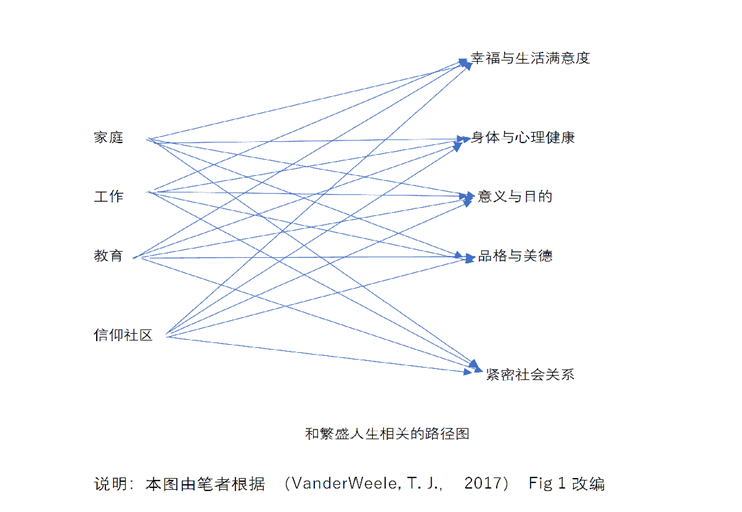
3.纽曼的大学博雅教育理念与人类繁盛
大学作为人类最古老的组织之一,其使命不断变迁演变。人类现代意义的大学起源于意大利的博洛尼亚大学(创立于 1088 年 )和法国巴黎大学( 约1150-1170年 ),其主要使命是培养人才,包括法律、医学和神学人才,其功能是人才培养、传递知识和文明的传承。19 世纪初到 20 世纪初,科学研究作为大学重要使命被提出并强化,创造和发现知识成为大学并重的两个功能和使命。 原德国柏林大学校长威廉.冯.洪堡( 1767-1835 )是现代研究型大学鼻祖,他强调科学研究是大学的重要使命,他提出教学与科研的统一。 英国著名教育家约翰.亨利.纽曼( 1801-1890 )所在时代,就面临大学育人使命被不断扩展的挑战。 曾任加州大学校长的克拉克. 科尔( 1911-2003 )在上个世纪60年代提出多元化巨型大学概念,他认为大学至少具有三个基本功能:科学研究、人才培养和社会服务。尽管大学的育人使命不断被大学增长的其他新功能和使命所挤压,但培养人这一使命,始终应该是大学最核心的使命。
回顾纽曼关于大学的理念尤其是博雅教育的论述意义重大。纽曼生活在后启蒙时代,他先知性地注意到 “时代新潮流” —— 世俗主义、功利主义、科学主义和职业主义 —— 对大学的破坏性影响。他认为大学的核心使命是通过博雅教育帮助学生走向人的繁盛之路( Shrimpton, 2022;Ungurean, J.C. 2025 )。 他强调普遍知识本身即目的,其目地在于训练年轻人的心智、品格和思维习惯。他认为大学通过伟大而平凡的方法来达到伟大的平凡的目的:大学的目的不应承诺培养所谓 “杰出创新人才”, 而在于通过培育有繁盛特征的人 —— 良善的社会成员 —— 以服务和改进社会。
1.大学的核心使命培养学生走向繁盛生命
在纽曼看来,大学的使命是通过博雅教育使学生的生命通向人的繁盛。 “大学不仅仅是一个传授知识的地方,更是一个育人成才的地方。因为传授知识,是传递信息的过程;而育人成才,则是塑造人的心灵( mind )和品格的过程。” “对学生的教育被称为博雅的( liberal )。 这就可以形成一种终生受益的心智习惯,属于这种习惯的特点是有自由、公平、冷静、温和与智慧”[xix]。学生学习是追求以知识本身为目的的知识,不在于其任何外在的实用价值,比如说职业准备,或者是所谓通过 “追求科学和知识而造福社会”,这些都不能促进学生真正被知识吸引的内在动机。 [xx]
他指出,大学博雅教育是培养全人的教育。 他们有良好的自我觉察能力,清晰的头脑、卓越的表达能力、有真诚的态度和热切的力量。纽曼以优美的文笔,描写他理想中的博雅教育培养出来的人才特征。
“这种教育,使人能够清晰自觉地审视己见与判断,在阐发观点时秉持真诚,在表达观点时展现雄辩,在倡导观点时凝聚力量。它教导能明察事物的本质,直指问题的核心,理清纷繁的思绪,识破诡辩的陷阱,摒弃无关的枝节”。[xxi]
在纽曼的大学愿景中,博雅教育培养出来是全面发展的人。他们不是狭隘的专业人才,他们有极强的职业转换能力; 他们与人交往形成融洽的人际关系,有很好的社会情感能力;他们富有同理心,有宽容心。
“它使人能胜任任何职位而赢得信誉,精通任何学科而游刃有余。它教会人:如何与人融洽相处,如何体察他人心境,如何表达自身立场,如何施加积极影响,如何达成相互理解,如何保有宽容之心。他能在任何场合应对自如,与各个阶层皆有共同语言;懂得何时畅所欲言,何时缄默倾听;既善于交谈,也乐于倾听;即使无高见可陈,也能适时提问,虚心获益;他时刻准备着,却从不碍事;他是令人愉悦的伙伴,也是值得信赖的同伴;他懂得何时该庄重,何时可打趣,并拥有一种可靠的机敏,使他的风趣不失优雅,庄重更具力量。[xxii]
大学博雅教育培养出来的人能够处理好内在自我与外在世界的关系,能找到真正的内在幸福与满足,能处理好财富与成功的关系,即使在人生的失败与失望中,依然能不失风度。在这个意义上,大学教育的目标,也非常实用。
他的心灵安详自持 —— 既积极入世,又保有内在丰盈;纵使足不出户,也有自得其乐的源泉。他拥有一种秉赋:在公众场合助其施展,在退隐之时予以支撑。没有这种素养,万贯家财不过也流于平庸;具备这种素养,失败与失望也富有魅力。 旨在成就一个人如此境界的大学教育,其所追求的目标,如同追求财富或健康的技艺一样实用,尽管其成效更不易被精确衡量[xxiii]。
2.大学伟大而平凡的现实目标
纽曼尽管出身精英,但反对精英主义。他毕业于牛津大学,学习数学和古典学,在牛津大学学习和生活超过30年。 他认为大学教育的使命就是要实现 “一个伟大而平凡的目标”。这个伟大的目标就是为社会培养良好的成员。这个平凡的目标就是反对以培养 “杰出人才” 为大学目标。 他写道:“大学并不是诗人或不朽作家、学校创始人、殖民领袖或国家征服者的摇篮;它并不承诺培养出新一代的亚里士多德、牛顿、拿破仑、华盛顿、拉斐尔莎士比亚——尽管此类旷世奇才确曾在其殿堂中出现。”[xxiv] 纽曼认为,大学的目的不是要追求所谓 “杰出创新人才”,因为天才和英雄的产生都不循常规,都不受任何规矩约束。
关于大学的伟大目标,纽曼认为,就是大学通过对个人发展和成长最有益的心智训练,也使人胜任社会职责。 大学教育不仅培育有繁荣特征的人,而且也培养不与社会脱节,能很好服务社会的成员。 他在《 大学的理念 》中写道:“如果一定要为大学教育设定一个现实目标,那么,我认为那就是培养良善的社会成员。这种技艺就是社会生活的艺术,其宗旨在于使人适应这个世界。它既不将视野局限于特定职业,也不以塑造英雄或激发天才为己任。”[xxv]
“大学教育是以一种伟大而平凡的方法达成一个伟大而平凡的目标。它的目标旨在提升社会的心智境界,培育公众的心智,净化民族的品味,为大众的热忱提供真确的原则,为大众的愿望确立坚定的目标,拓展时代的视野并使之稳健,促进政治权力的明智行使,精炼私人生活的交往艺术。”[xxvi]
他认为大学的使命也不只培养一些有实用技能的工匠。“它也不能满足于仅仅培养批评家、实验家、经济学家或工程师——尽管这样的专业之才也在其培养范围之内。”
3生命影响生命的博雅教育模式
如何实现大学博雅教育的培育通往人理念? 纽曼不仅是一个教育理论家,同时也是一个实践者。作为爱尔兰都柏林天主教大学的创校校长,基于自己在牛津大学 30 多年的经验,他不仅设计了即将创办的一所新大学的方方面面,而且亲自承担一个在寄宿制书院的负责人,其中安排 12 个左右的学生和 2 个授课老师( Shrimpton, 2022 );同时,他自己亲自出任校牧和导师( Tutor )陪伴和牧养学生成长。在他看来,博雅教育在人与人之间的深入交往中发生,是一种生命对生命的影响[xxvii]。 这种生命对生命的影响,通过和学生生活在一起的导师传递。
他不仅看重博雅教育核心要素,寄宿制、导师制、跨学科知识学习,而且他更看重学生之间的非正式学习。在他看来,大学教育不仅仅通过教授给学生上课以及考试,比这更重要的是学生之间的互动和彼此学习。在正式课堂之外的各种非正式活动中,比如音乐、辩论、体育等各种社团活动。 他多次提到,“如果你们硬要我在以下两种所谓大学中做出选择,……一种大学拥有宿舍和导师监督制度,给每一个通过很多科目考试的人授予学位,而另一种大学没有教授也没有考试,只是把许多年轻人汇集在一起3到4年,然后打发他们离开……那么,我会毫不犹豫地把优先票投入那种无所作为的大学。”[xxviii]
他认为,这种自由地生命互动的博雅教育更能成功地训练、塑造和扩展心智的人。
总之,纽曼的大学教育愿景和使命,旨在于通过对看似无用的普遍知识本身的追求,以教育本身为目的,而不以实用的专业教育和职业教育为重点,让学生心智和品格得以的发展,从而把人引向追求真理和美德的生命繁盛之路。 这样的大学教育,可以整体提升社会整体文化水平。
4.以人的繁盛为目标的大学教育
通过对人的繁盛概念的介绍和纽曼大学使命的回顾,笔者由此提出大学教育当以人的繁盛为目标的观点。这是因为,人的繁盛概论给我们提供了一面检视当今大学教育已经严重偏离以人的发展为核心目的的镜子。长期以来,以人力资本理论为代表的教育价值观导致教育特别是高等教育的工具化。在高等教育普及化和大众化的时代,在人工智能高速发展的时代,重新回归纽曼先知性的大学使命显得尤为重要。 中国大学育人种种挑战,其实也是全球大学教育迷失目标的一个案例。
1.以人的繁盛来透视中国大学育人挑战
在本文第一部分,笔者初步梳理中国大学在人才培养方面的中国问题和挑战,如果以人的繁盛概念和纽曼的大学使命来看,我们的大学最核心的问题是工具主义和实用主义。 换言之,就把教育对象当作工具,把教育本身当作工具,而不是把人的繁盛作为教育的目的。比如,关于 “钱学森之问” 本身就带有工具性,这是一个把所谓 “拔尖创新人才培养” 作为实用性目,是精英人才培养工具化的体现。这事实上和170多年前纽曼的大学使命相去甚远。 “钱理群之忧”所体现的是精英大学中的相当多学生没有体现出美德和品格,而展现美德正是繁盛人生的核心维度 ( VanderWeele, 2017 )。亚里士多德的繁盛或幸福的人生( Eudaimonia )是指有德性的人生;钱老指出我们精英大学生身上体现出来的把他人作为工具以实现自我目标的实用主义。徐凯文先生指出的 “空心病” 以及大量研究所揭示令人震惊比例的大学生心理健康问题及自杀问题,一个最重要的原因就是大学生人生意义和目的性丧失。大学生失去目的和意义感是因为他们精神层面没有根基。 当大学教育逐渐放弃对生命意义的追问,转而聚焦于技能培训和职业成功时,大学生可能获得专业知识,可能一时能获得高薪的工作,却无法回答 “为何而活” 的根本问题。
大学生心理健康出现问题的另一个根源没有发展出健康的关系连接。学生之间常常是激烈的竞争关系而不是彼此祝福和造就。为了 GPA,为了奖学金、为了入选学生会 / 团委,学生之间关系不正常。此外,很多学生很少参加服务社区和他人的志愿者活动。 笔者曾被邀请给大学生讲 “大学生参加社会公益” 作为思想品德课的一部分,发现参加过过志愿服务的学生微乎其微。大学生中的实用主义和功利主义导致他们自我中心,从而失去与社会的健康链接。
中国大学生批判性思考能力下降或者没有显著增值,表面上认知维度发展不足问题,但本质也和教育的工具性和实用性有关。他们没有发展出提问能力,他们可能知识丰富,知道很多 What, 但不会问 “为什么”;他们失去了对知识本身自为目的追问和乐趣;他们失去对世界的好奇心。更重要的是,功利性地学习也是难以形成批判性思维能力的重要原因( 钱颖一,2018 )。
实证研究揭示中国大学生劳动力市场表现( 收入 )和他们的大学学业成绩关系不大,而和他们的身份( 是否党员 )和学校类型( 是否来自精英 985 或 211 )有关,这背后是宏观社会结构性和市场问题。这说明政治身份和进入精英大学有很高的经济回报。这种物质和经济方面的收益驱动了学生的个人选择。研究表明,经济水平与人的繁盛并不直接相关 (Vander Weele & Johnson, 2025;Easterlin, 1974 )。
2.走出人力资本理论的负面影响
人力资本理论背后的底层逻辑,本质上就是只重视高等教育的工具性价值。 在国家层面,高等教育的使命在于发展科技,增强国力,国际竞争,在于反 “卡脖子”,使国家和民族立于世界强国之林……。在家庭和个体层面,接受大学教育的目的是寻求经济回报,在于获得社会地位。 政府和社会在宏观层面对高等教育的期待与个人和家庭在微观层面的期待又张力 ( Chan, R. Y.2016 )。
在人力资本理论框架下,无论是政策制定者、研究者、各级教育行政官员、还是家长和学生都把以此为默认假设,没有深入追问其合理性。比如,所谓 “钱学森之问” 以及当前教育界政策制定者们关心的 “拔尖创新人才” 培养问题,本质上是看重人作为 “生产性人力资本” 的工具性,其背后的价值观其实是功利主义和实用主义的。正如花重金 “选苗子” 打造 “国家队” 试图 “冲出亚洲走向世界” 的足球发展测量的背后逻辑非常相似, 这种功利主义和实用主义价值观和纽曼所倡导的大学博雅教育理念相去甚远。 纽曼先生的大学博雅教育 “平凡而伟大” 的育人目标,根本上反对功利主义和使用主义。在目标上,不承诺大学将培养 “拔尖创新人才”,在方法上,强调 “无用知识” 的重要性,反对过度为学生职业作准备的专业教育。
在教育经济学、劳动经济学以及发展经济学领域,研究者所开展的大量实证研究的核心因变量大多与人的繁盛无关,而是与人的工具性价值有关。经济增长,教育年限、就业情况、工资收入、学业成绩,是否进入大学以及进入何种类型的大学 ( “985” 还是 “211” ) 等等都是最常见的因变量,这些就是人力资本理论最关注的变量。 以笔者过去十多年所参与的大量实证研究为例,我们关心的核心变量主要都是考试分数[xxix](中小学数学或者阅读,高考成绩)、进入高中、进入大学、进入 “好” 大学等等。我们的研究背后有一个默认假设:学生在学业考试中多一分是好的,接受更多教育是好的,进入 “更好” 的大学是好的。我们很少去追问一个问题,这些教育是否促进了人的繁盛?同时,这些实证研究在非常好的学术刊物发表,产生一定的学术影响 ( 体现在一定的引用率 ),但这些研究对学生的生命影响,似乎显得微乎其微。
事实上,我们作为在大学工作的教育经济学研究者所关心的这些产出变量和学生家长们所关心的几乎没有差异。对家长来说,尽管表面上,在孩子出生时,他们希望自己的孩子健康幸福就好。但是在进入学校之后,学习成绩好,进入好的小心、初中、高中,然后就是好的大学( 最好是清华北大或者哈佛耶鲁这样的名校 )似乎就是最重要的目标。
3.大学当以人的繁盛为核心目标
人类繁盛概念的复兴与倡导,大学教育更应促进大学生个体生命的全面发展。 借用犹太经典的一个象征性叙述,人类繁盛,就是一个人要象一棵栽在溪水边的树, “按时候结果子,叶子也不枯干” ( 诗篇第 1 篇 3 节 )。 就是每个人类个体,如果能扎根于合适的环境中,被水土、空气、阳光滋润,就能照其潜能,美好生长。 大学教育的最高价值在于使学生愿意追求永恒真理, 愿意回归到生命的活水源头。 大学教育的真正使命就是让学生能在身体、认知、情绪、关系等方面全面发展, 使他们灵魂苏醒,发展其生命潜能,发现其生命呼召,发挥其生命影响。 良好的教育促进人类繁盛,使拥有幸福的人可以成为家庭、社区、社会和世界之祝福。
4.AI时代对大学以人的繁盛为目标的呼唤
目前人类已经处于通用人工智能( General Artificial Intelligence, GAI )革命前夕,这场革命毫无疑问将大大改变人类生产、生活以及教育方式。 一方面GAI将大大提高人类生产力,人类在物质方面获得的富足程度将会超出我们的想象力;物质极大丰富到一个程度,以致于经济学核心概念 “资源稀缺性” 都会改变。另一方面,人类现有的大量工作类型会被 AI 取代,社会对人的生产性人力资本需要大大降低, 人可能有更多闲暇;人的平均寿命也有可能有所延长; “AI时代,何以为人” 成为重要议题; 人作为脆弱和必死的动物,人可能更多需要追问意义:人为什么活?如何活得有价值和意义? 人与人之间的关系可能会更加疏远而不是更为亲近;人跟人之间的认知能力差距( 不平等性 )可能更加扩大…… 都将发生巨大变化,我们的想象力总是有限。 在教育方面,大量的知识传授的工作,AI的效率和质量可能比现有的最博学的教师都好,但是在关于人的心智和品格发展,好奇心、敬畏感、在复杂情景下的伦理是非选择,提出重要有趣问题的能力……等等方面,AI 永远不能代替教师。换言之,就是以生命影响生命的博雅教育,显得更加重要的迫切。
五、总结和讨论
中国高等教育已经成为世界规模最大的教育体系,然而在人才培养方面却面对各种挑战,其中包括:我们的大学为什么难有拔尖创新杰出人才出现?( “钱学森之问” ),精英大学培养了相当多 “绝对的精致的利己主义者” ( “钱理群之忧” ),相当大比例的大学生因没有目标和意义感出现 “空心病” 以及心理健康危机,大学生批判性思考力在大学期间没有增长,以及大学毕业生的劳动力市场表现似乎与大学期间学业成绩没有直接关系等等。 为了理解这些挑战,本文基于人的繁盛概念和纽曼的博雅大学教育理念,揭示了大学教育以人为生产性工具和生存性工具的现状;因此,本文提出大学教育应该回归到以人的繁盛为目标。本文呼吁人们走出人力资本理论框架的隐形捆锁,尤其在人工智能将全面重塑人类生产、生活、人际关系甚至 “何以为人” 的时代,这样的回归和转向显得尤为重要。
一些可能的质疑或反对观点
已经有不少学者反对将人类繁盛作为教育目的,比如,(1)这个概念混杂,不够清晰( Carr, 2021 );(2)影响人类繁盛的因素很多,社会、政治、文化,环境等等,教育只是其中一个因素。(3)这个概念不好操作,对于什么是好的教育似乎指导性不强。(4)强调品格教育似乎存在强加价值观之嫌。关于这些反对的观点,已经有学者予以回应( Curren, R.et al.2024;VanderWeele, et al. 2023 ) 。 除此之外,可能还有很多对高等教育回归以人的繁盛为目标的观点的质疑或反对:
- 纽曼的大学博雅教育思想已经过时,170多年前的理念在当时影响有限,在这个时代依然不会更有影响,—— 可以称为 “过时论”;
- 大学教育的实用主义、功利主义、工具主义趋势是已然现实,该潮流不可逆转,提出以人的繁盛为目标的大学教育这个观念很难扭转这个历史潮流 —— 可以称为 “已然论”;
- 大学博雅教育太奢侈,一般家庭无力支付如此昂贵的教育投入,如果大学毕业学生不能就业,大学博雅教育将无法实现个人和家庭的大学教育回报期望 —— 可以称为 “价格论”;
- 基础教育阶段也许更适合提以人的繁盛为目标,而不是大学阶段 —— 可以称为 “阶段论”;
- 影响人的繁盛的因素不仅是大学教育,还有很多大学不能控制的因素,比如政治、经济、文化、历史等时代环境因素 —— 可以称为 “环境论”;
- 人力资本理论框架已经成为经济学、公共政策领域里影响和主导人们观念和行为的默认假设,人的繁盛概念不太可能替代这已经成为主流的理论 —— 可以称为 “主流论”。
必须承认,这些质疑和论点都各有其合理性, 笔者谨在此略作回应。
关于 “过时论”,也许引用纽曼在 170 多年前对亚里士多德哲学价值的讨论本身就是一个很好的回应。 他写道:“请不要以为,我像这样求助于古人,好像在把世界抛回到两千年前去,好像在用异教的推理来束缚哲学。事实上,只要这个世界存在,亚里士多德关于这些问题的学说就会一直有效,因为他是自然的贤者,真理的贤者。只要我们还是人,我们在很大程度上就不能不是亚里士多德主义者。因为这位伟大的导师的确分析了人类的思想、情感、观点与见解。早在你我出生以前,他就已经道出了我们自身言语和观念的含义。在很多的问题上,要正确的思考,就要像亚里士多德那样思考。不管我们愿不愿意,甚至不管我们有没有意识到,我们其实都是他的门徒。”[xxx]
同样,纽曼的大学博雅教育理念不过时。因为他对大学使命的思考指向人类繁盛,这个概念不仅包含在亚里士多德关于人类终极幸福的思考,而且也包含在比这位古希腊先贤更为古老的希伯文明关于人之所为人的观念里。 在这个意义上,我们都是纽曼的门徒。
关于 “已然论”,即全球范围内大学教育体系的实用主义、功利主义及工具主义趋势,似乎势不可挡,固若金汤,笔者的回应是,我们相信概念的力量、观念的力量和话语的力量。 其实,人力资本理论在经济学领域扎稳根基也就 60-70 年;当然以人的繁盛观念来替代,有非常大的难度。 正如 1989 年,当美国总统里根先生访问西德时,当时柏林墙还固若金汤,他还是凭着信念和勇气,发表了演讲 《 推倒这堵墙吧!》。当时,没有人相信柏林墙会倒塌!当然,这样的比方似乎并不恰当。要改变全球性高等教育的功利主义、实用主义和工具主义的现实惰性,可能比堆到柏林墙更难。
关于 “价格论” 听上去似乎相当有道理,但事实上,这是一个实证研究问题。已经有不少实证研究显示, 博雅教育有很好的长远收入回报率( Hill & Pisacreta, 2019 ) 。 比如,哈佛大学知名经济学家 David Deming 就发表研究证明和博雅教育相关的社交技能( 比如团队合作精神 )有很好的收入回报( Deming, 2017 )。他和来自起来领域的研究者一起阐释大学博雅教育的真正价值[xxxi]。
关于 “阶段论” 和 “环境论” 毫无疑问是非常好的论点。关于大学使命与人类繁盛的论点必须有限定在合理范围。 在基础教育阶段,以人的生命繁盛为教育目标的理由已经被教育哲学领域的诸多学者很好建立( Kristjánsson, 2017; De Ruyter, et al., 2022; Materla, 2024;Curren et al. 2024 )。 关于大学教育对人的繁盛的重要性,我们承认这个论点也只是一种探索性的尝试,有一定实用范围( VanderWeele & Case,2025 )。事实上,教育家纽曼在 170 多前就有些论证, 我们又可以求助于他。 在《 大学的理念 》前言中,他论述到:
“那些又充裕时间的……青年会继续他们的学业直到二十一二岁;因而他们将会有一个充实的,有助于陶冶文化品性的人生。一个早在 17 岁就结束学业的年轻人,无法与一个一直求学到 22 岁的人相匹敌…….”[xxxii]。
关于高等教育与人的繁盛 “环境论” 反对论点极其重要,其实我们可以辩驳的余地有限。事实上,这已经超出本文范畴,也许值得专文论述。
人力资本理论的 “主流” 地位确实很难撼动,而人的繁盛概念若要在教育领域尤其是高等教育领域成为替代性理论,还需要在概念清晰和测量工具理论假设方面大大提升。
本文局限
毋庸置疑,本文还存在诸多局限。 首先,本文只是揭示了高等教育工具化的事实,但没有解释为什么高等教育工具性会成为主流。 其次,关于纽曼的大学博雅教育的内容,本文也没有展开讨论。比如在 170 多年前那些他认为重要的知识内容,在今天还有哪些相关性?关于博雅教育如何帮助学生形成美德?再次,关于环境与个人繁盛的关系,本文也没有能够展开讨论。 比如什么特征的大学更有可能促进学生的繁盛?同样,个人可以多大程度促进大学社区的繁盛。 又次,对于生来就有残障的人,何以繁盛?比如,生来瞎眼的,生来瘸腿的,生来智障的,何以繁盛?其实,文献中对这样的问题其实已经有所讨论 ( Briggs, & Reiss,2021 ), 最后,本文也没有讨论如何( how )的问题。 比如,如何实施推动以人的繁盛为目标的大学教育?在国际上有大学把人的繁盛写入使命宣言,有的大学开设人类繁盛研究中心,有的大学开设人类繁盛和幸福方面的选修课程,有的大学设立博雅教育项目等等,但这些项目的效果如何,我们不得而知;也许值得专门的研究。
提出新问题
笔者认为,关于高等教育与人的繁盛,不同于 “钱学森之问”,我们应该问一系列问题,并期待不同的人们可以探索这些问题的答案。 比如,我自己在的多大程度上限制或者促进了人的繁盛?我们的家庭多大程度促进或限制了孩子的繁盛?我们的大学在多大程度上促进或是限制了人的繁盛?我们的国家在多大程度上促进或者限制了人的繁盛?
参考文献
Alan, S., & Ertac, S. ( 2018 ). Fostering patience in the classroom: results from randomized educational intervention. Journal of Political Economics, 126 ( 5 ), 1865–1911.
Alan, S., Boneva, T., & Ertac, S. ( 2019 ). Ever failed, try again, succeed better: results from a randomized educational intervention on grit. Quarterly Journal of Economics. 134 ( 3 ), 1121–1162.
Alexander, G.S. ( 2019 ). Property, Dignity, and Human Flourishing, Cornell Law Review. 104 ( 4 ): 991-1045. https://scholarship.law.cornell.edu/clr/vol104/iss4/5
Allen, S. ( 2018 ). The Science of Generosity. Good Science Center at UC Berkeley. A white paper prepared for the John Templeton Foundation by the Greater.
Anscombe, G.E.M. ( 1958 ). Morden moral philosophy, The Journal of The Royal Institute of Philosophy, XXXIII. 124:1-19.
Balaguer, Á., Johnson,D. & Gatty,F. ( 2025 ). Education for human flourishing in adolescents: a scoping review, The Journal of Positive Psychology, DOI: 10.1080/17439760.2025.250248
Briggs, A. & Reiss, MJ.( 2021 ). Dimensions and pillars of human flourishing. In: Briggs, A and Reiss, MJ, ( eds. ) Human Flourishing: Scientific insight and spiritual wisdom in uncertain times. ( pp. 1-22 ). Oxford University Press: Oxford, UK.
Brooks, D. How the Ivy League broke America. The Atlantic, Nov 14, 2024.
Brooks, D. & Winfrey,O. ( 2023 ). Build the life you want: The art and science of getting happier. Penguin Random House.
Cebral-Loureda M, Tamés-Muñoz E, Hernández-Baqueiro A. (2022). The fertility of a concept: A bibliometric review of human flourishing. International Journal Environment Research and Public Health. 19 ( 5 ):2586. doi: 10.3390/ijerph19052586.
Chan, R. Y. ( 2016 ). Understanding the purpose of higher education: An analysis of the economic and social benefits for completing a college degree. Journal of Education Policy, Planning and Administration, 6 ( 5 ), 1-40.
Curren R, Boniwell I, Ryan RM, et al. ( 2024 ). Finding consensus on well-being in education.Theory and Research in Education, 22: 117–57.
Dahlsgaard, K., Peterson, C., & Seligman, M. E. ( 2005 ). Shared virtue: the convergence of valued human strengths across culture and history. Review of General. Psychology., 9 ( 3 ), 203–213.
Deming, D. ( 2017 ).
The growing importance of social skills in the labor market,
Quarterly Journal of Economics, 132 ( 4 ): 1593-1640. doi:10.1093/qje/qjx022
De Ruyter, D. J. ( 2004 ). Pottering in the Garden. On human flourishing and education, British Journal of Educational Studies, 52: 377–89
De Ruyter, D. J. ( 2024 ) . Flourishing as an aim of higher education: exploring the aspirations and challenges of the educational philosophy of the University of Humanistic Studies ( UvH ). Journal of Philosophy of Education, 2024, 00, 1–16
https://doi.org/10.1093/jopedu/qhae083.
De Ruyter, D., Oades, L.G., Waghid, Y.,et al. ( 2022 ).Education for flourishing and flourishing in education in Duraiappah, et al. ( eds. ) Reimagining Education: The International Science and Evidence based Assessment. New Delhi: UNESCO MGIEP. 73–110.
Easterlin, R.A. ( 1974 ). Does economic growth improve the human lot? Some empirical evidence, in David, P.A. and Reder, M.W. ( eds .) Nations and households in economic growth. Amsterdam: Elsevier, pp. 89–125.
Gao, L., Xie, Y., Jia, C. et al ( 2020 ). Prevalence of depression among Chinese university students: a systematic review and meta-analysis. Scientific Report 10, 15897 ( 2020 ).
https://doi.org/10.1038/s41598-020-72998-1
Graff Zivin. J., Liu, T, Song,Y., Tang, Q., Zhang P. ( 2020 ). The unintended impacts of agricultural fires: Human capital in China, Journal of Development Economics, 147.
Graff Zivin J. ,Song Y, Tang Q. , Zhang, P ( 2020 ).
Journal of Environmental Economics and Management. 104.
Höltge, R. G. Cowden, Matthew T. Lee, A. O. Bechara, S. Joynt, S. Kamble, V. V. Khalanskyi, L. Shtanko, N. M. T. Kurniati, S. Tymchenko, V. L. Voytenko, E. McNeely & T. J. VanderWeele ( 2023 ) A systems perspective on human flourishing: Exploring cross-country similarities and differences of a multisystemic flourishing network,The Journal of Positive Psychology, 18:5, 695-710, DOI: 10.1080/17439760.2022.2093784
Hill, C. & Pisacreta, E.D. ( 2019 ). The Economic benefits and costs of liberal arts education. Report commissioned by The Andrew Mellon Foundation.
Huang J & Liu X. ( 2023 ). Anxiety, depression, and their comorbidity among Chinese college students during the COVID-19 lockdown in the post-epidemic era: an online cross-sectional survey. BMC Psychiatry. 2023 Dec 8;23 ( 1 ):923. doi: 10.1186/s12888-023-05442-z.
Kristjánsson K ( 2017 ) Recent work on flourishing as the aim of education: A critical review. British Journal of Educational Studies 65 ( 1 ): 87–107.
Lei X., Xiao L. Liu Y., & Li Y. ( 2016 ). Prevalence of depression among Chinese university students: A meta-analysis.PLoS One. 11(4):e0153454. doi: 10.1371/journal.pone.0153454.
Li, F., Song, Y., Yi, H., Wei, J., Zhang, L., Shi, Y., Chu, J., Johnson, N., Loyalka, P., Rozelle, S. ( 2016 ). The impact of conditional cash transfers on the matriculation of junior high school students into rural China. Journal of Development Effectiveness.9 ( 1 ):41-60.
Li. H., Wang. H., Cousineau. C, & Boswell, M. ( 2023 ).What can students gain from China’s higher education?Asian Economic Policy Review. 18(2): 287-304.
https://doi.org/10.1111/aepr.12426
Li,Z, Li Y., Lei X., Zhang D, Liu L, Tang S., Chen L. ( 2014 ). Prevalence of suicidal ideation in Chinese college students: a meta-analysis.PLoS One. 6;9 ( 10 ):e104368. doi: 10.1371/journal.pone.0104368.
Loyalka, P., Liu, C., Song, Y., Yi, H., Huang, X., Wei, J., Zhang, L., Shi, Y., Chu, J., and Rozelle, S. ( 2013 ). Can information and counseling help students from poor rural areas go to high school? Evidence from China. Journal of Comparative Economics, 41, 1012-1025.
Loyalka P., Liu O., Li G. et al. ( 2021 ). Skill levels and gains in university STEM education inChina, India, Russia and the United States. Nature Human Behavior. 5 ( 7 ), 892–904.
https://doi.org/10.1038/s41562-021-01062-3
Lomas, T.; VanderWeele, T.J. ( 2023 ). A flexible map of flourishing: The dynamics and drivers of flourishing, wellbeing, health, and happiness. International Journal of Wellbeing, 13, 3665
Martela , F. ( 2024 ). Flourishing as the central aim of education: Steps toward a consensus.Theory and Research in Education. 22 ( 2 ): 180–188. DOI: 10.1177/14778785241258857.
Meynell, H. ( 1969 ) II. Human flourishing: On the scope of moral inquiry. Religious Studies. 5: 147–154.
Reiss, M.J. ( 2025 ). Flourishing as an educational aim: the case for school health education. Journal of Philosophy of Education, 2025, 00, 1–16
https://doi.org/10.1093/jopedu/qhaf029
Olimpio, L.D. & De Ruyter.( 2025 ).Flourishing as an educational aim. Journal of Philosophy of Education, 2025, 00, 1–8 https://doi.org/10.1093/jopedu/qhaf030
Seligman, M.( 2018 ). PERMA and the building blocks of well-being. The Journal of Positive Psychology, 13 ( 4 ), 333–335
Sen, A. ( 2008 ) ‘The economics of happiness and capability’, in Bruni,L., Comin, F. and Pungo, M. ( eds. ) Capabilities and happiness ( vol. 27 ). Oxford: Oxford University Press, pp. 16–27.
Shrimption, P. ( 2022 ). Education in the large sense of the word: Newman’s idea of human flourishing at university: Newman lecture at Newman Centre, McGill University, Canada, 25 March 2022.
Tan,E. ( 2014 ). Human capital theory: A holistic criticism review. Review of Educational Research, 84 ( 3 ):411-445.
UNESCO. ( 2022 ). International Science and Evidence Based Education ( ISEE ) A ssessment Report; Mahatma Gandhi Institute of Education for Peace and Sustainable Development ( MGIEP ): Delhi, India.
Ungurean, J.C. ( 2025 ). Cultivating the whole person: Newman’s vision for higher learning
https://jamescungurean/2015/1/17 cultivating- the-whole-peron-newmans-vision-for-higher-learning .
VanderWeele,T.J., Case, B.W., Chen,Y., Cowden, R.G., Johnson, B., Lee, M.T., Lomas.T. & Long, K.G. ( 2023 ). Flourishing in critical dialogue. SSM – Mental Health 3, 100172
VanderWeele, T. J. ( 2017 ). On the promotion of human flourishing. Proceedings of the National Academy of Sciences, 114 ( 31 ), 8148–8156.
https://doi.org/10.1073/pnas.1702996114.
VanderWeele, T. J. ( 2020 ). Activities for flourishing: An evidence-based guide. Journal of Positive Psychology and Wellbeing, 4 ( 1 ), 79-91.
https://hfh.fas.harvard.edu/files/pik/files/activitiesforflourishing_jppw.pdf
VanderWeele, T.J. & Case, B. ( 2025 ). Academic flourishing and student formation. International Journal of Wellbeing.
VanderWeele, T. J. & Johnson, B.R. ( 2025 ). Why we need to measure people’s well-being — lessons from a global survey. Nature. V641: 34-36.
https://doi.org/10.1038/d41586-025-01254-1 (2025).
VanderWeele, T. J., & Lomas, T. ( 2023 ). Terminology and the well-being literature. Affective Science, 4 ( 1 ), 36-40.
https://doi.org/10.1007/s42761-022-00153-2
Wu, R., Zhu, H., Wang, Z. et al. ( 2021). A large sample survey of suicide risk among university students in China. BMC Psychiatry, 21, 474 ( 2021 ).
https://doi.org/10.1186/s12888-021-03480-z
Yang LS, Zhang ZH, Sun L, Sun YH, Ye DQ. ( 2015 ). Prevalence of suicide attempts among college students in China: a meta-analysis. PloS ONE. 10:e0116303. doi: 10.1371/journal.pone.0116303.
Yi, H., Song, Y., Liu, C., Huang, X., Bai, Y., Loyalka, P., Chu, J., Rozelle, S. ( 2015 ). Giving kids a Head Start: The impact and mechanisms of early commitment of financial aid on poor students in rural China. Journal of Development Economics, 113, 1-15, Jan 2015
Zhang,Q, Liu, Z. & Shen, H. ( 2023 ). Challenges to improving higher education students’ critical thinking capacity in China. European Journal of Education.
https://doi.org/10.1111/ejed.12570
Zhao, S., Zhang, J. ( 2024 ). Suicidal ideation among Chinese college students over a decade. In: Xia, Y.R., de Guzman, M.R.T., Esteinou, R., Hollist, C.S. ( eds ) Global Perspectives on Adolescents and Their Families. International and Cultural Psychology. Springer, Cham.
https://doi.org/10.1007/978-3-031-49230-3_9
Zhao,Y. & Zhong, R. ( 2025 ). From meritocracy to human interdependence: Redefining the purpose of education. ECNU Review of Education, 1–18, DOI: 10.1177/20965311251351988
Zhou, X., Yi, C., Chan, SL, Wei, J. ( 2025 ). Trajectories of authentic inner compass in the college Years: Implications for psychological functioning among Chinese students. Journal of Happiness Studies, 26, 48 ( 2025 ).
https://doi.org/10.1007/s10902-025-00890-8
Zhou, S.J.; Wang, L.L.; Qi, M.; Yang, X.J.; Gao, L.; Zhang, S.Y.; Zhang, L.G.; Yang, R.; Chen, J.X. Depression, anxiety, and suicidal ideation in Chinese university students during the COVID-19 pandemic. Frontier Psychology. 2021, 12, 669833
高博. 潘建伟院士:“钱学森之问” 症结在文化土壤[N]. 科技日报. 2013.3.9.
哈瑞.刘易斯[美].失去灵魂的卓越哈佛是如何忘记教育宗旨的: 侯定凯【译】上海:华东师范大学出版社,2012.
约翰.亨利.纽曼[英].大学的理念. 高师宁,何克勇,何可人,何光沪【译】. 北京:北京大学出版社,2016.
王蓉.人力资本理论的批判与突破——“新人力资本理论”十年之后再反思[J].北京大学教育评论,2020(01):42-58.
文东茅.心安幸福教育.北京:北京大学出版社,2023.
张瑜.“钱学森之问”究竟在问什么[N].中国教育报,2012.12.4
钱颖一. 中国如何破解 “钱学森之问”. 2018.清华大学教育研究 [ J ],39 ( 4 ).
钱理群.寻找失去了的 “大学精神” —— 北大 110 周年民间纪念会上的讲话 [ C ].
钱理群.重建家园—我的退思录.南宁:广西师范大学出版社,2012:67.
谢湘.为改革而生的理想主义者永远不老 [ N ].中国青年报,2012.05.03 ( 3 ).
余世存. 北大读本.成都:四川人民出版社, 2018。
中国教育部. ( 2025 ). 2024 年全国教育事业发展统计公报,中国教育部政府门户网站。
[i] Human Flourishing 目前还没有统一的中文翻译。在2023年夏在哈佛大学召开的一个以此为主题的会议中,与会中国学者们提出 “人类繁盛” 的译法,尽管 “人类繁荣”,“人类幸福”、“蓬勃生命”,“欣盛”,“心盛” 等译法也在中国大陆和台湾等被使用。 本文交替使用 “人类繁盛” “人的繁盛” 或者 “人的生命繁盛”,其中 “人类繁盛” 指群体层面的美善状态,而 “人的繁盛” 更倾向于指个体层面蓬勃生长的美好状态。
[ii] 北京大学时任校长林建华曾在 2017 年本科毕业致辞中表达,他不认同北大培养 “精致的利己主义者”。
[iii] 比如,美国的大学包括哈佛大学也被批评为 “失去灵魂的卓越”.【 美 】哈瑞.刘易斯.失去灵魂的卓越哈佛是如何忘记教育宗旨的: 侯定凯【 译 】上海:华东师范大学出版社,2012. 除了最近美国大学与联邦政府的剧烈冲突外,美国精英大学也受到各种批判,一个例子见 “How the Ivy League broke America” by David Brooks, The Atlantic, Nov 14, 2024.
[iv] Baylor University Launches Institute for Global Human Flourishing, 2025.4.30.
[v] 人类繁盛有多个层次,比如个体繁盛、社区繁盛、机构繁盛,民族繁盛、国家繁盛等。本文主要讨论个体层面的繁盛,因此使用人的繁盛。
[vi] 堪萨斯大学的赵勇教授及其合作者 ( Zhao,Y. & Zhong, R. ( 2025 ) 批判了绩优主义( Meritocracy ),提出在 AI 时代应该以人类相互依存性( Human Interdependency Paradigm )重新定义教育目。 他们的人类依存性概念不同于人类繁盛概念,尽管部分重叠之处。
[vii] 钱颖一. 中国如何破解 “钱学森之问”. 2018 年 8 月.《 清华大学教育研究 》第 39 卷第 4 期
[viii] ”潘建伟院士:‘钱学森之问’ 症结在文化土壤”. 科技日报,2013.3.9.
[ix] 施一公. “试答钱学森之问”,《 自我突围 》 2023,中信出版集团.
[x] 请参见 钱理群.寻找失去了的 “大学精神” —— 北大 110 周年民间纪念会上的讲话。钱理群.《 重建家园
—— 我的退思录 》.南宁:广西师范大学出版社,2012 ;钱理群. “大学教育究竟要培养什么人才尖子”. 余世存编《 北大读本 》,四川人民出版社 2018 年;
谢湘.为改革而生的理想主义者永远不老.中国青年报,2012-5-03( 3 ).
[xi] 抑郁症需要严格的临床心理学筛查,而这些心理学研究,大多使用关于抑郁症量表,在大学生中自我填报,结果可能有一定出入。
[xii] 关于大学生自杀现象,理论上本可以收集到可靠数据,但由于众所周知的原因,该领域的研究成了一个空白。 文献中只能关于大学生自杀意念方面的研究,作为替代。
[xiii] 很多重要的犹太希伯来经典,比如《 摩西五经 》《 诗篇 》成书年代远远早于亚里斯多德( 公元前 384-322 )所在的时代。
[xiv]在这个框架中, 有时候,财务稳健也作为一个维度纳入该框架。
[xv] 郭力,钱学森之问与北大物理系精英的毁灭。新三届( 微信公号 ),郭力专列,2025.6.17。
[xvi] 关于坚毅 Grit( Alan, et al, 2019 ) ;关于耐心( Alan, S., & Ertac, S. 2018 ).
[xvii] 力克.胡哲( Nick Vujicic )出版的书籍包括《 人生不设限 》,湖北教育出版社,2015;《 永不止步 》,天津社会科学院出版社,2012;
[xviii] 信仰社区的英文是 Religious Communities.
[xix] [ 英 ] 约翰.亨利.纽曼.大学的理念.高师宁,何克勇,何可人,何光沪译. 北京:北京大学出版社,2016. 第五讲 “自为目的的知识” 第 1 节,P91.
[xx] 同上,第五讲 “自为目的的知识” 第 2 节,P 94.
[xxi] 同上,第七讲 “从与专业技能的关系看待知识” 第 10 节,P 151.
[xxii] 同上,P 152.
[xxiii] 同上,P 152.
[xxiv] [ 英 ] 约翰.亨利.纽曼.大学的理念.高师宁,何克勇,何可人,何光沪译. 北京:北京大学出版社,2016, 151.
[xxv] 同上,第七讲 “从与专业技能的关系看待知识” 第 10 节,P 151.
[xxvi] 同上,第七讲 “从与专业技能的关系看待知识” 第 10 节,P 151.
[xxvii] 参见加拿大麦吉尔大学纽曼研究学者 Paul Shrimpton 教授的文章( Shrimpton, 2022 )。
[xxviii] 同上,第六讲,从与学习的关系看待知识, P 127.
[xxix] 比如,我们研究高考期间气温对学生高考成绩的影响( Graff Zivin, et al, 2020 );通过随机试验研究给农村初中生提供资助承诺以及生涯规划和不同教育阶段的收益率信息对他们学业成绩和升入高中的影响( Yi, et al, 2014; Loyalka, et al. 2013 );给农村县城高中学生提供大学资助政策信息对他们填报大学志愿的影响。
[xxx] [ 英 ]约翰.亨利.纽曼.大学的理念.高师宁,何克勇,何可人,何光沪译. 北京:北京大学出版社,2016. 第五讲 “自为目的的知识” 第 1 节,P 97-98.
[xxxi] The true value of a liberal arts education — Harvard Gazette,2024.10.9
[xxxii] 同上, P 5.
<全文完>
Higher Education and Human Flourishing: The Case of China
Yingquan Song
Abstract: Based on a preliminary review of the various challenges faced by Chinese universities in talent cultivation, this article proposes that universities should return to the core goal of fostering human flourishing. It first dives deep into the concept of human flourishing and a look back at the university mission and liberal education philosophy of the British educator John Henry Newman, after which it poses the central question of the university and flourishing of individual: To what extent do we and our universities promote or limit the flourishing of the individual?
https://doi.org/10.64053/TPLV8210
Higher Education and Human Flourishing[①]: The Case of China
“Education is of vital importance to people of all ages. So, what is the purpose of education? Before we can assess whether education systems are fulfilling their promise, we must ask a fundamental question: Should the goal of education be to promote the flourishing of human life or to meet the needs of ‘homo economicus’?”
—United Nations Educational, Scientific and Cultural Organization ( UNESCO, 2022 )
Introduction
Over the past two to three decades, Chinese higher education has experienced unprecedented growth. In 2024, the total number of students enrolled in various types of universities in China reached 48.46 million, with a gross enrollment rate in higher education of 60.8% ( Ministry of Education of China, 2025 ). Currently, one in every six university students worldwide is “made in China” ( Li, et al., 2023 ). However, the cultivation of talent in Chinese universities, including elite ones, has come under criticism and doubt. These can be roughly divided into three categories. The first is criticism laden with emotion. For example, Zhang Ming, a professor at Renmin University of China, has repeatedly stated in media interviews that “even Chinese football has more hopeful prospects than Chinese universities.” The second category consists of observations and questions from well-known figures. From “Qian Xuesen’s Question” and “Qian Liqun’s Worry” to the concept of “hollow-heart disease,” these voices seem to carry considerable authority and are rarely contested. The third category includes methodologically rigorous studies on the intellectual development of university students. For instance, a recent study published in a top academic journal revealed that after four years of university education, the critical thinking skills of Chinese university students, including those at elite universities, not only failed to improve but actually declined, while their academic abilities in the sciences stagnated ( Loyalka, et al., 2021 ).
The first type of criticism is often laughed off. The second type has prompted numerous explanations, clarifications, and even proposed solutions involving well-known scholars, academicians, and university administrators ( Qian Yingyi, 2018; Pan Jianwei, 2013; Shi Yigong, 2023; Lin Jianhua [②] , 2017 ). As for the third type of research, it has been widely disseminated by various media, seemingly serving as a “dagger” aimed at Chinese higher education. How should we understand such criticisms and doubts? This author believes that although these criticisms and doubts may appear “negative,” they reflect the love and expectations that everyone, including the critics, skeptics, and researchers, has for Chinese universities, and embody a scientific spirit of seeking truth from facts. Can we identify some internal consistency in these criticisms, doubts, and unpleasant research findings? Or, can we try to find some suitable conceptual frameworks with which to understand the problems of talent cultivation in Chinese higher education? In fact, the various challenges faced by Chinese universities in talent cultivation are also part of the challenges faced by higher education globally [③] , although the former are marked by unique historical, political, economic, and socio-cultural factors.
Over the past thirty years, human flourishing, an ancient philosophical and ethical concept, has garnered widespread attention in numerous fields, including psychology, political science, economics, law, health sciences, public policy, medicine, and even neuroscience ( Cebral-Loureda, et al., 2022; Alexander, 2019; Vander Weele, 2017; Seligman, 2012 ). A large number of studies, practices, and policy initiatives themed around human flourishing have emerged ( Cebral-Loureda, et al., 2022; Vander Weele & Johnson, 2025 ). World-renowned universities have established centers, institutes, or laboratories related to human flourishing. For example, Harvard University established a Human Flourishing Program in 2016 and has since published a large volume of high-level empirical research on the topic. In 2025, Baylor University launched the Institute for Global Human Flourishing [④]. The University of Pennsylvania established a Positive Psychology Center in 2000 and the Humanities and Human Flourishing project in 2014.
The revitalization of the concept of human flourishing [⑤] not only brings a new perspective on what it means to be human to scholars in different interdisciplinary fields, but also prompts us to reflect on the fundamental questions of the philosophy of education. For example, what is the nature of education? What is the purpose of education? What is good education? For some scholars, human flourishing is almost synonymous with the ancient Greek philosopher Aristotle’s concept of Eudaimonia, “the highest good.” Therefore, in the field of philosophy of education, many European scholars have proposed that promoting human flourishing should be the purpose, “the fundamental purpose,” or “the core purpose” of education ( Kristjánsson, 2017; De Ruyter, et al., 2022; Materla, 2024; Curren et al., 2024 ). UNESCO has recently organized the publication of a series of special issues on “Education for Human Flourishing” ( UNESCO, 2022 ). The first issue of the Journal of Philosophy of Education in 2025 published a special section of five articles, elaborating on the view of human flourishing as the aim of education from different perspectives ( Olimpio & De Ruyter, 2025 ). In the field of higher education, scholars have also begun to discuss the possibility of linking human flourishing with the mission of the university. For example, Professor VanderWeele, the director of the Human Flourishing Program at Harvard, and his collaborators have proposed concepts of academic flourishing and student development, along with a measurement framework ( Vander Weele & Case, 2025 ). A Dutch philosopher of education has proposed human flourishing as the purpose of the university ( De Ruyter, 2025 ).
The idea of human flourishing as the aim of education largely stems from a reflection on human capital theory. For the past sixty to seventy years, human capital theory has been the default framework for viewing education, especially higher education: education as an investment in human capital is the most important source of national economic growth and individual income. In this framework, people are treated as tools and means rather than ends. This theory has never been without critics, and many scholars have critiqued it ( Wang Rong, 2020; Tan, 2014; Easterlin, 1974 ). For example, Professor Wang Rong of Peking University pointed out that traditional human capital theory does not consider the endogeneity of institutions, and proposed the concepts of distributive and productive human capital. In fact, both distributive and productive human capital still treat people as tools and capital to be invested in. Despite much criticism, there seems to be a lack of in-depth reflection on the purpose of education from the perspective of human flourishing.
In recent years, Chinese scholars have engaged in practices and research in positive psychology and the subjective well-being of university students. For example, Professor Peng Kaiping of Tsinghua University has vigorously promoted the practice of positive psychology or happiness psychology among the public. Professor Wen Dongmao of Peking University, based on the thought of Confucian sages, especially Wang Yangming’s “School of the Mind,” has proposed the “Education Theory of Upward, Good-ward, Heart-at-Ease, and Happiness” ( Wen Dongmao, 2023 ). At the same time, there have been empirical studies on the subjective well-being of university students ( Zhou, et al., 2025 ), but almost no scholar [⑥] has examined the various challenges faced by Chinese universities from the perspective of human flourishing. Therefore, this article reviews the various challenges in cultivating talent in Chinese universities and, through the concept of human flourishing and a look back at the university mission and liberal education philosophy of the British educator John Henry Newman, proposes that the mission of the university should be centered on the flourishing of the person. Using China as a case study, the author poses the central question of the university and human flourishing: To what extent do our universities promote or limit the flourishing of the person?
This article is divided into five parts. The first part outlines the doubts and challenges faced by Chinese universities in talent cultivation in recent years. The second part briefly introduces the concept of human flourishing, its characteristics, and influencing factors. The third part reviews Newman’s university mission and his ideas on liberal education, pointing out that his vision for a liberal university education is directed towards a flourishing life. The fourth part examines the challenges of student development in China and proposes that the mission of university education should be to promote human flourishing, and that in the age of artificial intelligence, it is even more imperative that education be oriented towards flourishing. The fifth part provides a conclusion and discussion.
I. Challenges Facing Chinese University Education
Chinese higher education has developed rapidly and on an unprecedented scale, moving from the elite sphere to mass accessibility. However, in recent years, the effectiveness of talent cultivation in Chinese higher education has come under question in various ways, the most famous of which are “Qian Xuesen’s Question,” “Qian Liqun’s Worry,” and the concept of “hollow-heart disease.” At the same time, empirical research has found that the critical thinking skills of Chinese university students, after four years of university, not only fail to improve but actually decline. In addition, a large body of research shows that the detection rate of psychological disorders ( such as depression ) among Chinese university students is relatively high, and the proportion of those who have experienced suicidal ideation, plans, and attempts is not insignificant and warrants attention.
1. “Qian Xuesen’s Question”
“Qian Xuesen’s Question,” in simple terms, is a profound question posed by the renowned Chinese scientist Qian Xuesen in his later years to the Chinese education system: Why can’t Chinese universities consistently cultivate outstanding innovative talent? In 2005, when Premier Wen Jiabao visited Qian Xuesen, Mr. Qian stated, “China has not fully developed yet. This is largely due to the fact that there isn’t a single university structurally set up to cultivate inventors and creative minds in science and technology. They lack their own unique, innovative ways of thinking, and outstanding talent is just not emerging. This is a very big problem.” This has come to be known as “Qian Xuesen’s Question.” It has sparked widespread discussion in the education and science and technology communities, as well as society at large. Many well-known scholars have also joined the discussion, proposing ways to solve “Qian Xuesen’s Question,” such as Qian Yingyi [⑦], the dean of the School of Economics and Management at Tsinghua University; Pan Jianwei [⑧], a professor at the University of Science and Technology of China; and Shi Yigong [⑨], the president of Westlake University. It is no exaggeration to say that “Qian Xuesen’s Question” and how to solve it have become a popular and important topic in the field of Chinese education.
2. “Qian Liqun’s Worry”
Mr. Qian Liqun, a professor in the Chinese Department at Peking University, has shared his observations of contemporary elite university students on multiple occasions since 2008. He has said: “Elite university education today is cultivating a batch of ‘absolute and refined egoists.'” A scholar of Lu Xun, Mr. Qian has expressed similar views in numerous seminars, interviews, and public articles. [⑩] The following is an excerpt from Mr. Qian’s article “What Kind of Top Talent Should Universities Cultivate?” in the Peking University Reader.
…I am currently very worried about these top students — not all of them, of course — but a considerable number of top students, including those at Peking University, make me feel concerned. In my view, true elites should have an independent, free, and creative spirit, as I proposed in my last speech at the Peking University Chinese Department. They should have a sense of self-responsibility, a responsibility toward their profession, and a responsibility toward the country, the nation, society, and humanity. This is the kind of elite I understand and expect. But I feel that our current education system, especially the pragmatic, utilitarian, and nihilistic model of education I just mentioned, is cultivating a batch of what I call “absolute and refined egoists.” “Absolute” means that their own interests are the sole, absolute, and direct driving force of their words and actions; doing things for others is all a form of investment. What does “refined” mean? They have very high IQs, very good manners, and everything they do is reasonable, legal, and without flaw. They are astonishingly worldly, sophisticated, and mature. They deliberately adopt a loyal posture, are very good at cooperating and performing, and are very adept at using the power of the system to achieve their own goals.
“Some of our universities, including Peking University, are cultivating some ‘refined egoists.’ They are highly intelligent, secular, sophisticated, good at performing, adept at cooperating, and even better at using the system to achieve their own goals. Once such people gain power, they are more harmful than ordinary corrupt officials.”
These are the character problems Mr. Qian believes permeate the cultivation of a considerable number of top students in elite universities, which have come to be called “Qian Liqun’s Worry.” His observation of “self-centeredness” in university students is widely shared among the populace.
3. “Hollow-Heart Disease”
In a 2016 speech, psychiatrist Dr. Xu Kaiwan claimed, “Nearly forty percent of Peking University students have ‘hollow-heart disease’!” Dr. Xu holds a Ph.D. in clinical psychology and served at the Peking University Counseling Center for over 12 years. Based on his years of experience and observation in providing psychological counseling and crisis intervention services to students at Peking University, he pointed out the existence of this “hollow-heart disease” phenomenon among students. He noted, “‘Hollow-heart disease’ is a metaphor, but it is indeed an illness. You could call it smiling depression. It’s different from severe mental illnesses that are accompanied by abnormal behavior. Emotionally, there don’t seem to be any major problems; there’s no low mood, slowed thinking, or sleep disorders, and all aspects of the students’ performance are normal. But in severe cases, social functioning can be severely impaired, causing a person to lose their direction in life and even fall into depression and suicide. Hollow-heart disease touches upon a no-man’s-land in previous psychological research, which is whether a person has a spiritual life. When a person lacks ideals, beliefs, and values, their spiritual life may collapse. They don’t know the value and meaning of life, so this is also an ultimate question.”
This “hollow-heart disease” described by Dr. Xu may not only exist at Peking University.
4. Precarious Mental Health
If Dr. Xu Kaiwen’s “hollow-heart disease” is just a personal observation, then the large body of research in the literature finding that the mental health of university students is precarious may serve as some form of corroboration. One study found the prevalence of depression among Chinese university students to be as high as 23.8% ( 95% CI: 19.9%-28.5%, n=32,694 ). This study used a meta-analysis of 39 studies from 1997-2015 to arrive at this figure ( Lei et al., 2016 ). Another study published in the Nature sub-journal Scientific Reports ( Gao et al., 2022 ) placed the figure at 28.4% ( 95% CI: 25.7% to 31.2%, n=185,787 ). This study also used a meta-analysis, synthesizing 113 studies. A recent study found that during the COVID-19 pandemic, the figure rose even higher, exceeding one-third ( 34.1% ) ( Huang et al., 2023 ). The prevalence of depression among Chinese university students revealed by these studies is thus between one-quarter and one-third. This is a frightening statistic, meaning that one in every three to four Chinese university students has depression or a tendency toward depression.[11]
In addition, research shows that the proportion of Chinese university students with suicidal ideation is not insignificant. For example, one study ( Li, et al., 2014 ) which extracted and analyzed 41 studies from 2004-2013 found the detection rate of suicidal ideation among Chinese university students to be 10.92% ( 95% CI: 8.41% to 13.28%, n=160,339 ). This means that about one in ten students has had suicidal thoughts. A separate meta-analysis of 29 studies ( n=88,225 ) found that the proportion of those who had attempted suicide in the past 12 months was as high as 2.9% ( 95% CI: 2.0%–3.8% ) ( Yang, et al., 2015 ). A survey at a comprehensive university in Shanghai ( n=6,836 ) showed ( Wu, et al., 2021 ) that 18% had experienced suicidal ideation, 18.8% had made a suicide plan, and 1% had attempted suicide. Among students with suicidal ideation, over 60% ( 61.4% ) felt that life had no value. It is worth noting that while the sample sizes of these studies are large, they are not necessarily nationally representative.
5. Decline in Critical Thinking Skills
In recent years, two academic articles on the development of critical thinking skills among Chinese university students have drawn attention ( Loyalka, et al., 2021; Zhang, et al., 2023 ). The first found a significant decline in the critical thinking skills of Chinese university students, while academic skills in STEM fields showed almost no growth. The second found that there was an increase in the critical thinking skills of Chinese university students, but elite universities did not have a significant advantage.
A study published in 2021 in the Nature sub-journal Nature Human Behaviour attracted widespread attention ( Loyalka, et al., 2021 ). This was a cross-national, longitudinal comparative study of over four years involving nearly 20 researchers from the United States, China, Russia, and India. The study found that in the first year of university, the critical thinking skills of Chinese and American university students were at a similar level. However, as they progressed through university, the critical thinking skills of Chinese students declined significantly in the last two years compared to their American counterparts, while their academic skills showed almost no significant improvement.
The research team compared the changes in critical thinking skills of university students from the four countries at different stages of their university education. First-year Chinese students’ critical thinking skills were comparable to those of first-year American students, but significantly higher than first-year Indian students and also noticeably higher than first-year Russian students. By the end of the second year, Chinese students’ critical thinking skills were still significantly higher than Indian students, slightly higher than Russian students, and comparable to American students. However, by the end of the fourth year, while Chinese students’ scores were still significantly higher than Indian students, they were not significantly different from Russian students, and far below fourth-year American students. The gap in critical thinking skills at graduation was mainly due to the differences in skill growth in the last two years of university among the four countries. In contrast, students at elite Chinese universities showed no growth in critical thinking, math, or physics skills in the first two years, while students at non-elite universities showed a significant decline in critical thinking skills. The sharp decline in the academic skills of students at both elite and non-elite Chinese universities—in stark contrast to the growth in India and Russia—is shocking. The researchers offer a possible explanation that Chinese students are rarely forced to drop out of courses or withdraw from school due to poor grades, and thus have lower motivation to learn. Another possible reason is that Chinese university professors assign less out-of-class homework and reading, which may also limit student learning outcomes. In contrast, students in India and Russia may be more motivated to learn because they face regular assessments and the risk of failing.
An article by Professor Shen Hong’s team at Southern University of Science and Technology ( Zhang et al., 2023 ) found that over 50% of the sampled university students showed an increase in critical thinking skills. However, this study also found that the increase in critical thinking skills for students from key universities ( 985, 211 universities ) was not significantly better than that of students from ordinary universities.
6. Labor Market Performance Unrelated to Academic Performance
A large body of empirical research shows that the rate of return on investment in university education in China is quite high. On average, one year of university education increases wage income by at least 10%. A recent study by Professor Li Hongbin of Stanford University and others ( Li, et al., 2023 ) found that the wage income differences of Chinese university graduates in the labor market seem to be mainly explained by variables such as whether they are a member of the Communist Party and whether they graduated from an elite university, and are not significantly related to factors such as academic performance during university ( GPA ) or participation in internships. This study suggests that signaling theory and social network theory may be better able to explain the labor market performance of university graduates than human capital theory.
7. An Urgent Need for an Interpretive Framework
How should we understand these challenges in Chinese universities, especially in the development of Chinese university students? What are the common features or internal logic of these challenges? Mr. Qian Xuesen’s concern about the cultivation of top innovative talent in our country seems to focus on the “national-level players” while ignoring the vast majority of ordinary university students. The phenomenon of “refined egoism,” coined by Mr. Qian Liqun, is a character issue among elite university students. Mr. Xu Kaiwen’s revelation of “hollow-heart disease” among Peking University students is a spiritual problem—mainly the phenomenon of university students lacking purpose and meaning. The high prevalence of mental and psychological disorders and the detection rate of suicidal ideation[12] among university students are also related to a lack of meaning in life. The decline in students’ critical thinking skills, coupled with the lack of advantage elite universities grant their students in this aspect of education, is a dimension of the cognitive development of university students.
II. Human Flourishing, a New Perspective
1. Human Flourishing: The Revival of an Ancient Concept
Human flourishing [13] refers to a holistic, positive, and meaningful state of life in which an individual’s potential is fully realized, and all aspects of an individual’s life are relatively good within the context of their environment. Etymologically, “flourish” comes from the Latin florere, meaning “to flower,” which gives a sense of living in harmony with one’s environment and receiving nourishment from it. It does not only mean that an individual is “doing well” or is “successful,” but also implies that the environment itself is in a good state. This refers to a holistic,and profound state of life, where there is a harmonious, growing, and meaningful interaction between the individual and their environment.
Human flourishing is first and foremost an ethical concept, which is commonly traced back to the ancient Greek philosopher Aristotle ( 384-322 BCE ), who proposed Eudaimonia, a state of supreme happiness that emphasizes the achievement of a happy life through the rational cultivation of virtue and the development of personal potential. In fact, the concept of human flourishing is much older than this ancient Greek philosopher.[14] In the Hebrew scriptures, the concept of human flourishing is found everywhere. For example, in the book of Psalms, two kinds of lives are compared with each other. One is a blessed life: “He is like a tree planted by streams of water, which yields its fruit in season and whose leaf does not wither.” The other is a shallow, unblessed life: “like chaff that the wind blows away,” which “will not stand” in the righteous judgment. Such a life “will perish.” In addition, the Jewish greeting Shalom, “peace,” also connotes a state of blessedness and flourishing.
Over the past three decades, this ancient concept of human flourishing has been revitalized. Initially, the concept was only discussed in the field of philosophical ethics. The British philosopher G.E.M. Anscombe ( 1919-2001 ) criticized modern moral philosophy for going astray and proposed that ethics should return to Aristotle’s virtue ethics, focusing on human flourishing ( Anscombe, 1958 ). The Canadian philosopher Hugo Meynell argued that the core of human flourishing lies in the combination of virtue and reason, especially divine reason ( Meynell, 1969; 1980 ). In the last 20-30 years, the concept has entered the field of psychology, in particular promoting the emergence and popularization of positive psychology. Beyond that, the concept has also entered disciplines such as public health, economics, law, ecology, environmental science, political science, education, public policy, and even brain science and cognitive neuroscience ( De Ruyter, et al., 2022 ) and has established itself as an important concept in these fields.
The reason the concept of human flourishing has rapidly gained popularity in so many disciplines may be because it provides a new perspective that is positively integrative and focuses on the development of individuals and communities, responding to the deep needs of contemporary society, education, psychology, and public policy. First, human flourishing provides a new perspective on what it means to be human. This concept shifts people’s understanding of humanity from being problem-oriented to potential-oriented. Traditional disciplines often focus on the problematic side of human life, such as disease, poverty, and failure, while human flourishing emphasizes the potential and healthy side of human life. The concept of human flourishing prompts scholars in various disciplines to focus on some important basic questions. For example, what does human flourishing mean? What makes people live better? How can human potential be realized? How can one build a meaningful life? The shift from a problem-oriented to a potential-oriented approach has made human flourishing a new focus in multiple disciplinary fields.
Second, the concept of human flourishing attempts to respond to the deep anxieties of post-modern society. In the context of globalization, technologization, and heightened competition, individuals face various mental health crises, loss of values, and social isolation. People need to rethink concepts like “success” and “happiness.” And human flourishing seems to provide a positive and hopeful vision of life; it helps people to reexamine the meaning of life and hope to reestablish deep interpersonal connections.
Third, human flourishing is interdisciplinary and integrative in nature. Human flourishing is a highly inclusive concept that can find resonance in many different disciplines. For example, in psychology, it focuses on well-being, a sense of meaning, and positive emotions, and the rapid development of positive psychology is closely tied to the concept of human flourishing. In education, it focuses on holistic development, character education, and the intrinsic motivation of students. In public health, it focuses on the holistic physical and mental health of individuals and communities, not just the absence of disease. In economics, many economists have proposed shifting the focus from measuring GDP as the primary indicator of national economic development to the economics of happiness and the quality of life of individuals ( Sen, 2008 ).
However, there is still no unified definition of human flourishing. It is related to concepts like happiness, well-being, and wellness, but it also transcends them. “Happiness” tends to be a subjective, pleasant, and transient state; “well-being” refers to a state of being where one subjectively feels good ( Lomas & VanderWeele, 2023 ).
2. Characteristics of Human Flourishing
Although there are many different definitions of human flourishing, most scholars agree on the following characteristics of the concept, including its multidimensionality and holistic nature, its dynamism and process-orientation, the dependence of individual flourishing on the environment, the combination of subjectivity and objectivity, autonomy and agency, and locality and universality.
(1) Multidimensionality and Holism. The multidimensionality of human flourishing means that flourishing consists of multiple aspects of a person being in a relatively good state, not only one single dimension. The health and balance of a person’s cognitive, physical, psychological, emotional, social, and spiritual life are all different aspects of a flourishing life. For example, the Human Flourishing Program at Harvard University has proposed a framework for a flourishing life and its environmental influences, which includes five dimensions[15]: happiness and life satisfaction, physical and mental health, meaning and purpose, character and virtue, and close social relationships ( Vander Weele, 2017 ). The father of positive psychology, Professor Martin Seligman, proposed the five dimensions of flourishing, “PERMA” ( Seligman, 2011 ), which include Positive Emotions, Engagement, Relationships, Meaning, and Accomplishment. There are some differences between these frameworks, but there is also considerable consistency. For example, they all carry a dimension of meaning and purpose in life and emphasize the importance of interpersonal social relationships. In recent years, some scholars have also proposed a three-dimensional model of human flourishing ( Briggs & Reiss, 2021 ): the material, the relational, and the transcendent. The material dimension includes physical health (bodily functions, nutrition, sleep, lifespan, etc.) and financial stability ( secure housing, income ), etc. The relational dimension includes various relationships with other people ( social, parent-child, spousal, friendship, etc. ), as well as the relationship between people and nature and the environment. The transcendent dimension mainly refers to one’s spiritual life, including the relationship between a person and eternity—for example, the sense of sublime one may experience through literary and artistic works, the awe one may feel in the face of natural beauty, and faith that transcends suffering and death. They believe that the core of flourishing lies in the pursuit of eternal truth, meaningful goals, and values.
Holism means that the different dimensions of a flourishing life are not completely isolated and unrelated, but are interconnected and influence each other. Just like the different branches of a tree, they may seem unrelated, but the transport and delivery of nutrients and water that allow the tree to grow are all connected to the roots. It is obvious that a university student who only performs well academically but lacks good character cannot be said to have a flourishing life.
(2) Dynamism and Process-Orientation. In terms of time scale, flourishing refers to a lifelong dynamic process rather than achievements at certain points in time. In different seasons of life, a person has different main roles and responsibilities to undertake. For example, “passing the imperial examination with distinction”—getting into a top university like Tsinghua, Peking, Fudan, or Jiaotong—is what most Chinese students dream of, a highlight of life, but it is a static state and does not indicate flourishing. Receiving multiple well-paying and decent job offers upon graduation is the result of long-term effort by the student and family expectations, but this is also a static state and does not necessarily entail a flourishing life. The “wedding night”—entering the hall of marriage—also does not necessarily mean a successful marriage and a happy family. The recent tragedy of the “Google engineer who killed his wife” in the California Bay Area can serve as a cautionary tale to understand the dynamic and continuous nature of the concept of flourishing. In this case, both the husband and wife had been admitted to Tsinghua University with outstanding results. After graduation, they went abroad to study and got jobs as engineers at Google. They had already purchased a multi-million dollar property in the Bay Area. However, when problems arose in their marriage and they could not handle the crisis, the husband beat his wife to death with his fists. We can hardly say that this young couple had a flourishing life.
(3) Dependence of Individual Flourishing on the Environment. Individual flourishing is profoundly influenced by the environment in which one is situated. The material, social, cultural, and institutional aspects of the environment are extremely important for individual flourishing. The flourishing of a person depends on the environment, but it is also possible to transcend the environment. Just as a dry desert is not conducive to the growth of most plants, in a harsh political, social, and cultural environment, it is difficult for a person to thrive and flourish. Ms. Guo Li, an alumna of the Chinese Department at Peking University who once worked at Peking University Press, recently compiled the history of the university. Her compilation revealed that from 1953 to 1956, 164 faculty members and students from the Physics Department at Peking University were classified as rightists, including 9 faculty members. After the Anti-Rightist Campaign and the Cultural Revolution, many of these elite university students, selected from all over the country, died unnatural deaths, including being executed, starving to death in prison or on labor reform farms, and committing suicide. Many attempted to flee the country and were imprisoned. Many suffered from mental illness, and many died of depression. One notable exception was a man who benefited from the Sino-American Physics Examination and Application program initiated by Mr. Tsung-Dao Lee; he was able to enter Columbia University for his Ph.D., and achieved outstanding success in the United States. Aside from him, most others withered away.[16] Therefore, individual flourishing is highly related to the community and environment in which one is situated. In rare cases a person can still make breakthroughs and develop their potential in a harsh or corrupt environment, but true flourishing must also consider the influence of social and environmental factors.
(4) Combination of Subjectivity and Objectivity. Human flourishing is not just a positive psychological feeling, but a state that includes both subjective feelings and objective aspects ( De Ruyter, 2004 ). On the one hand, it includes subjective factors such as self-satisfaction, happiness, and other positive emotions. On the other hand, human flourishing is also rooted in objectivity, namely one’s physical health, cognitive level, ability to find meaningful work, and close interpersonal relationships.
(5) Autonomy and Agency. An important characteristic of human flourishing is manifested in the display and practice of positive psychological traits and abilities. Autonomy is expressed as self-determination, the feeling of being in control of one’s own life. Positive psychological qualities, such as resilience, the ability to recover strength in the face of adversity and setbacks; and grit, the will not to give up on one’s goals. Recently, many economics studies using randomized controlled trials have found the positive effects of psychological traits.[17] There are many such examples in human history and in our current age. For example, Nick Vujicic, born in Australia in 1982, was born without limbs. As a child, he almost committed suicide because he felt useless due to his physical disability, but through his strong will and unremitting effort, he mastered difficult sports such as football, swimming, diving, and surfing. He went to university and obtained a double bachelor’s degree in accounting and financial planning. He also became a world-renowned motivational speaker, published several inspirational books, and uses his own story to persuade people that life is a miracle and to never give up.[18]
(6) Specificity and Universality. Different cultures have different understandings of human flourishing. Nevertheless, some important dimensions of human flourishing also have a universality that transcends cultural differences ( Höltge, et al., 2023; Vander Weele, et al., 2023; Dahlsgaard, et al., 2005 ). For example, almost all cultures agree on the importance of character and virtue, including faithfulness, love, wisdom, temperance, courage, justice, compassion, etc., and that virtue is a core dimension of human flourishing. A flourishing life is also a life that blesses others and the world through virtue.
(7) Purpose and Meaning. The core of a flourishing life lies in having goals that are purposeful and meaningful to the individual. Such a life has direction, purpose, and a sense of value. A foundation in truth, purpose, and a sense of meaning are called the three foundations of a flourishing life ( Briggs & Reiss, 2021 ).
In summary, a flourishing life is a beautiful state of life that is multidimensional, dynamic, dependent on the environment yet possessing autonomy and agency, and characterized by the display of virtue, the pursuit of purpose and meaning, and having both subjective feelings and objective foundations. That is, it is a positive state of life that demonstrates potential in a suitable environment, and sometimes even in adversity.
3. The Path to Human Flourishing
What factors influence and determine human flourishing? Some scholars have proposed that a good family life, meaningful work, a good level of education, and participation in faith community activities are all factors that influence flourishing ( Vander Weele, 2017 ). As shown in the figure, the four factors mentioned above are each related to the five dimensions of a flourishing life.[19] While education is obviously an important factor affecting human flourishing, it is not the only one. In addition, a large body of research shows that cognitive interventions ( expressing gratitude, imagining one’s best self ), practicing virtues (patience), behavioral changes ( showing kindness to strangers ), positive community involvement ( volunteering ), a good marital relationship, etc., are all factors that influence a flourishing life ( Vander Weele, 2020 ). Some scholars have also offered a flourishing-happiness equation: Family, Friends, Faith, and Meaningful Work ( Brooks & Winfrey, 2023 ).
III. Newman’s Idea of a Liberal Education and Human Flourishing
The mission of the university, one of the oldest institutions in human history, is constantly changing and evolving. The modern university originated with the University of Bologna in Italy ( founded in 1088 ) and the University of Paris in France ( c. 1150-1170 ). Their main mission was to cultivate talent across the legal, medical, and theological fields. Their function was talent cultivation, the transmission of knowledge, and the preservation of civilization. From the early 19th to the early 20th century, scientific research was introduced as an important mission of the university, and the creation and discovery of knowledge became two equally important functions and missions of the university. Wilhelm von Humboldt ( 1767-1835 ), the former president of the University of Berlin in Germany, is the originator of the modern research university. He emphasized that scientific research is an important mission of the university and proposed the unity of teaching and research. The famous British educator John Henry Newman ( 1801-1890 ), in his time, faced the challenge of the constantly expanding mission of the university. Clark Kerr ( 1911-2003 ), the former president of the University of California, proposed the concept of the multiversity in the 1960s. He believed that the university has at least three basic functions: scientific research, talent cultivation, and social service. Although the educational mission of the university has been constantly squeezed by the growth of other new functions and missions, the mission of cultivating people should always be the central mission of the university.
It is meaningful to review Newman’s ideas about the university, especially his discourse on liberal education. Newman lived in the post-Enlightenment era and prophetically noted the destructive effects of the “new trends of the times”—secularism, utilitarianism, scientism, and professionalism—on the university. He believed that the core mission of the university is to help students on the path to human flourishing through a liberal education ( Shrimpton, 2022; Ungurean, 2025 ). He emphasized that universal knowledge is an end in itself, and its purpose is to train the minds, character, and habits of thought of young people. He believed that the university achieves a great but ordinary end through a great ordinary means: its purpose should not be a commitment to cultivate so-called “outstanding innovative talent,” but to serve and improve society by cultivating people who lead lives of flourishing—good members of society.
1. The Core Mission of the University is to Cultivate Students Towards a Flourishing Life
In Newman’s view, the mission of the university is to lead students towards lives of human flourishing through a liberal education. “A University is a place of teaching universal knowledge. This implies that its object is, on the one hand, intellectual, not moral; and, on the other, that it is the diffusion and extension of knowledge rather than the advancement. If its object were scientific and philosophical discovery, I do not see why a University should have students.” “The education of the student is called liberal. This can form a habit of mind which is its own end, and is characterized by freedom, equitableness, calmness, moderation, and wisdom.”[20] Students learn for the sake of knowledge itself, not for any external practical value, such as career preparation, or the so-called “benefiting society by pursuing science and knowledge.” These cannot inspire any genuine intrinsic motivation to pursue knowledge.[ 21 ]
He pointed out that a liberal university education is an education of the whole person. Such a person possesses good self-awareness, a clear mind, an excellent ability to articulate himself, a sincere attitude, and great fortitude. Newman, with his elegant prose, described the characteristics of a person cultivated by his ideal of a liberal education:
“That training of the intellect, which is best for the individual himself, best enables him to discharge his duties to society. The Philosopher, indeed, and the man of the world differ in their very notion, but the methods, by which they are respectively formed, are nevertheless akin, and illustrate and benefit each other. The Philosopher has the same command of matters in general, which the true citizen and gentleman has of matters in detail. If then a practical end must be assigned to a University course, I say it is that of training good members of society.”[ 22 ]
In Newman’s vision of the university, a liberal education cultivates well-rounded people. They are not narrow specialists; they are able to switch careers with ease. They form harmonious interpersonal relationships and have strong social and emotional skills. They are empathetic and tolerant.
“It is the education which gives a man a clear conscious view of his own opinions and judgments, a truth in developing them, an eloquence in expressing them, and a force in urging them. It teaches him to see things as they are, to go right to the point, to disentangle a skein of thought, to detect what is sophistical, and to discard what is irrelevant.”[23]
People cultivated by a liberal university education can handle the relationship between their inner self and the outer world, find true inner happiness and satisfaction, and manage the relationship between wealth and success. Even in the failures and disappointments of life, they remain resilient. In this sense, the goal of a university education is also very practical.
“He is at home in any society, he has common ground with every class; he knows when to speak and when to be silent; he is able to converse, he is able to listen; he can ask a question pertinently, and gain a lesson seasonably, when he has nothing to impart himself; he is ever ready, yet never in the way; he is a pleasant companion, and a comrade you can depend upon; he knows when to be serious and when to trifle, and he has a sure tact which enables him to trifle with gracefulness and to be serious with effect.”[ 24 ]
2. The Great and Ordinary Practical End of the University
Although Newman was from an elite background, he opposed elitism. He graduated from Oxford University, where he studied mathematics and classics, and continued to study and reside at Oxford for over 30 years. He believed that the mission of university education is to achieve “a great but ordinary end.” This great end is to cultivate good members of society. This ordinary end is to refute the concept of cultivating “outstanding talent” as the university’s purpose. He wrote, “It is not the business of a University to make poets or immortal authors, founders of schools, leaders of colonies, or conquerors of nations. It does not promise to make Aristotles or Newtons, Napoleons or Washingtons, Raphaels or Shakespeares, though such miracles of nature it has before now contained within its precincts.”[ 25 ] Newman believed that the purpose of the university is not to pursue so-called “outstanding innovative talent,” because geniuses and heroes are not produced by conventional means and are not bound by any rules.
Newman believed that the great end of the university is to make a person competent for his social duties through the intellectual training that is most beneficial to their individual development and growth. A university education not only cultivates people who lead lives of flourishing but also people who serve society well instead of remaining detached from it. He wrote in The Idea of a University, “If then a practical end must be assigned to a University course, I say it is that of training good members of society. This art is the art of social life, and its end is fitness for the world. It neither confines its views to particular professions on the one hand, nor creates heroes or inspires genius on the other.”[ 26 ]
“It is the education which aims at raising the intellectual tone of society, at cultivating the public mind, at purifying the national taste, at supplying true principles to popular enthusiasm and fixed aims to popular aspiration, at giving enlargement and sobriety to the ideas of the age, at facilitating the exercise of political power, and refining the intercourse of private life.”[ 27 ]
He believed that the mission of the university is not just to cultivate craftsmen with practical skills. “Nor is it content on the other hand with forming the critic or the experimentalist, the economist or the engineer, though such professions, of course, it includes in its activity.”
3. A Liberal Education Model of Life Influencing Life
How to realize the idea of a liberal university education that cultivates people? Newman was not only an educational theorist but also a practitioner. As the founding rector of the Catholic University of Ireland in Dublin, drawing upon his more than 30 years of experience at Oxford, he not only designed all aspects of the new university but also personally took on the role of head of a residential college, where he oversaw 12 students and 2 teaching fellows ( Shrimpton, 2022 ). At the same time, he served as the university chaplain and tutor to accompany and shepherd students’ growth. In his view, a liberal education happens in the deep interactions between people; it is the influence of one life on another.[ 28 ] This influence of life on life is transmitted through tutors who live alongside the students.
He not only valued the core elements of a liberal education—the residential system, the mentorship system, and interdisciplinary knowledge—but valued informal learning among students even more. In his estimation, a university education is not just about professors teaching students and giving exams; more important are the interaction and mutual learning among students. This happens in informal settings outside the classroom, such as music, debate, sports, and various club activities. He mentioned multiple times, “If I had to choose between a so-called university which … gave its degrees to any person who passed an examination in a wide range of subjects, and a university which had no professors or examinations at all, but merely brought a number of young men together for three or four years, and then sent them away … I have no hesitation in giving the preference to that University which did nothing.”[ 29 ]
He believed that this kind of liberal education of free interaction among individuals is more successful in training, shaping, and expanding the minds of young people.
In short, Newman’s vision and mission for university education aim to lead people on the path to a flourishing life of pursuing truth and virtue by pursuing universal knowledge for its own sake, regardless if some might regard this as impractical. It holds education itself as its end, rather than focusing on practical professional and vocational education, so that the minds and character of students can reach their full potential. Such a university education can enrich the overall culture of a society as a whole.
IV. University Education Aimed at Human Flourishing
Through the introduction of the concept of human flourishing and the review of Newman’s university mission, the author hereby proposes the view that university education should be aimed at human flourishing. The concept of human flourishing provides us with a mirror to examine how far today’s university education has deviated from the core end of human development. For a long time, the educational values put forth by human capital theory have treated education, especially higher education, as merely a tool. In the era of the popularization and mass accessibility of higher education, and as artificial intelligence rapidly develops, it is particularly important to return to Newman’s prophetic university mission. The various challenges in cultivating people in Chinese universities are, in fact, representative of how university education globally has lost its way.
1. Viewing the Challenges of Cultivating People in Chinese Universities Through the Lens of Human Flourishing
In the first part of this article, the author reviewed the problems and challenges in talent cultivation in Chinese universities. If we approach them from the perspective of the concept of human flourishing and Newman’s university mission, the central problem our universities face is instrumentalism and utilitarianism. In other words, universities treat the end of education as a means, and education itself as a means, rather than making human flourishing the end of education. For example, “Qian Xuesen’s Question” carries a mindset of instrumentalism. It makes so-called “cultivation of top innovative talent” a practical goal, which is a manifestation of the instrumentalization of elite talent cultivation. This is, in fact, far removed from the university mission advocated by Newman more than 170 years ago. “Qian Liqun’s Worry” observes that a considerable number of students in elite universities do not demonstrate virtue and character, and that possessing virtue is a core dimension of a flourishing life ( Vander Weele, 2017 ). Aristotle’s idea of flourishing or a happy life ( Eudaimonia ) refers to a virtuous life. Mr. Qian pointed out the utilitarianism manifested in our elite university students who use others as tools to achieve their own goals. Mr. Xu Kaiwen explores a “hollow-heart disease” that plagues campuses, and the shockingly high proportion of mental health problems and suicidal ideation revealed by a large number of studies among university students. He points to the loss of meaning and purpose among students as a major driving force behind these phenomena. He believes that students lose their sense of purpose and meaning because they lack a spiritual foundation. When university education gradually abandons any inquiry into the meaning of life and instead focuses on skills training and professional success, university students may gain professional knowledge and acquire a high-paying job for a while, but they cannot answer the fundamental question of “what am I living for.”
Another root cause of mental health problems among university students is the failure to develop healthy relationships. Students are often in a fierce competitive relationship with each other rather than blessing and building each other up. For the sake of GPA, scholarships, and being selected into the student union or youth league committee, relationships among students have become abnormal. In addition, many students rarely participate in volunteer activities to serve the community and others. The author was once invited to give a lecture to university students on “University Students’ Participation in Social Welfare” as part of a moral education course and found that very few students had participated in volunteer services. A utilitarian and pragmatic mindset leads students to become self-centered and lose a healthy connection with society.
The decline or lack of significant increase in the critical thinking skills of Chinese university students is, on the surface, a problem of insufficient cognitive development, but in essence, it is rooted in the instrumental and utilitarian nature of education. They have not developed the ability to ask the right questions. They may be knowledgeable and know a lot of “what,” but they don’t ask “why.” They have lost the pursuit and pleasure of knowledge for its own sake. They have lost their curiosity about the world. More importantly, learning for utilitarian ends is also an important reason why it is difficult to form critical thinking skills ( Qian Yingyi, 2018 ).
Empirical research reveals that the labor market performance ( income ) of Chinese university students is not strongly correlated to their academic performance during university, but rather to their identity ( whether they are a Communist Party member ) and school type ( whether they are from an elite 985 or 211 university ). Behind this are macro-level social structural and market problems. This shows that political identity and entering an elite university yield high economic returns. This material and economic gain drives the personal choices of students. Research shows that the economic level is not directly related to human flourishing ( Vander Weele & Johnson, 2025; Easterlin, 1974 ).
2. Moving Beyond the Negative Influence of Human Capital Theory
The underlying logic behind human capital theory is, in essence, sees only the instrumental value of higher education. At the national level, the mission of higher education is to develop science and technology, enhance the nation’s power, become more competitive internationally, and counter “stranglehold” problems, so that the country and the nation can stand among the world’s great powers. At the family and individual level, the purpose of receiving a university education is to seek economic returns and to obtain higher social status. There is a tension between the expectations of the government and society for higher education at the macro level and the expectations of individuals and families at the micro level ( Chan, 2016 ).
Under the framework of human capital theory, policymakers, researchers, educational administrators at all levels, as well as parents and students, all accept this theory as a default assumption, without deeply questioning its rationality. For example, “Qian Xuesen’s Question” and the current concern of education policymakers about the cultivation of “top innovative talent” essentially treat people as merely “productive human capital.” The values behind this are actually utilitarianism and pragmatism. One might compare this to how China has tried to build up its national football program by investing heavily in “select seedlings” in the hopes that China’s football team will become more competitive in the global arena. This utilitarian and pragmatic worldview is far from the idea of a liberal university education advocated by Newman. Mr. Newman’s “ordinary and great” educational goal for a liberal university education is fundamentally opposed to utilitarianism and pragmatism. In terms of goals, it does not promise that the university will cultivate “top innovative talent.” In terms of methods, it emphasizes the importance of so-called “useless knowledge” and opposes excessive professional education in preparing students for a career.
In the fields of economics of education, labor economics, and development economics, the core dependent variables in the large number of empirical studies conducted are mostly unrelated to human flourishing but are instead tied to the instrumental value of people. Economic growth, years of education, employment status, wage income, academic performance, whether one enters university and what type of university one enters ( “985” or “211” ), etc., are the most common dependent variables. These are the variables that human capital theory is most concerned about. Taking the large number of empirical studies that the author has participated in over the past decade as an example, the core variables of these studies are mainly test scores[ 30 ] ( primary and secondary school math or reading, gaokao scores ), and rates of entering high school, university, and “good” universities, etc. Behind our research are these default assumptions: it is good for students to score one more point on an academic exam, it is good to receive more education, and it is good to enter a “better” university. We rarely ask the question, does this education promote human flourishing? At the same time, these empirical studies are published in highly regarded academic journals and bear influence in the academic world ( reflected in a certain citation rate ), but their impact on the lives of students seems to be minimal.
In fact, the output variables that we, as researchers in the economics of education working in universities, focus on are almost no different from those that parents are concerned with. When their children are young, most parents hope they will go on to lead healthy and happy lives, but once they enter school, their priorities change. Good academic performance, entering a good primary school, junior high, high school, and then a good university ( preferably a famous one like Tsinghua, Peking, Harvard, or Yale ) seem to be the most important goals.
3. Universities Should Aim for Human Flourishing as their Core Goal
With the revival and advocacy of the concept of human flourishing, university education should do more to promote the comprehensive development of the individual lives of university students. To borrow a symbolic narrative from the Hebrew scriptures, human flourishing is for a person to be like a tree planted by streams of water, which “yields its fruit in season and whose leaf does not wither” ( Psalm 1:3 ). That is, every human individual, if they can be rooted in a suitable environment and nourished by the soil, water, air, and sunlight, can grow beautifully according to their potential. The highest value of a university education lies in guiding students to pursue eternal truth and to return to the living source of life. The true mission of a university education is to allow students to develop holistically in their physical, cognitive, emotional, and relational capacity, to awaken their souls, develop their life potential, discover their life’s calling, and make a positive impact on the world around them. A good education promotes human flourishing, so that those who have happiness can become a blessing to their families, communities, society, and the world.
4. The Call for a University Aimed at Human Flourishing in the AI Era
Humanity is currently on the cusp of a General Artificial Intelligence ( GAI ) revolution. This revolution will undoubtedly greatly change the way humans work, live, and educate. On the one hand, GAI will greatly increase human productivity, and the degree of material abundance that humans will achieve will exceed our imagination. Material wealth will be so great that the core concept of economics, “resource scarcity,” will change. On the other hand, a large number of existing job types will be replaced by AI, and society’s need for human productive capital will be greatly reduced. People may have more leisure time. The average human lifespan may also be extended. “What it means to be human in the AI era” will become an important issue. As fragile and mortal animals, humans may need to ask more about meaning: why do I live? How can I live a valuable and meaningful life? People may grow more distant from their fellow humans instead of drawing closer in relationship. The gap in cognitive ability between people with more education and those with less may widen even further… Every area of human life will undergo huge changes beyond what we can imagine. In education, where teachers have traditionally been the vehicle to impart large amounts of knowledge to students, AI’s efficiency and quality of information may surpass the most knowledgeable teachers today. But in terms of the development of the human mind and character, curiosity, a sense of awe, ethical choices in complex situations, the ability to ask important and interesting questions, etc., AI can never replace the teacher. In other words, a liberal education of life influencing life will become even more important and urgent.
V. Conclusion and Discussion
Chinese higher education has become the largest education system in the world, yet it faces various challenges in talent cultivation, including: Why is it difficult for our universities to produce top innovative and outstanding talent? ( “Qian Xuesen’s Question” ); Elite universities are cultivating a considerable number of “absolute and refined egoists” ( “Qian Liqun’s Worry” ); A considerable proportion of university students suffer from “hollow-heart disease” and mental health crises due to a lack of purpose and meaning; The critical thinking skills of university students do not grow during their time at university; and the labor market performance of university graduates seems to have no direct relationship with their academic performance during university, etc. To understand these challenges, this article, based on the concept of human flourishing and Newman’s idea of a liberal university education, examines how university education currently treats people as productive machines and tools of survival. Therefore, this article proposes that university education should return to the goal of human flourishing. This article calls on people to break free from the invisible shackles of the human capital theory framework. Especially in an era when artificial intelligence will comprehensively reshape work, life, interpersonal relationships, and even “what it means to be human,” such a return and shift is particularly important.
Some Possible Objections or Counterarguments
Many scholars have already opposed making human flourishing the aim of education, with arguments such as: ( 1 ) the concept is ill-defined and insufficiently clear ( Carr, 2021 ); ( 2 ) many factors affect human flourishing, such as society, politics, culture, and the environment, and education is only one of them; ( 3 ) the concept is not easy to operationalize and does not seem to provide strong guidance on what constitutes good education; ( 4 ) emphasizing character education seems to risk imposing a certain set of moral values over others. Some scholars have already responded to these objections ( Curren et al., 2024; Vander Weele, et al., 2023 ). Other doubts or objections may include:
- Newman’s idea of a liberal university education is outdated. His ideas from more than 170 years ago had limited influence then and will not gain more traction in this era—we can call this the “outdated theory.”
- The trend of utilitarianism, pragmatism, and instrumentalism in university education is an established reality. This trend is irreversible, and it is too late to propose the idea of a university education aimed at human flourishing—this can be called the “reality theory.”
- A liberal university education is too much of a luxury. Ordinary families cannot afford such an expensive educational investment. If university graduates cannot find employment, a liberal university education will not be able to meet the expectations of individuals and families for a return on their university education—this can be called the “price theory.”
- It may be more suitable to focus on human flourishing as a goal for students in younger grades, before they reach university—this can be called the “stage theory.”
- The factors affecting human flourishing are not only university education but also many that the university cannot control, such as the political, economic, cultural, and historical factors of the era—this can be called the “environment theory.”
- The human capital theory framework has become the default assumption that influences and dominates people’s thinking and behaviors in the fields of economics and public policy. The concept of human flourishing is unlikely to replace this mainstream theory—this can be called the “mainstream theory.”
These doubts and arguments are rational to different extents. The author would like to offer a brief response here.
Regarding the “outdated theory,” perhaps quoting Newman’s discussion of the value of Aristotle’s philosophy more than 170 years ago is a good response in itself. He wrote, “Do not suppose, that in thus appealing to the ancients, I am throwing back the world two thousand years, and fettering Philosophy with the reasonings of paganism. The dicta of entwicklung of that philosopher, in spite of the feverish activity of science and the protest of faith, were still recognized as the gospel of the intellect. The utterer of that prayer was the Stagyrite. What he has been to the world, he will be to the end of it; for he is the philosopher of nature, and the master of truth. And, as long as we are men, we cannot be otherwise than, in a great measure, Aristotelians; for the great Master does but analyze the thoughts, feelings, views, and opinions of human kind. He has told us the meaning of our own words and ideas, before we were born. In many matters, to think correctly, is to think like Aristotle; and we are his disciples whether we will or no, though we may not know it.”[ 30]
Similarly, Newman’s idea of a liberal university education is not outdated. His thinking about the mission of the university points to human flourishing, a concept that is not only contained in Aristotle’s thinking about the ultimate happiness of humanity but also in the concept of what it means to be human in the Hebrew civilization, which predates Aristotle. In this sense, we are all Newman’s disciples.
Regarding the “reality theory,” that is, the seemingly unstoppable global trend of utilitarianism, pragmatism, and instrumentalism in the university education system, the author’s response is that we believe in the power of concepts, the power of ideas, and the power of discourse. In fact, human capital theory has only been firmly established in the field of economics for 60-70 years. Of course, it is very difficult to replace it with the concept of human flourishing. Just as in 1989, when US President Reagan visited West Germany, the Berlin Wall was still impregnable. Yet he, with faith and courage, delivered an impassioned speech imploring his USSR counterpart to “Tear down this wall!” At that time, no one believed the Berlin Wall would fall! Of course, this analogy may not be fully applicable. To break the real inertia of utilitarianism, pragmatism, and instrumentalism in global higher education may be more difficult than tearing down the Berlin Wall.
Regarding the “price theory,” it sounds quite reasonable, but in fact, this is an empirical research question. Many empirical studies have shown that a liberal education yields a good long-term rate of return on investment ( Hill & Pisacreta, 2019 ). For example, the well-known economist David Deming of Harvard University has published research proving that the social skills stemming from a liberal education ( such as teamwork ) yield a good rate of return on investment ( Deming, 2017 ). He and researchers from other fields have together explained the true value of a liberal university education.[ 31 ]
The “stage theory” and “environment theory” are undoubtedly very good arguments. The argument about the mission of the university and human flourishing must be limited to a reasonable scope. , The reasons for making human flourishing the educational goal in pre-university education have been well established by many scholars in the field of philosophy of education ( Kristjánsson, 2017; De Ruyter, et al., 2022; Materla, 2024; Curren et al., 2024 ). Regarding the importance of university education for human flourishing, we admit that this argument is also just an exploratory attempt with a certain practical scope ( Vander Weele & Case, 2025 ). In fact, the educator Newman addressed this topic more than 170 years ago, and we can turn to him again. In the preface to The Idea of a University, he argued:
“Those who have plenty of time … will continue their studies till twenty-one or twenty-two; and thus they will have a full and cultivated life. A young man who has finished his education at seventeen is no match for one who has been at it till twenty-two…”[ 32 ]
The “environment theory” objection to higher education and human flourishing is extremely important, and in fact, we have limited room for rebuttal. In fact, this is beyond the scope of this article and may be worth a separate discussion.
The “mainstream” status of human capital theory is indeed difficult to shake, and if the concept of human flourishing is to become an alternative theory in the field of education, especially in higher education, it needs to be greatly improved in terms of conceptual clarity and measurement tool theoretical assumptions.
Limitations of This Article
Undoubtedly, this article still has many limitations. First, this article only explores the reality of the instrumentalization of higher education but does not explain why this reality has become mainstream. Second, this article does not go in depth into the content of Newman’s liberal university education theory. For example, what is the relevance today of the knowledge that he considered important more than 170 years ago? How does a liberal education help students form virtues? Third, this article has not been able to discuss the relationship between the environment and individual flourishing. For example, what characteristics of a university are more likely to promote student flourishing? Similarly, to what extent can an individual promote the flourishing of the university community? Furthermore, for those born with disabilities, how can they flourish? For example, those born blind, or with physical or intellectual disabilities—how can they flourish? In fact, existing literature has already discussed such questions ( Briggs & Reiss, 2021 ). Finally, this article has not discussed the question of “how.” For example, how might one implement a university education aimed at human flourishing? Internationally, some universities have written human flourishing into their mission statements, some have established centers for human flourishing research, some offer elective courses on human flourishing and happiness, and some have established liberal education programs, etc., but we do not know the effects of these programs; perhaps this is worth further research.
Posing New Questions
Regarding higher education and human flourishing, the author believes we should take a different approach from “Qian Xuesen’s Question.” We should ask a series of questions and hope that different people can explore the answers to them. For example, to what extent have I myself limited or promoted human flourishing? To what extent has our family promoted or limited the flourishing of our children? To what extent has our university promoted or limited human flourishing? To what extent has our country promoted or limited human flourishing?
Endnotes
- There is currently no unified Chinese translation for “Human Flourishing.” At a conference on this topic held at Harvard University in the summer of 2023, participating Chinese scholars proposed the translation “人类繁盛” ( rénlèi fánshèng ). However, other translations such as “人类繁荣” ( human prosperity ), “人类幸福” ( human happiness ), “蓬勃生命” ( thriving life ), “欣盛” ( xīn shèng, joyous flourishing ), and “心盛” ( xīn shèng, flourishing of the heart / mind ) are also used in mainland China and Taiwan. This article uses “人类繁盛” ( human flourishing ), “人的繁盛” ( flourishing of persons ), or “人的生命繁盛” ( flourishing of human life ) interchangeably. Here, “人类繁盛” refers to the state of well-being at the group level, while “人的繁盛” is more inclined to refer to the beautiful state of thriving growth at the individual level.
- Lin Jianhua, then president of Peking University, expressed in his 2017 undergraduate commencement speech that he did not agree that Peking University was cultivating “exquisite egoists.”
- For example, American universities, including Harvard, have been criticized for their “excellence without a soul.” See [ USA ] Harry R. Lewis, Excellence Without a Soul: How a Great University Forgot Education, trans. Hou Dingkai ( Shanghai: East China Normal University Press, 2012 ). In addition to recent intense conflicts between American universities and the federal government, elite American universities have also faced various criticisms. For an example, see “How the Ivy League broke America” by David Brooks, The Atlantic, Nov 14, 2024.
- Baylor University Launches Institute for Global Human Flourishing, April 30, 2025.
- Human flourishing has multiple levels, such as individual flourishing, community flourishing, institutional flourishing, ethnic flourishing, and national flourishing. This article mainly discusses flourishing at the individual level, hence the use of “flourishing of persons” ( 人的繁盛 ).
- Professor Yong Zhao of the University of Kansas and his collaborator ( Zhao, Y. & Zhong, R., 2025 ) criticized meritocracy and proposed redefining the purpose of education in the AI era with a “Human Interdependency Paradigm.” Their concept of human interdependency is different from the concept of human flourishing, although there are some overlaps.
- Qian Yingyi, “How China Can Solve the ‘Qian Xuesen Question’,” Tsinghua Journal of Education, Vol. 39, No. 4, August 2018.
- “Academician Pan Jianwei: The Crux of the ‘Qian Xuesen Question’ Lies in the Cultural Soil,” Science and Technology Daily, March 9, 2013.
- Shi Yigong, “An Attempt to Answer the Qian Xuesen Question,” in Self-Breakthrough ( CITIC Press Group, 2023 ).
- See Qian Liqun, “Searching for the Lost ‘University Spirit’—Speech at the Unofficial Commemoration of Peking University’s 110th Anniversary”; Qian Liqun, Rebuilding Our Home—My Reflections in Retirement ( Nanning: Guangxi Normal University Press, 2012 ); Qian Liqun, “What Kind of Top Talents Should University Education Cultivate?” in Peking University Reader, ed. Yu Shicun ( Sichuan People’s Publishing House, 2018 ); Xie Xiang, “Idealists Born for Reform Never Grow Old,” China Youth Daily, May 3, 2012 ( 3 ).
- Depression requires strict clinical psychological screening. Most of these psychological studies use self-reported depression scales among university students, so the results may have certain discrepancies.
- Regarding the phenomenon of suicide among university students, reliable data could theoretically be collected, but for well-known reasons, research in this area has become a blank space. The literature can only offer research on suicidal ideation among university students as a substitute.
- Many important Judeo-Hebrew classics, such as the Pentateuch (Five Books of Moses) and the Psalms, were written long before the time of Aristotle ( 384-322 BCE ).
- In this framework, financial stability is sometimes included as a dimension.
- Guo Li, “The Qian Xuesen Question and the Destruction of Peking University’s Physics Department Elites,” Xin San Jie ( WeChat Public Account ), Guo Li Special Column, June 17, 2025.
- Regarding grit ( Alan, et al., 2019 ); regarding patience ( Alan, S., & Ertac, S., 2018 ).
- Books published by Nick Vujicic include Life Without Limits ( Hubei Education Press, 2015 ) and Unstoppable ( Tianjin Academy of Social Sciences Press, 2012 ).
- The English for “信仰社区” is “Religious Communities.”
- [ UK ] John Henry Newman, The Idea of a University, trans. Gao Shining, He Keyong, He Keren, He Guanghu ( Beijing: Peking University Press, 2016 ), Lecture 5, “Knowledge Its Own End,” Section 1, p. 91.
- Ibid., Lecture 5, “Knowledge Its Own End,” Section 2, p. 94.
- Ibid., Lecture 7, “Knowledge Viewed in Relation to Professional Skill,” Section 10, p. 151.
- Ibid., p. 152.
- Ibid., p. 152.
- [ UK ] John Henry Newman, The Idea of a University, trans. Gao Shining, He Keyong, He Keren, He Guanghu ( Beijing: Peking University Press, 2016 ), p. 151.
- Ibid., Lecture 7, “Knowledge Viewed in Relation to Professional Skill,” Section 10, p. 151.
- Ibid., Lecture 7, “Knowledge Viewed in Relation to Professional Skill,” Section 10, p. 151.
- See the article by Professor Paul Shrimpton, a Newman scholar at McGill University, Canada ( Shrimpton, 2022 ).
- Ibid., Lecture 6, “Knowledge Viewed in Relation to Learning,” p. 127.
- For example, we studied the impact of temperature during the Gaokao ( National College Entrance Examination ) on students’ scores ( Graff Zivin, et al., 2020 ); used randomized trials to study the impact of providing financial aid commitments, career planning, and information on rates of return to different educational stages on the academic performance and high school enrollment of rural junior high students (Yi, et al., 2014; Loyalka, et al., 2013); and studied the impact of providing university financial aid policy information to high school students in rural counties on their university application choices .
- [ UK ] John Henry Newman, The Idea of a University, trans. Gao Shining, He Keyong, He Keren, He Guanghu ( Beijing: Peking University Press, 2016 ), Lecture 5, “Knowledge Its Own End,” Section 1, pp. 97-98.
- “The true value of a liberal arts education,” Harvard Gazette, October 9, 2024.
- Ibid., p. 5.
References
Alan, S., & Ertac, S. ( 2018 ). Fostering patience in the classroom: results from randomized educational intervention. Journal of Political Economy, 126 ( 5 ), 1865–1911.
Alan, S., Boneva, T., & Ertac, S. ( 2019 ). Ever failed, try again, succeed better: results from a randomized educational intervention on grit. Quarterly Journal of Economics, 134 ( 3 ), 1121–1162.
Alexander, G. S. ( 2019 ). Property, Dignity, and Human Flourishing. Cornell Law Review, 104(4), 991-1045.
https://scholarship.law.cornell.edu/clr/vol104/iss4/5
Allen, S. ( 2018 ). The Science of Generosity. A white paper prepared for the John Templeton Foundation by the Greater Good Science Center at UC Berkeley.
Anscombe, G. E. M. ( 1958 ). Modern moral philosophy. The Journal of The Royal Institute of Philosophy, 33 ( 124 ), 1-19.
Balaguer, Á., Johnson, D., & Gatty, F. ( 2025 ). Education for human flourishing in adolescents: a scoping review. The Journal of Positive Psychology. DOI: 10.1080/17439760.2025.250248
Briggs, A., & Reiss, M. J. ( 2021 ). Dimensions and pillars of human flourishing. In A. Briggs & M. J. Reiss ( Eds. ), Human Flourishing: Scientific insight and spiritual wisdom in uncertain times ( pp. 1-22 ). Oxford University Press.
Brooks, D. ( 2024, November 14 ). How the Ivy League broke America. The Atlantic.
Brooks, D., & Winfrey, O. ( 2023 ). Build the life you want: The art and science of getting happier. Penguin Random House.
Cebral-Loureda, M., Tamés-Muñoz, E., & Hernández-Baqueiro, A. ( 2022 ). The fertility of a concept: A bibliometric review of human flourishing. International Journal of Environmental Research and Public Health, 19 ( 5 ), 2586. doi: 10.3390/ijerph19052586
Chan, R. Y. ( 2016 ). Understanding the purpose of higher education: An analysis of the economic and social benefits for completing a college degree. Journal of Education Policy, Planning and Administration, 6 ( 5 ), 1-40.
Curren, R., Boniwell, I., Ryan, R. M., et al. ( 2024 ). Finding consensus on well-being in education. Theory and Research in Education, 22, 117–57.
Dahlsgaard, K., Peterson, C., & Seligman, M. E. P. ( 2005 ). Shared virtue: The convergence of valued human strengths across culture and history. Review of General Psychology, 9 ( 3 ), 203–213.
Deming, D. ( 2017 ). The growing importance of social skills in the labor market. Quarterly Journal of Economics, 132 ( 4 ), 1593-1640. doi:10.1093/qje/qjx022
De Ruyter, D. J. ( 2004 ). Pottering in the Garden. On human flourishing and education. British Journal of Educational Studies, 52, 377–89.
De Ruyter, D. J. ( 2024 ). Flourishing as an aim of higher education: exploring the aspirations and challenges of the educational philosophy of the University of Humanistic Studies (UvH). Journal of Philosophy of Education, 2024, 00, 1–16.
https://doi.org/10.1093/jopedu/qhae083
De Ruyter, D., Oades, L. G., Waghid, Y., et al. ( 2022 ). Education for flourishing and flourishing in education. In A. Duraiappah, et al. ( Eds. ), Reimagining Education: The International Science and Evidence based Assessment ( pp. 73–110 ). UNESCO MGIEP.
Easterlin, R. A. ( 1974 ). Does economic growth improve the human lot? Some empirical evidence. In P. A. David & M. W. Reder ( Eds. ), Nations and households in economic growth ( pp. 89–125 ). Elsevier.
Gao, Bo. ( 2013, March 9 ). Academician Pan Jianwei: The crux of “Qian Xuesen’s Question” lies in the cultural soil. Science and Technology Daily.
Gao, L., Xie, Y., Jia, C., et al. ( 2020 ). Prevalence of depression among Chinese university students: a systematic review and meta-analysis. Scientific Reports, 10, 15897.
https://doi.org/10.1038/s41598-020-72998-1
Graff Zivin, J., Liu, T., Song, Y., Tang, Q., & Zhang, P. ( 2020 ). The unintended impacts of agricultural fires: Human capital in China. Journal of Development Economics, 147.
Graff Zivin, J., Song, Y., Tang, Q., & Zhang, P. ( 2020 ). Temperature and high-stakes cognitive performance: Evidence from the national college entrance examination in China. Journal of Environmental Economics and Management, 104.
Hill, C., & Pisacreta, E. D. ( 2019 ). The Economic benefits and costs of liberal arts education. Report commissioned by The Andrew W. Mellon Foundation.
Höltge, J., Cowden, R. G., Lee, M. T., Bechara, A. O., Joynt, S., Kamble, S., … & VanderWeele, T. J. ( 2023 ). A systems perspective on human flourishing: Exploring cross-country similarities and differences of a multisystemic flourishing network. The Journal of Positive Psychology, 18 ( 5 ), 695-710. DOI: 10.1080/17439760.2022.2093784
Huang, J., & Liu, X. ( 2023 ). Anxiety, depression, and their comorbidity among Chinese college students during the COVID-19 lockdown in the post-epidemic era: an online cross-sectional survey. BMC Psychiatry, 23 ( 1 ), 923. doi: 10.1186/s12888-023-05442-z
Kristjánsson, K. ( 2017 ). Recent work on flourishing as the aim of education: A critical review. British Journal of Educational Studies, 65 ( 1 ), 87–107.
Lei, X., Xiao, L., Liu, Y., & Li, Y. ( 2016 ). Prevalence of depression among Chinese university students: A meta-analysis. PLoS One, 11 ( 4 ), e0153454. doi: 10.1371/journal.pone.0153454
Lewis, H. R. ( 2012 ). Shīqù Línghún de Zhuóyuè: Hāfó Shì Rúhé Wàngjì Jiàoyù Zōngzhǐ de [ Excellence Without a Soul: How Harvard Forgot the Purpose of Education ] ( D. Hou, Trans. ). East China Normal University Press.
Li, F., Song, Y., Yi, H., Wei, J., Zhang, L., Shi, Y., … & Rozelle, S. ( 2016 ). The impact of conditional cash transfers on the matriculation of junior high school students into rural China. Journal of Development Effectiveness, 9 ( 1 ), 41-60.
Li, H., Wang, H., Cousineau, C., & Boswell, M. ( 2023 ). What can students gain from China’s higher education? Asian Economic Policy Review, 18 ( 2 ), 287-304.
https://doi.org/10.1111/aepr.12426
Li, Z., Li, Y., Lei, X., Zhang, D., Liu, L., Tang, S., & Chen, L. ( 2014 ). Prevalence of suicidal ideation in Chinese college students: a meta-analysis. PLoS One, 9 ( 10 ), e104368. doi: 10.1371/journal.pone.0104368
Lomas, T., & VanderWeele, T. J. ( 2023 ). A flexible map of flourishing: The dynamics and drivers of flourishing, wellbeing, health, and happiness. International Journal of Wellbeing, 13, 3665.
Loyalka, P., Liu, C., Song, Y., Yi, H., Huang, X., Wei, J., … & Rozelle, S. ( 2013 ). Can information and counseling help students from poor rural areas go to high school? Evidence from China. Journal of Comparative Economics, 41, 1012-1025.
Loyalka, P., Liu, O., Li, G., et al. (2021). Skill levels and gains in university STEM education in China, India, Russia and the United States. Nature Human Behaviour, 5 ( 7 ), 892–904.
https://doi.org/10.1038/s41562-021-01062-3
Martela, F. ( 2024 ). Flourishing as the central aim of education: Steps toward a consensus. Theory and Research in Education, 22 ( 2 , 180–188. DOI: 10.1177/14778785241258857
Meynell, H. ( 1969 ). II. Human flourishing: On the scope of moral inquiry. Religious Studies, 5, 147–154.
Ministry of Education of China. ( 2025 ). 2024 National Education Development Statistical Communiqué. Official Website of the Ministry of Education of China.
Newman, J. H. ( 2016 ). Dàxué de Lǐniàn [ The Idea of a University ] ( S. Gao, K. He, K. He, & G. He, Trans. ). Peking University Press.
Olimpio, L. D., & De Ruyter, D. J. ( 2025 ). Flourishing as an educational aim. Journal of Philosophy of Education, 2025, 00, 1–8.
https://doi.org/10.1093/jopedu/qhaf030
Qian, Liqun. ( 2012 ). Chóngjiàn Jiāyuán—Wǒ de Tuìsīlù [ Rebuilding the Homeland—My Reflections in Retirement ]. Guangxi Normal University Press.
Qian, Liqun. ( n.d. ). Xúnzhǎo Shīqù le de “Dàxué Jīngshén”—Běidà 110 Zhōunián Mínjiān Jìniàn Huì shàng de Jiǎnghuà [ Searching for the Lost “University Spirit”—A Speech at the Unofficial Commemoration of Peking University’s 110th Anniversary ].
Qian, Yingyi. ( 2018 ). How China can solve “Qian Xuesen’s Question”. Tsinghua University Education Research, 39 ( 4 ).
Reiss, M. J. ( 2025 ). Flourishing as an educational aim: the case for school health education. Journal of Philosophy of Education, 2025, 00, 1–16.
https://doi.org/10.1093/jopedu/qhaf029
Seligman, M. E. P. ( 2018 ). PERMA and the building blocks of well-being. The Journal of Positive Psychology, 13 ( 4 ), 333–335.
Sen, A. ( 2008 ). The economics of happiness and capability. In L. Bruni, F. Comin, & M. Pungo ( Eds. ), Capabilities and happiness ( Vol. 27, pp. 16–27 ). Oxford University Press.
Shrimpton, P. ( 2022, March 25 ). Education in the large sense of the word: Newman’s idea of human flourishing at university [ Newman Lecture ]. Newman Centre, McGill University, Canada.
Tan, E. ( 2014 ). Human capital theory: A holistic criticism review. Review of Educational Research, 84 ( 3 ), 411-445.
UNESCO. ( 2022 ). International Science and Evidence Based Education ( ISEE ) Assessment Report. Mahatma Gandhi Institute of Education for Peace and Sustainable Development ( MGIEP ).
Ungurean, J. C. ( 2015, January 17 ). Cultivating the whole person: Newman’s vision for higher learning.
VanderWeele, T. J. ( 2017 ). On the promotion of human flourishing. Proceedings of the National Academy of Sciences, 114 ( 31 ), 8148–8156.
https://doi.org/10.1073/pnas.1702996114
VanderWeele, T. J. ( 2020 ). Activities for flourishing: An evidence-based guide. Journal of Positive Psychology and Wellbeing, 4 ( 1 ), 79-91.
VanderWeele, T. J., & Case, B. ( 2025 ). Academic flourishing and student formation. International Journal of Wellbeing.
VanderWeele, T. J., Case, B. W., Chen, Y., Cowden, R. G., Johnson, B., Lee, M. T., … & Long, K. G. ( 2023 ). Flourishing in critical dialogue. SSM – Mental Health, 3, 100172.
VanderWeele, T. J., & Johnson, B. R. ( 2025 ). Why we need to measure people’s well-being — lessons from a global survey. Nature, 641, 34-36.
https://doi.org/10.1038/d41586-025-01254-1
VanderWeele, T. J., & Lomas, T. ( 2023 ). Terminology and the well-being literature. Affective Science, 4 ( 1 ), 36-40.
https://doi.org/10.1007/s42761-022-00153-2
Wang, Rong. ( 2020 ). A critique and breakthrough of human capital theory: A re-reflection on the “new human capital theory” ten years later. Peking University Education Review, (1), 42-58.
Wen, Dongmao. ( 2023 ). Xīn’ān Xìngfú Jiàoyù [ Education for Peace of Mind and Happiness ]. Peking University Press.
Wu, R., Zhu, H., Wang, Z., et al. ( 2021 ). A large sample survey of suicide risk among university students in China. BMC Psychiatry, 21, 474.
https://doi.org/10.1186/s12888-021-03480-z
Xie, Xiang. ( 2012, May 3 ). An idealist born for reform never grows old. China Youth Daily, ( 3 ).
Yang, L. S., Zhang, Z. H., Sun, L., Sun, Y. H., & Ye, D. Q. ( 2015 ). Prevalence of suicide attempts among college students in China: a meta-analysis. PLoS ONE, 10, e0116303. doi: 10.1371/journal.pone.0116303
Yi, H., Song, Y., Liu, C., Huang, X., Bai, Y., Loyalka, P., … & Rozelle, S. ( 2015 ). Giving kids a Head Start: The impact and mechanisms of early commitment of financial aid on poor students in rural China. Journal of Development Economics, 113, 1-15.
Yu, Shicun. ( 2018 ). Běidà Dúběn [ The Peking University Reader ]. Sichuan People’s Publishing House.
Zhang, Q., Liu, Z., & Shen, H. ( 2023 ). Challenges to improving higher education students’ critical thinking capacity in China. European Journal of Education.
https://doi.org/10.1111/ejed.12570
Zhang, Yu. ( 2012, December 4 ). What exactly is “Qian Xuesen’s Question” asking? China Education Daily.
Zhao, S., & Zhang, J. ( 2024 ). Suicidal ideation among Chinese college students over a decade. In Y. R. Xia, M. R. T. de Guzman, R. Esteinou, & C. S. Hollist ( Eds. ), Global Perspectives on Adolescents and Their Families. Springer.
https://doi.org/10.1007/978-3-031-49230-3_9
Zhao, Y., & Zhong, R. ( 2025 ). From meritocracy to human interdependence: Redefining the purpose of education. ECNU Review of Education, 1–18. DOI: 10.1177/20965311251351988
Zhou, S. J., Wang, L. L., Qi, M., Yang, X. J., Gao, L., Zhang, S. Y., … & Chen, J. X. (2021). Depression, anxiety, and suicidal ideation in Chinese university students during the COVID-19 pandemic. Frontiers in Psychology, 12, 669833.
Zhou, X., Yi, C., Chan, S. L., & Wei, J. ( 2025 ). Trajectories of authentic inner compass in the college Years: Implications for psychological functioning among Chinese students. Journal of Happiness Studies, 26, 48.
https://doi.org/10.1007/s10902-025-00890-8
