傅国涌 徐颂赞
摘要
面对日益白热化的应试教育,傅先生提出以 “母语为支点、想象为中心” 的人文取向:核心课程 “与世界对话” ( “三年百课千人万里” )通过深度阅读、背诵、写作、戏剧与行走,培育儿童的审美力、思想力与表达力,强调从审美入手而达独立思考。访谈以文明史视域为背景( 援引席勒、哈维尔、布罗茨基 ),提出并展开 “教育相遇论 —— 教育对话论 —— 教育留白论” 三论,主张在儿童成长中为想象力预留时间与空间( 留白 ),以形成稳固的教养与品格。文本通过早期学员个案与导师群像,呈现 “手工作坊” 式的小规模、不可复制实践,以及 “想象的共同体” 对工业化学校逻辑的温和抗衡;同时指出当下制度环境下民间教育的边界,并将人工智能定位为工具而非目的。整体而言,本访谈提供一套兼具理论根基与在地操作的教育自救路径 —— 平衡的经典阅读与亲子共读 —— 并清醒界定其可能与限度。
关键词: 审美教育;人文课程;应试教育;教养(Bildung);想象的共同体
https://doi.org/10.64053/SFIQ8956
访谈手记:
2025 年 7 月 7 日凌晨,傅国涌先生在杭州遽然去世,这是 6 月初完成这篇访谈时未曾预料到的。这篇访谈因而也成了我与傅老师的最后对话。斯人已去,但国语书塾还在,童子们还在,愿傅老师的精神和底气继续与他们、我们同在,以此为永远的怀念。
受访嘉宾:傅国涌
简介:历史学者,儿童母语教育实践者。主要关注中国近代史,特别是百年言论史、知识分子问题和教育传统等。2010 年入选《 时代周报 》 “影响中国时代进程一百人”。2017 年创办国语书塾,致力于儿童母语教育。著有《 笔底波澜 》《 文人的底气 》《 百年辛亥:亲历者的私人记录 》《 1949 年:中国知识分子的私人记录 》《 从龚自珍到司徒雷登 》《 新学记:中国现代教育起源八讲 》《 寻找母语教育的另一种可能性:傅国涌课童记 》等。
访谈人:徐颂赞
简介:剑桥大学哲学博士候选人,主修神学与宗教研究,曾在 2015 至 2017 年参与傅国涌老师的近代中国史研修班,并在 2019 至 2020 年策划与发行傅老师《 少年日知录 》音频节目。
世人总是说 “人往高处走”,我反其道而行之,选择了 “人往低处走”,好 “低” 骛远是我给自己的一个定位。作为一个低调理想主义者,我和儿童站在一起,其实也就是与未来站在一起,未来并不是从未来才开始的。—— 傅国涌,2025 年 5 月在《 汉语学志 》的访谈中如此说。
国语书塾第八年:不是为了扭转乾坤,而是寻找教育的另一种可能
徐:2017 年秋天,您创办国语书塾时,当时对中国教育问题的观察是什么?
傅:在国语书塾这个小小的教育实验刚开始时,我看到的中国教育就是以知识点为中心、不断刷题的应试教育,追求分数是压到一切的目标。在这样的评价和考试制度之下,学生从小就被禁锢在一条既定的轨道上,没有自由阅读的时间,也没有独立思考的空间,整天围绕的就是重复性的知识操练,缺乏思想操练、心灵操练。这样一种教育模式,不关注人的创造性、情感、人格的培养。为了追求分数、升学,学生从小就被绑在考试的战车上,始终处于紧张的类似军备竞赛的状态。校外培训机构迎合这种需要而蔓延,很多学生的校外时间进了各种各样以提高分数为目标的培训班,美其名曰“刚需”。久而久之,孩子眼中的光渐渐暗淡,许多人得了“无兴趣病”,能指望这样的孩子长大后有想象力吗?
徐:这是中国教育的老问题了。现在已经过去八年,这些问题有没有 “缓解”?
傅:相隔近八年,这些问题不仅没有缓解,反而越来越严重,要说变化也是有的,八年前孩子们主要在各种培训班之间疲于奔命,自从前些年打击教培行业、所谓 “减负” 以来,学校对孩子在时间上的压榨达到了前所未有的地步,孩子们光是完成学校的各种要求、应付各种作业,就已不堪重负,再加上校外的培训班,他们的时间被填得满满的,真正自主的课外阅读、遐想的时间越来越难得了。
徐:回看国语书塾自身,这八年来有没有什么转变?现在和最开始的情形有没有什么不同?
傅:国语书塾本身的定位并没有什么转变,还是以想象力为中心,而不是以知识点为中心,致力于开阔每个孩子的视野,启发他们的想象力,培育他们的审美力,提升他们的思想力,也就是独立思考的能力。我设计的主要课程是 “与世界对话”,虽然是以母语教育为支点,但不是通常意义上的语文课,而是人文课。我把国语书塾的教育实验概括为 “三百千万” 四个字,也就是在三年时间给孩子们上一百堂 “与世界对话课”,让他们认识一千个古今中外的作者,并通过行万里路,在孩子们心中编织出属于自己的人文地图。我们的课堂不纠缠字词句,不在某个知识点上打转,而是从审美和想象入手,帮助孩子形成自己的思维方式和表述方式,而不仅是知识的累积。
要说现在和最开始的情况有什么不同,主要发生在孩子们身上,他们自己能支配的时间越来越少了。最早来国语书塾的孩子大部分是小学五年级,读了三年童子班,还继续读三年半的少年班,第二批、第三批孩子也能持续在国语书塾待五年。后面来的孩子课业压力、学校内卷愈演愈烈,到初中以后就很难抽出时间,课外阅读也几乎废弃了。这种变化一年比一年明显。这是整个刚性的大环境,很少有家庭能抵抗,孩子只能成为牺牲品。一句话,教育的军备竞赛比过去更为白热化,甚至有下延到小学阶段的趋势。
徐:那么对您个人而言,心境和问题意识有没有什么变化?
傅:个人心境倒没有特别的变化,我的初衷本来就不是扭转乾坤,并没有什么宏大理想,而是寻找母语教育或人文教育的另一种可能。今天这个小小的教育实验还在进行中,我在实践中的摸索和思考也在继续。
徐:我很好奇从国语书塾第一、二批毕业的孩子,现在都在做什么?或许从他们身上,能看到书塾的更多可能性。
傅:第一批毕业的孩子大部分是今年参加高考,正在最后的备考阶段,也有极少数几个已进入大学。付润石因为初中毕业前就被西安交通大学少年班录取,虽然考取了杭二中,但他放弃了。在西交大读了一年预科,又在物理系读了一年,他申请到了美国纽约大学石溪分校物理系,已经在那里读了一年。他在读物理的同时,没有放弃广泛的人文阅读,最近喜欢上了苏珊·桑塔格。去年初春,他和同学张禾的通信集《 少年书简 》在东京出版,让许多朋友惊讶的不是他们读的哪些书,而是他们思考问题的深度和广度、他们表达思想的方式。付润石选择的是物理学专业,但他有很好的人文素养,在物理公式与小说、诗歌、哲学著作之间切换自如,他到美国之后,感到一点都不隔,东西方文明之间他能找到精神上的安顿,这和他在国语书塾所受的熏陶有很大的关系。从 2017 年 10 月他来国语书塾之初,我就一直强调要出入于古典与现代、东方与西方之间,他对但丁、莎士比亚、歌德、雨果、陀思妥耶夫斯基、斯宾诺莎、泰戈尔、胡适、鲁迅、爱默生、川端康成、爱因斯坦这些人的作品都不陌生,在他生命中早已有一种世界性的因素。
《 少年书简 》的另一位作者 —— 张禾,目前还要应付高考,他有志于研究历史,对西南联大有特别的情结,他的理解力很好,往往能从别人看不到的地方看出问题来。第二批学生中,陈天悦目前就读于杭二中高一,叶悠然就读于苍南中学高一,袁子煊就读于华东师大附属中学,正常情况下他们将在两年后升入大学。他们离开国语书塾时都已能写出像样的文章。我有时候看他们在自办的《 霞关 》小刊上的文章,有文采、有趣味,也有一定深度,繁重的课业压力没有压垮他们。我不知道他们将来能走多远,飞多高,我只是相信,他们童年、少年时奠定的人文底色总是会发生影响的。
二、“儿童母语教育” 只是支点,目的指向 “人”
徐:刚才您也谈到,您在探索和实践的是强调想象力和思想力的 “母语教育”,这是国语书塾一开始创办时就已有的理念。这种母语教育,在一个人的教育史、成长史中的角色和意义是什么?
傅:我所说的 “儿童母语教育” 其实只是个支点,目的是指向人,是探寻人之为人的价值,也就是人文价值。毫无疑问,一个人正是从母语开始,学习与世界对话。考虑到孩子们的接受能力,我的切入点是审美,因为一个人的审美力是精神成人的第一步。我喜欢席勒的一句话:“审美教育是人达到精神解放和人性完善的必需条件。” 而母语是审美教育的起点,一个人在童年、少年时代接触到什么样的母语,就拥有一个什么样的审美起点。我强调从审美开始,因为相信儿童的世界是个图绘的世界,他们是从形象开始认识世界的,但终究要从形象走向观念。母语也是每个人的思想起点。一位德国诗人说:“语词破碎处,万物不复存。” 捷克的哈维尔也说,言语是万物之始。言语是一个奇迹,因为它我们才成为人类。我和孩子们一起与世界对话 —— 决不是不着边际的、空对空的对话,而是有一个实实在在的支点。这个支点就是我们的母语,以母语为支点,在与世界对话的过程中不断提升认知能力、理解能力、表达能力。这种能力进入一个人的生命,他就拥有了一个不可摧毁的支点。
徐:在您看来,“教育” 的根本定义是什么?
傅:恐怕迄今还没有一个关于 “教育” 的根本定义,但古今中西的先哲对于“教育”有过许多不同的表述。 教育是有限的人在有限的时间中求问确定不变之价值的管道,通过教育,让人更有可能超越自身的生物性限制,从而获得对人和人所在的这个世界更确切和实在的理解。简而言之,教育只是要让每个人成为“人中之人”,确认 “人之为人” 的价值。教育的本质是自由,通过教育获得生命的自我解放。
徐:那么,什么是 “好” 的、“繁盛的” 人生?教育如何帮助通向这样的人生?
傅:我想起美国哲学家威尔·杜兰特的说法,他认为教育的三个目标,通过健康、性格、智慧和科技控制生活;通过友谊、自然、文学和艺术来享受生活;通过历史、科学、宗教和哲学理解生活。教育包含了两个过程,这两个过程相辅相成。首先,在一个过程中,人类向成长中的个体传递了代代积累的丰富遗产,包括知识、技艺、道德和艺术;在另外一个过程中,个体将这些遗赠用来发展其自身的能力、丰富生活。教育是使生活日臻完善的过程,也就是用人类的遗产充实个人。如果这一传递和吸收的重要过程被中断半个世纪,那么文明就将消亡,我们的子孙将比野蛮人还要原始。我很喜欢威尔·杜兰特的这些说法。教育说到底就是帮助人更好地控制生活、享受生活、理解生活、丰富生活,也就是帮助人走向 “好” 的、“繁盛的” 人生。
徐:但是对于没有受过好教育的人,是否也有其他可能性?
傅:没有机会接受这样的教育,也并不意味着没有机会享有这样的人生。每个生命的经历不同、遭遇不同,只要有机会进入人类文明的链条中,接受这样文明的遗赠,并以此来理解生活、丰富生活,也不是不可能的,只是要付出更大的努力,走更艰难的道路。
徐:《 汉语学志 》的编辑们还很关心一个问题,就是对于教育者自身来说,如何知道自己走在 “正确” 的路上?又如何知道我们应该知道却不知道的东西?
傅:一个教育者如何确定自己是否走在正确的路上,取决于对文明史的理解和把握,因为每一个人都是活在文明史的脉络中的,而不是孤零零地、前无古人地活着的。所谓“正确”这个词,如果不加限定也容易产生歧义,所以我不大愿意使用这个词。我只知道,从古希腊、印度、中国先秦以来,人类文明史已确立的基本价值。二十世纪初留学美国的梅光迪说过一句话:“我们必须理解并拥有通过时间考验的一切真、善、美的东西。”我特别欣赏,这是和进化论不一样的看法,人类自有一些更为恒久的不变价值,经受了时间的考验,东西方在不同背景下各自形成却不约而同的基本价值。教育者不是高高在上、俯视人间的存在,只是作为文明人类的一分子,在从事平凡而神奇的教育工作。在更严格的意义上说,老师与学生不是双方,而是站在一起与自然、与人、与世界对话。换言之,师生是站在一个方向,面对古今中外的作者们。作为老师,也不是以自己的知识总量来面对孩子,而是以自己的生命和孩子的生命对接,教育的过程也是生命与生命相遇的过程。从知识上说,无论到什么时候,老师总是有限的,其实不存在 “我们应该知道却不知道” 的问题,从始至终,我们应该都知道自己的有限,但这种知识上的有限并不妨碍老师将孩子带到人类文明的遗赠面前,刚才我说过师生站是同一方的,师生也是同行者。我曾经对人类的有限十分沮丧,直到有一天读到布罗茨基的一句话,才豁然开朗 —— “无限只能通过有限来领会。”
三、国语书塾的教材、导师、学习方式
徐:我想更深入国语书塾的一些细节。比如,在教材内容选择、教课方式、学生的学习方式上,如何体现你的教育理念?曾经有过怎样的考虑和调整?
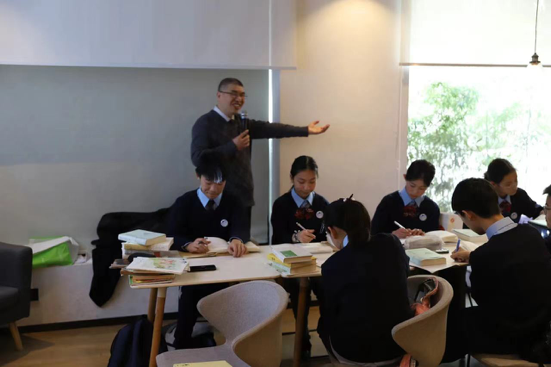
傅:我设计的 “与世界对话” 一百课,目前已公开出版的有四辑十六课,第五辑的五课也已交给出版社,也就是二十一课成书了,一课一本小册子,每册包括课堂实录、阅读文本和孩子习作三个部分。我自编的 “阅读文本” 大约一、两百万字,就是我们的教材内容,上课的方式就是师生问对,不仅是师生之间的对话,也是师生一起与古今中外的作者们对话,课堂是对话,也是织网,围绕着一个主题,织出一张审美的网、想象的网、思想的网,孩子们的学习方式除了上课时提出问题、回答问题、做笔记,更多的时间其实是在课外阅读,除了每一课一两万字的阅读文本,还有指定的古诗文背诵篇目和推荐的选读书目。所以,一个孩子要进入状态,真正完成我构想的学习目标,主要依靠的是课外,如果课外投入的时间、精力不够,光是靠课堂,效果就会大打折扣。
徐:已过这些年,孩子们投入得怎么样?
傅:过去的七八年,我看到成长得好的孩子都是在课外有大量的投入。我的教育理念之一是让孩子们像一棵树一样 —— 向下扎根,向上生长,这不能只靠课堂上有限的这一点时间。所以,我不断地强调 “读” 出来、“背” 出来、“写” 出来、“走”出来、“演”出来,都是想要激发他们的热情,唤醒他们内心的力量,我一次次在孩子们的身上看到了这种潜藏的力量,一旦被唤醒,他们就像换了一个人似的。戏剧表演、线下游学常常就是激发他们的时刻,因为平时我和他们在一起的时间太短了。许多孩子一开始接触戏剧,很害羞、胆怯,一旦进入角色,就会放开。在竞争角色的过程中,他们背后似乎有一种强大的推动力,让他们学会大胆地表达,把握人物的性格,也是绽放自己的个性。
徐:记得您曾说过读书就要直接读第一流的汉语作品,而不是幼稚化、经过改编后的儿童读物。过程中效果如何?有没有不适应的孩子?
傅:我说要读第一流的作品,不限于母语的作品,也包括东西方其他民族、其他语言的作品,只要翻译成了我们的母语,都要早早地接触,这是开视野,培养阅读口味,也是人的世界化过程。我推荐的书目就考虑到这种因素,一个孩子早一点接触到荷马史诗、莎士比亚的戏剧,当然还有中国的古典作品和二十世纪最好的白话作品,有奇妙的效果。我一直说,一个人在童年、少年时代与什么样的书相遇,对他的一生将产生难以估量的影响。对许多孩子来说,浅薄、低幼化的儿童读物可能更有阅读快感,更有诱惑力,而有深度的好作品不一定能吸引他们,我也碰到过不少不适应的孩子,随着年龄增长,才慢慢抛弃低幼读物,开始进入真正像样的阅读状态,而有的孩子很快就被好书抓住,比如一个四年级的孩子第一次读梭罗的《 瓦尔登湖 》,就一口气能读下去。
徐:我还对国语书塾孩子们的戏剧表演,印象非常深刻,也见过其他几位导师,比如文学导师、哲学导师,您如何考虑和选择这些导师?
傅:国语书塾聘请过一些导师,我选择导师的标准当然是有学识、有成就,同时热爱孩子,愿意和孩子站在一起的朋友。先后给孩子们上过课的有南京大学的景凯旋教授,他是研究古典文学的专家,也是翻译和研究东欧文学、思想的学者,给孩子们开过古诗欣赏和东欧文学课;杭州师范大学的黄岳杰教授一辈子致力于在大学生中推广戏剧教育,创办的 “流霞剧社” 影响深远,被誉为 “校园莎士比亚”,是学生心目中的 “大胡子老黄”。他在国语书塾给孩子们开过多次的戏剧课和朗诵课,排练过《 木兰诗 》、梅特林克的《 青鸟 》节选、莎士比亚的《 威尼斯商人 》、埃斯库罗斯的《 被缚的普罗米修斯 》、沙叶新的《 耶稣·孔子·披头士列侬 》、李静的《 大先生 》、张晓风的《 武陵人 》等,还有他给孩子们开的朗诵课,包括《 哈姆雷特 》《 浮士德 》《 桃花扇 》《 红楼梦 》《 楚辞 》等。他的生命激情感染了很多孩子。
还有中国美术学院的闻中教授,致力于印度哲学的研究,也翻译过泰戈尔的诗集,他在国语书塾给孩子们开过中英文对读课,以泰戈尔的《 飞鸟集 》为例,也开过但丁的课。王小庆是一位英语教育的专家,编过一套非常好的英语读本,给孩子们开过一期英文朗诵课。这些导师出现国语书塾孩子的面前,让他们从小就有机会接触到这样的先生,在他们的生命中布下的线索,将来会发挥什么样的作用是今天还看不到的,但我相信 “平常中的惊奇”。
徐:对于国语书塾的教育实践,看起来家长好像需要完全认同和投入才能行得通?这是否会相对限制国语书塾的 “规模”?
傅:国语书塾从来都不追求规模,因为 “手工作坊”,不是 “工业化流水线”,不可能复制,所以只能是个小型、甚至是微型的实验。我从一开始就想,这只是我作为一个个体生命亲身接触这个时代的儿童,我的生命与他们的生命相连接,我能不能真正影响他们还要取决于许多因素。家长如果完全认同并投入虽不是决定性的条件,因为部分认同、部分投入,也可能送孩子跟我一起与世界对话,但认同与投入不足,注定了孩子的收获也不足。包括前面提到的付润石、张禾、陈天悦、叶悠然、袁子煊,还有赵馨悦、刘艺婷、金恬欣、冯彦臻等,都是因为家长的高度认同,孩子们才在精神上长出了日渐坚硬的翅膀,开始在人类文明史的天空下练习飞翔。
四、当代中国教育的 “药方”:最好的教育自救之路,就是平衡的经典阅读
徐:国语书塾的实践方案,和其他同样在进行教育实验的创新教育、学校教育的方案,有什么不同?
傅:其实,从一开始国语书塾就没有什么同类的教育方案,至少迄今我没有发现,所以也无法谈论什么不同。因为国语书塾不是一个学校,也不是一个机构,而是一个 “想象的共同体”, “是孩子们关于国语书塾的所有记忆共同组成的 ”。国语书塾的实践方案带有更多的精神属性,我在国语书塾六周年时写过这样一段话:“国语书塾其实是个桃花源,只是在地上插了几枝桃花而已,不是一个实体,不是学校,也不是机构,是我个人五十岁之后和孩子们的生命连接,是在精神空间中的连接,通过母语的纽带,以古今中外的经典文本为媒介建立起来的,是像云一样抓不住,却又实实在在存在于天地之间的一个精神家园。我在孩子们心中播下母语的种子,用心血去浇灌,却要靠他们自身渐渐长成不同的样子,是不是参天大树,会不会果实累累,取决于很多的因素,外在的和内在的。我只是让他们相聚在一个‘想象的共同体’或‘想象的共和国’中,彼此碰撞,彼此对话,不仅是与看得见的今人,也与看不见的古人,有传世的文本在,文明的活水就在汩汩流淌。一个个已逝的生命也都活在文明史中。”
徐:是的,国语书塾小而精,但这个 “想象的共同体” 能容纳的孩子毕竟有限,有没有适合更多家长参考的一些实用行动方案?
傅:多年前我曾经说过:一个人能走多远,能看见一个多辽阔的世界, 归根到底还是取决于从童年、少年到青年一路读过的课外书的数量与质量,光是考分高、读名校,没读过什么像样的书,照样只能看见眼前一点小小得失。只有读书才能摆脱不可抗拒的命运加在你头上的一切,赢得一个更大的天空。可以从更有审美性的阅读开始。一个读过荷马史诗、歌德、泰戈尔、托尔斯泰、卡夫卡、布罗茨基……,读过柏拉图、亚里士多德、康德、尼采、罗素……,读过伽利略、牛顿、爱因斯坦……的人,心灵上享有更大的自由。最好的教育自救之路,就是平衡的经典阅读,是每个家庭可以进行的亲子共读,这是风险最小、代价最轻的一条道路。与单一化的刷题、拼分数相比,好的阅读才是真正将一个人与整个人类文明史联系在一起的方式。
徐:目前也有一些教育 NGO 在实践亲子共读、经典母语阅读等,怎么看待这些不同的教育方案?
傅:其他在教育领域不同的探索都各有自己的侧重面,各有自己的方向,具体的个案我关注的不够,也很难做出确切而客观的评价。我一向认为各种探索本身就是有意义的,至少来自民间的这些微小努力,可以拓展出不同的可能性。一个开放的、多元的,而不是封闭的、单一的教育生态,是多么令人期待。
徐:书塾主要在周末和假期上课,有没有想过采用更彻底的在家教育形式?
傅:由于客观条件的限制,国语书塾还没有考虑过全日制的在家教育形式。全日制所需要的那些条件,在今天的现实中都很难解决。我所知道的“在家教育实践”也没有比较好的范例。
徐:这些现实因素的限制,是不是也是中国的私学共同面临的关键问题?
傅:私立学校在中国今天的制度设计中,事实上也难有什么作为,在办学模式、教学内容、评价方式上都不可能拥有多少独立性。在这种大环境下,谈论私学存在的意义为时尚早。 “私学” 要有制度保障,才有真正自由的办学空间,探索自己的办学方向,比如民国时代的南开、南洋这些私立学校,都是那个时代的产物。
徐:是的,时代环境不一样。我们这个时代有一个新变量,就是人工智能的迅速发展,并且开始影响到了应试教育。您如何看待它对教育产生的任何影响?或者说,人工智能是否带来了更多可能性?
傅:在工具层面上,人工智能的发展会对教育领域产生一些影响,甚至很大的影响。但我相信教育是围绕着人,以人为中心,是为了人的生活,人的个性、情感、思想之丰富性、复杂性,而人工智能只是人发明的工具,无论多么发达,都代替不了人自身。“我思故我在”,“我爱故我在”,“我想象故我在”,人工智能归根结底只能是工具。
五、回望近代中国教育史:经验、问题与反思
徐:您长期研究民国史、近代教育史,在开始办学时,心目中有没有对标历史上的学堂?记得您提过白马湖的春晖中学?还是说,您是在探索一个全新的无人之境?
傅:数十年来,我关注过晚清以来的教育史,尤其是民国的教育,我寻找 “童子六七人”,开始国语书塾的尝试时,激励过我的有印度的泰戈尔、日本的福泽谕吉、俄国的托尔斯泰这些个案,他们都有办学的经历,但从来没有想过跟他们比较,因为我和他们所处的环境截然不同,他们具备的大部分条件我都不具备。我编过《 过去的中学 》《 过去的小学 》等书,也写过《 美的相遇 》《 新学记:中国现代教育起源八讲 》等书,熟悉在民国的中小学,包括天津南开中学、上海南洋中学、上虞白马湖畔的春晖中学的办学经验都是值得后人汲取的宝贵资源。但我从一开始就没有想过要模仿民国的某个学堂,不仅国语书塾不是一个学校,而且时代完全不同,所以我探索的这条路只是个人性的,是我个人带着孩子们一起读书、行走,与世界对话。
徐:是的,时代完全不同了。但是,民国读书人的思考方式,以及他们的办学方式,在你的教学内容、教学方式上有没有什么影响?比如,我看到您也大量采用民国时期的白话文学。
傅:我长期关注、研究民国史,民国教育在不知不觉中影响了我,我的 “与世界对话” 课程并不限于白话文,文言文和古典诗词也占有相当的比重。但我不认同民国以来在母语教育中采取单篇范文为主的范式,而是想另辟新路。在最近出版的新书《 寻找母语教育的另一种可能 》序言中,我写过这样一番话:
“我试图在叶圣陶、夏丏尊、朱自清等先生在民国践行并确立的母语教育范式之外,寻找并践行另外一条路径。
在文言转向白话的时代转型中,他们为近现代中国的母语教育摸索出了一条切实可行的道路,他们本身的母语根底和付出的努力,他们从一线的教育实践到教科书、课外辅导读物的编写,都已成为教育史上难以逾越的典范,其价值已被时间所证明。但是,随着时光的推移,世事的变迁,如何在一个变化了的时代重新找到更好地开启孩子心灵的路径,使他们真正习得纯正的母语,并不断提升用母语与世界对话的能力,激发他们的想象力,涵育他们的审美力,仅仅以既定的成熟范式是否就能完成,这便成为一个值得追问的问题。
叶、夏诸先生开创的被广泛接受的以单篇阅读、字词句为中心的教学方式,对于多数孩子也许是合适的,但未必适合所有的孩子,何况在一个有了互联网、搜索引擎的时代,仍然强调以知识为中心也已显得被动。我所思考的就是如何在他们的基础上有所突破,有所斩获。“尝试成功自古无”,是陆游的诗句。我所求的不是成功,更不是替代。我寻求的只是新的可能,新的创造,新的价值。尝试本身就是一种价值。一个古老民族从古代教育中挣脱出来不过百余年,一切都还在路上,难道就此停下尝试的脚步?”
徐:很精彩!但是民国读书人办学的缺点,在今天如何克服和超越?
傅:民国知识分子办学,当然也有缺点,比如民族主义、国家主义的导向还是很明显,对于个体精神的重视不够,没有提倡国家起源于个人,没有将每个人的权利、尊严放在首位。但说实话,我个人以为,我们今天还不到讨论“如何克服和超越”他们缺点的时候,而是应该梳理过去的办学传统,挖掘可供参考的资源,“向后看” 有的时候就是更好地 “向前看”。我编《 过去的中学 》《 过去的小学 》和撰述《 新学记:中国现代教育起源八讲 》的用意也是如此。
徐:您研究历史是 “向后看”,在这群孩子身上却是 “向前看”,有什么期待吗?会不会有历史包袱?
傅:没有特别的期待,不会有历史包袱。每个人都只能在自己所在时代给定的条件下努力,不可能超越自己的时代凭空创造。我曾经说过, “三年百课千人万里,铺就一个中国少年一生的人文底色。” 这是底线意义的期待。历史的变化总是在不起眼的角落里悄无声息地发生的,一个微不足道的个体在一个微不足道的角落所做的微不足道的努力,当下看来也许微不足道,也许在更大的时间尺度之下,却有重要的意义和价值,这是文明史的奇妙之处。”
六、当代中国公共知识分子与教育的可能性
徐:民国有入仕、办报、办学、经商、独立写作等多元途径,当代中国公共知识分子在体制内外能做什么?办教育是否一条新路?
傅:民国那个时代的空间,容许知识分子有更多元的选择,在报业、出版业、教育、实业、金融业、文学等不同领域,都给他们提供了安身立命的某种可能性。这样的空间在当代中国是不存在的,所以也很难有什么作为。办教育更是难之又难的一条路,前面我就说过,我所做的只是一件微不足道的事,与过去时代有机会办学的那些先辈走的是不同的路,更不可能成为一种示范。世人总是说 “人往高处走”,我反其道而行之,选择了 “人往低处走”,好 “低” 骛远是我给自己的一个定位。作为一个低调理想主义者,我和儿童站在一起,其实也就是与未来站在一起,未来并不是从未来才开始的。
徐:那么,公共知识分子如何在真实社会中,实现自己精神追求和社会价值?
傅: “知识分子” 这个概念很笼统,如果就受教育程度而言,事实上与社会其他群体已混合,没有什么特定的内涵,如果就从事的职业而论,也已经面目模糊、没有精神特质了。只有在精神上重新界定这个概念,其社会价值才能体现出来,那就是要担当社会的良心,对现实保持清醒的批评,不仅站在专业的角度,也站在人类文明的角度说出负责任的真话,这是要付出代价的。今天这样的时代,谈论这个话题,我都觉得是个奢侈的事,更不要说扮演这个角色。至于 “公共知识分子” 在中国大陆的语境中早已被污名化,相比之下,专业知识分子更容易生存,真正的公共知识分子几乎已失去存身之地。在极为复杂和艰难的社会环境中,要想实现自己的精神追求和社会价值,首先当然是在思想上保持独立性,不放弃独立思考,对于历史和现实要有深入体认,脚踏实地,从小处、低处着手,但从大处、高处着眼,坚守经过了时间考验的人类最基本的价值。如果有可能,就将自己的思考、研究转化为可以分享给世人或留在时间中的精神成果。在自己身上克服这个时代,不是一句空话,而是要实实在在通过个体生命的努力,在现实中行出来的。在不完美的今天付出的努力,就是最大限度地实现自己的精神追求和社会价值。
徐:在您的办学经历中,有没有一些可供进一步学术研究的主题?还有哪些教育问题值得进一步探索?
傅:我的小小的教育实验还在进行当中,也许要等国语书塾的孩子们长大,才能较为准确地评估这个实验的价值。教育是慢的事业,不是立竿见影的,要在时间中慢慢展开,如同一棵树的长成,是一个漫长的、潜移默化、润物无声的过程。从这个实验开始之前,我完成了《 新学记:中国现代教育起源八讲 》,探寻过中国现代教育的来龙去脉,还思考过 “教育相遇论”,出版过《 美的相遇 》一书,但那只是一本随笔集,还不是系统的研究。国语书塾让我投入到 “教育对话论” 的实践中,设计了 “与世界对话” 一百课,过去这几年,已出版《 与世界对话 》系列十六册,游学课程《 少年中国行 》系列已出版的有《 少年双城记 》( 北京、南京 )、《 少年西安行 》、《 少年江南行 》( 无锡、嘉兴、海宁 )四册,《 少年西湖走读课 》《 少年富春江走读课 》也将出版。游学课堂《 少年世界行 》还来不及整理出版。 “读万卷书、行万里路”,归结为“与世界对话”。与此同时,我逐渐形成了 “教育留白论”,在时间上给孩子留白在一个教育内卷白热化的时代尤其重要,没有留白,一个孩子在童年、少年时代疲于奔命,是不可能有想象力的。我将 “教育相遇论”、“教育对话论”、“教育留白论” 称之为 “三论”,这是我对教育的基本看法。我觉得 “三论” 就很值得进一步探索。
徐:最后一个问题可能比较直接,目前国语书塾的实践有没有哪些局限性?未来可能会有怎样的调整?
傅:国语书塾的实验本来就是带着镣铐跳舞,当然有局限,而且有极大的局限,我们只是在这种局限中眺望世界。有时候我会想到一句话, “达摩菩提东来只为了寻求一个不为人惑的人。” 我们周围的环境如此恶劣,日复一日面对的都是不可抗力,眼看着一个个天真的孩子忙碌的身影和疲倦的眼神,我常常感到无能为力,学校不是在保护他们天真的童年,而是按照行政的量化管理模式在塑造他们,多数孩子的家庭不是在保护他们的童年,而是被动或主动地配合学校。国语书塾能做的实在太有限了,要跟学校抢一点闲暇的时间,让孩子可以阅读、可以思考、可以留白,这一点时间太奢侈了。忙碌的结果就是天真的逐渐丧失,也就是植物性力量的丧失。我深信童年时代人身上的这种植物性力量极为宝贵。捷克小说家昆德拉说,人的一生注定扎根在前十年。童年是一口记忆的深井,这口井中源源不断的活水可以滋养人的一生。爱因斯坦的身上就能看到那种天真,这是典型的植物性力量。
未来充满了不确定的因素。我能坚持的就是信奉文明史中经过时间考验的基本价值,它们包含在那些传世的文本中,我把极少数有机缘跟我一起读世界的孩子带到这些作者和文本面前,即使在极不确定的时代也要追寻并确定这样的价值。
现实的局促决定了国语书塾不可能有什么扩展,我也没有不想改变我的初衷,向现实让步。我依然深信,一个人在最好的年龄,遇见什么样的书、什么样的人,到过什么样的地方,都会进入生命深处,化为一生的精神源泉。国语书塾不是要给孩子们一瓢水或一桶水,而是带他们看见滔滔江河奔流入海的样子,看见文明史的浩瀚星空,让他们成为布罗茨基意义上的“文明的孩子”。
<全文完>
The Guoyu Shushu—Fu Guoyong’s Educational Experiment with “Six or Seven Boys”
Guoyong Fu, Songzan Xu
Abstract
Against an intensifying exam-oriented regime in China, Fu advances a humanities-first, imagination-centered pedagogy: the flagship “Dialogue with the World” curriculum (“three-hundred-thousand-ten thousand”) uses the mother tongue as fulcrum to cultivate aesthetic discernment, independent thought, and expressive capacity through deep reading, memorization, writing, drama, and travel. Drawing on a civilizational frame (Schiller, Havel, Brodsky), Fu proposes three linked theses—Educational Encounter, Educational Dialogue, and Educational White Space—arguing that childhood requires time and openness to form durable moral-aesthetic habits (Bildung). Case vignettes from early cohorts illustrate outcomes and constraints; mentors and texts (classical and modern, Chinese and global) scaffold a deliberately “handmade workshop” rather than a scalable model, an “imagined community” that resists industrialized schooling. Fu reads AI as a tool, not a telos; and he situates private education’s limits within contemporary institutional conditions. The interview thus offers a theoretically grounded, practice-tested template for educational self-help—balanced classic reading and parent-child co-reading—while clarifying what such work can and cannot do within present constraints.
Keywords: aesthetic education; humanities curriculum; exam-oriented schooling; Bildung; imagined community
https://doi.org/10.64053/SFIQ8956
Interviewer’s Note:
On the morning of July 7, 2025, Mr. Fu Guoyong passed away suddenly in Hangzhou, something I never anticipated when we completed this interview in early June. This interview has thus become my final conversation with Teacher Fu. The man himself is gone, but the Guoyu Shushu lives on, and the young boys whose lives he impacted live on. May Teacher Fu’s spirit and integrity continue to be with them, and with us. This is in his eternal memory.
Interviewee: Fu Guoyong
Bio: Historian and practitioner of children’s mother-tongue education. His main research focuses on modern Chinese history, particularly the history of public opinion over the past century, the role of intellectuals, and educational traditions. In 2010, he was selected as one of the “100 People Who Have Influenced the Course of China’s Era” by Time Weekly. In 2017, he founded the Guoyu Shushu (National Language Academy), dedicating himself to children’s mother-tongue education. His published works include Waves at the Tip of the Pen, The Moral Backbone of a Literatus, The Centenary of the 1911 Revolution: Private Records of Eyewitnesses, 1949: Private Records of Chinese Intellectuals, From Gong Zizhen to John Leighton Stuart, A New Record of Learning: Eight Lectures on the Origins of Modern Chinese Education, and Seeking Another Possibility for Mother-Tongue Education: Fu Guoyong’s Notes on Teaching Children.
Interviewer: Xu Songzan
Bio: PhD candidate in Theology and Religious Studies at the University of Cambridge. From 2015 to 2017, he participated in Teacher Fu Guoyong’s seminar on modern Chinese history, and from 2019 to 2020, he planned and produced Teacher Fu’s audio program A Youth’s Daily Record of Knowledge.
The world always says, “people strive to move upwards,” but I have gone against the current, choosing to “walk to low places.” “Aiming ‘low’ for the long term” is how I position myself. As a low-key idealist, standing with children is, in fact, standing with the future. The future does not begin in the future.
— Fu Guoyong, in a May 2025 interview with Chinese Language Journal.
I. The Eighth Year of the Guoyu Shushu: Not to Turn the Tide, But to Find Another Possibility for Education
Xu: In the autumn of 2017, when you founded the Guoyu Shushu, what were your observations of the problems in Chinese education at the time?
Fu: When this small educational experiment of the Guoyu Shushu had just begun, the Chinese education I observed was an exam-oriented system centered on memorizing facts and endless test-drilling. The pursuit of high test scores was the overwhelming goal. Under such an evaluation and examination system, students were confined to a predetermined track from a young age, with no time for free reading and no space for independent thinking. Their days revolved around repetitive knowledge drills, lacking exercises for the mind and for the soul. Such an educational model pays no attention to the cultivation of a person’s creativity, emotions, or character. In the pursuit of high scores and advancement, students are tied to the war chariot of examinations from childhood, constantly in a state of tension akin to an arms race. After-school tutoring institutions have sprung up to meet this need, and many students spend their out-of-school time in various training classes aimed at improving scores, euphemistically called a “must-have.” Over time, the light in the children’s eyes gradually dims, and many fall victim to the disease of apathy. Can we expect such children to grow up with any imagination?
Xu: This is an old problem in Chinese education. It has been eight years now. Have these problems been “alleviated”?
Fu: Nearly eight years later, not only have these problems not been alleviated, but they have become more and more serious. There have been some changes, of course. Eight years ago, children were mainly exhausted from rushing between various training classes. Since the crackdown on the tutoring industry and the so-called “burden reduction” a few years ago, schools’ exploitation of children’s time has reached an unprecedented level. Children are already overwhelmed just completing the various requirements and assignments from school. Add to that the after-school training classes, and their time is completely filled, making truly autonomous extracurricular reading and time for creative thought increasingly rare.
Xu: Looking back at the Guoyu Shushu itself, have there been any changes in these eight years? Is the situation now different from the very beginning?
Fu: The positioning of the Guoyu Shushu itself has not changed much. It is still centered on imagination, not on memorizing facts, and is committed to broadening each child’s horizons, inspiring their imagination, cultivating their aesthetic sense, and enhancing their capacity for thought, that is, the ability to think independently. The main course I designed is “Dialogue with the World.” Although it uses mother-tongue education as a fulcrum, it is not a language class in the usual sense, but a humanities class. I summarize the educational experiment of the Guoyu Shushu with the mnemonic “three-hundred-thousand-ten thousand”: that is, over three years, to give the children one hundred “Dialogue with the World” classes, to introduce to them one thousand authors from China and abroad throughout the ages, and through traveling ten thousand li, to weave a humanistic map of their own in their hearts. Our classes do not get bogged down in words and sentences, nor do they fixate on a certain set of facts. Instead, we start from aesthetics and imagination to help children form their own ways of thinking and expression, not just an accumulation of knowledge.
If you ask what is different now from the beginning, the main change is in the children themselves; the time they can control has become less and less. Most of the first children who came to the Guoyu Shushu were in the fifth grade of primary school. They attended the “young boys’ class” for three years and continued for another three and a half years in the “youth class.” The second and third batches of children were also able to stay at the Guoyu Shushu for five years. The children who came later faced increasing academic pressure and internal competition at school. After entering junior high, it became very difficult for them to find time, and extracurricular reading was almost completely abandoned. This change has become more obvious year by year. This is the rigid macro-environment that very few families can resist, and the children can only become its victims. In other words, the educational arms race has become more intense than in the past, and has even begun to extend down to the primary school level.
Xu: So for you personally, have your state of mind and awareness of the problems changed?
Fu: My personal state of mind hasn’t changed particularly. My original intention was never to turn the tide; I had no grand ideals, but rather to find another possibility for mother-tongue education or humanities education. Today, this small educational experiment is still ongoing, and my exploration and reflection in practice are also continuing.
Xu: I’m very curious about what the children from the first and second batches of the Guoyu Shushu are doing now. Perhaps from them, we can see more of the Shushu’s potential.
Fu: Most of the children from the first batch are taking the gaokao this year and are in the final preparation stage. A very small number have already entered university. Fu Runshi was admitted to the junior class of Xi’an Jiaotong University before graduating from junior high, so although he was accepted by Hangzhou No. 2 High School, he relinquished his spot in the latter. After a year of preparatory study at Xi’an Jiaotong University and another year in the physics department, he was admitted to the physics department at Stony Brook University in New York and has been studying there for a year. While studying physics, he has not given up on extensive reading in the humanities; recently, he has taken a liking to Susan Sontag. In the early spring of last year, his collection of correspondence with his classmate Zhang He, A Youth’s Letters, was published in Tokyo. What surprised many friends was not which books they read, but the depth and breadth of their thinking and the way they expressed their ideas. Fu Runshi chose physics as his major, but he has a very good foundation in humanities, switching freely between physics formulas and novels, poetry, and philosophical works. After arriving in the United States, he felt no sense of disconnect at all; he could find a spiritual anchor between Eastern and Western civilizations, which has a lot to do with the cultivation he received at the Guoyu Shushu. From the very beginning when he came to the Guoyu Shushu in October 2017, I have always emphasized the need to move between the classical and the modern, the East and the West. He is no stranger to the works of Dante, Shakespeare, Goethe, Hugo, Dostoevsky, Spinoza, Tagore, Hu Shih, Lu Xun, Emerson, Kawabata Yasunari, and Einstein. His life has long been marked by a global perspective.
The other author of A Youth’s Letters—Zhang He—is still preparing for the gaokao. He aspires to study history and has a special affinity for the National Southwestern Associated University. His ability to grasp new ideas is excellent, and he can often see problems from perspectives that others miss. Among the second batch of students, Chen Tianyue is currently in the first year of high school at Hangzhou No. 2 High School, Ye Youran is in the first year at Cangnan High School, and Yuan Zixuan is at the high school affiliated with East China Normal University. If all goes well, they will enter university in two years. When they left the Guoyu Shushu, they could all write respectable articles. I sometimes read their articles in the small journal Xiaguan, which they run themselves. They are well-written, interesting, and have a certain depth. The heavy academic pressure has not crushed them. I don’t know how far they will go or how high they will fly in the future. I just believe that the foundation of humanities education laid in their childhood and youth will always have an impact.
II. “Children’s Mother-Tongue Education” is Just the Fulcrum; the Goal is the “Person”
Xu: You just mentioned that what you are exploring and practicing is a “mother-tongue education” that emphasizes imagination and the power of thought. This was a concept you had when you first started the Guoyu Shushu. What is the role and significance of this kind of mother-tongue education in a person’s educational and growth history?
Fu: The “children’s mother-tongue education” I have referred to is actually just a fulcrum. The goal is the person, the exploration of the value of being human, that is, humanistic value. Without a doubt, a person begins to learn to dialogue with the world through their mother tongue. Considering the receptive capacity of children, my entry point is aesthetics, because a person’s aesthetic sense is the first step towards spiritual adulthood. As Schiller said: “Aesthetic education is a necessary condition for man to achieve spiritual freedom and human perfection.” And the mother tongue is the starting point of aesthetic education. The kind of mother tongue a person is exposed to in their childhood and youth determines their aesthetic starting point. I emphasize starting with aesthetics because I believe that a child’s world is a world of pictures; they begin to understand the world through images, but must eventually move from images to concepts. The mother tongue is also the starting point of everyone’s thought life. A German poet once said, “Where words break, there all things cease to be.” The Czech intellectual Václav Havel also said that language is the beginning of all things. Language is a miracle; because of it, we become human. I engage in a dialogue with the world together with the children—by no means a vague, empty dialogue, but one with a solid fulcrum. This fulcrum is our mother tongue. With the mother tongue as the fulcrum, we continuously enhance our ability to think, comprehend, and express ourselves in the process of dialoguing with the world. Once a person gains this ability, he possesses an indestructible fulcrum.
Xu: In your view, what is the fundamental definition of “education”?
Fu: I’m afraid there is no fundamental definition of “education” to date, but the ancient and modern sages of both the East and the West have described “education” in many different ways. Education is the channel through which finite human beings, in their limited time on earth, inquire into certain and unchanging values. Through education, it becomes more possible for a person to transcend their own biological limitations and thus obtain a more certain and real understanding of people and the world they inhabit. In short, education is simply to help everyone become “a person among people,” to affirm the value of “being human.” The essence of education is freedom, to achieve the self-liberation of life through education.
Xu: So, what is a “good,” “flourishing” life? How does education help lead to such a life?
Fu: I am reminded of the American philosopher Will Durant’s words. He believed that the three goals of education are: to control life through health, character, wisdom, and technology; to enjoy life through friendship, nature, literature, and art; and to understand life through history, science, religion, and philosophy. Education involves two processes, and these two processes are complementary. In one process, humanity passes on a rich heritage accumulated over generations to the growing individual, including knowledge, skills, morality, and art. In the other process, the individual uses this legacy to develop their own abilities and enrich their life. Education is the process of making life more perfect day by day, that is, enriching the individual with the heritage of humanity. If this important process of transmission and absorption is interrupted for half a century, then civilization will perish, and our children and grandchildren will be more primitive than barbarians. I am very fond of these ideas from Will Durant. Education, in the end, is about helping people to better control, enjoy, understand, and enrich life, which is to say, helping people move towards a “good,” “flourishing” life.
Xu: But for those who have not received a good education, are there other possibilities?
Fu: Not having the opportunity to receive such an education does not mean there is no opportunity to enjoy such a life. Every person’s life experience and encounters are different. As long as there is an opportunity to enter the chain of human civilization, to receive this civilizational legacy, and to use it to understand and enrich life, it is not impossible. It just requires greater effort and a more difficult path.
Xu: The editors of Chinese Language Journal are also very concerned about a certain question: for educators themselves, how do they know they are on the “right” path? And how do we know what we ought to know but do not know?
Fu: How an educator determines whether they are on the right path depends on their understanding and grasp of the history of civilization, because every person lives within the context of the history of civilization, not as an isolated being without precedent. The word “right,” if not qualified, can easily lead to ambiguity, so I am not very willing to use it. I only know that since the times of ancient Greece, India, and pre-Qin China, the history of human civilization has established certain fundamental values. Mei Guangdi, who studied in the United States in the early twentieth century, once said, “We must understand and possess all things true, good, and beautiful that have stood the test of time.” I particularly admire this. This is a different view from evolutionism; humanity does possess more deeply enduring, unchanging values that have stood the test of time, fundamental values that were formed independently in different contexts in the East and West but are coincidentally similar. An educator is not a being who looks down on the world from on high, but is just a member of civilized humanity engaged in the ordinary yet magical work of education. In a stricter sense, the teacher and the student are not two opposing sides, but stand together to dialogue with nature, with people, and with the world. In other words, the teacher and the student stand in the same direction, facing the authors of ancient and modern times, from China and abroad. As a teacher, one does not face the child with the total sum of one’s own knowledge, but connects one’s own life with the child’s life. The process of education is also a process of life meeting life. In terms of knowledge, no matter when, the teacher is always limited. In fact, the problem of “what we ought to know but do not know” does not exist. From beginning to end, we should all know our own limitations. But this limitation in knowledge does not prevent the teacher from bringing the child before the legacy of human civilization. As I said just now, the teacher and student stand on the same side; they are also fellow travelers. I was once very frustrated by human limitations, until one day I read a sentence by Brodsky and was suddenly enlightened—”Infinity can only be comprehended through the finite.”
III. The Materials, Tutors, and Learning Methods of the Guoyu Shushu
Xu: I’d like to delve deeper into some of the details of the Guoyu Shushu. For example, in the selection of teaching materials, teaching methods, and the students’ learning methods, how are your educational philosophies reflected? What considerations and adjustments have you made?
Fu: Of the one hundred “Dialogue with the World” lessons I designed, four series of sixteen lessons have been published so far. The five lessons of the fifth series have also been submitted to the publisher, meaning twenty-one lessons are now in book form. Each lesson is a small booklet, and each booklet includes a transcript of the class, the reading texts, and the children’s writings. The “reading texts” I compiled myself, about one to two million characters, are our teaching materials. The way we have class is through dialogue between teacher and students, and not only that, but all of us together dialoguing with the authors of ancient and modern times, from China and abroad. The classroom is a dialogue, and it is also a weaving of a web. Centered around a theme, we weave a web of aesthetics, a web of imagination, a web of thought. Besides asking and answering questions and taking notes in class, children learn mostly through extracurricular reading. In addition to the ten to twenty thousand characters of reading texts for each lesson, there are also designated classical Chinese texts to memorize and recommended reading lists. So, for a child to get into the swing of things and truly achieve the learning goals I envision, it mainly relies on their work outside of class. If they cannot invest sufficient time and energy outside of class, what they learn in the classroom will have much less of an impact.
Xu: After all these years, how have the children invested themselves?
Fu: Over the past seven or eight years, I have seen that the children who have grown well are all those who have invested a great deal outside of class. One of my educational philosophies is to let the children be like a tree—rooting downwards and growing upwards. This cannot be achieved solely through their limited time in the classroom. Therefore, I constantly emphasize “reading it out,” “memorizing it out,” “writing it out,” “walking it out,” and “acting it out.” All these are to stimulate their passion and awaken their inner strength. I have seen this hidden power in the children time and again. Once awakened, they are like completely different people. Drama performances and offline study tours are often the moments that inspire them, because the time I spend with them is usually too short. Many children are very shy and timid when they first encounter drama. Once they get into character, they let their inhibitions go. In the process of auditioning for roles, there seems to be a powerful driving force behind them, making them learn to express themselves boldly and grasp the character’s personality, which is also a blossoming of their own individuality.
Xu: I remember you once said that one should read the great classic Chinese works directly, rather than the simplified versions adapted for children. How did that work out? Were there any children who couldn’t adapt?
Fu: I said one should read great works, not limited to works in the mother tongue, but also including works from other peoples and languages of the East and West. As long as they are translated into our mother tongue, they should be encountered early on. This is to broaden their horizons, cultivate their literary tastes, and develop a global perspective. The reading lists I recommend take this factor into account. A child who encounters the Homeric epics, Shakespeare’s plays, and of course, Chinese classical works and the best vernacular works of the twentieth century early on will experience something truly special. I have always said that the books a person encounters in their childhood and youth will have an immeasurable impact on their entire life. For many children, shallow, juvenile children’s books may be more pleasurable to read and more tempting, while good works with depth may not necessarily attract them. I have also encountered many children who could not adapt. As they grow older, they slowly abandon juvenile books and mature into discerning readers. And some children are quickly captivated by good books. For example, a fourth-grade child read Thoreau’s Walden for the first time and could read it in one go.
Xu: I was also very impressed by the drama performances of the Guoyu Shushu children. I’ve also met several other tutors, such as the literature tutor and the philosophy tutor. How do you consider and choose these tutors?
Fu: The Guoyu Shushu has hired several tutors. My standard for choosing tutors is, of course, that they are knowledgeable and accomplished, and at the same time, love children and are willing to stand alongside children. Those who have taught the children include Professor Jing Kaixuan from Nanjing University, who is an expert in classical literature and a scholar who translates and studies Eastern European literature and thought. He has taught classes on classical poetry appreciation and Eastern European literature for the children. Professor Huang Yuejie from Hangzhou Normal University has dedicated his life to promoting drama education among university students. The “Liuxia Drama Society” he founded has had a profound impact and he is known as the “campus Shakespeare,” the “bearded old Huang” in the eyes of his students. He has taught many drama and recitation classes for the children at the Guoyu Shushu, rehearsing The Ballad of Mulan, excerpts from Maeterlinck’s The Blue Bird, Shakespeare’s The Merchant of Venice, Aeschylus’s Prometheus Bound, Sha Yexin’s Jesus, Confucius, John Lennon, Li Jing’s The Great Master, and Zhang Xiaofeng’s The Man of Wuling. He has also taught recitation classes for the children, including works from Hamlet, Faust, The Peach Blossom Fan, Dream of the Red Chamber, and The Songs of Chu. His passion for life has inspired many children.
There is also Professor Wen Zhong from the China Academy of Art, who is dedicated to the study of Indian philosophy and has translated Tagore’s poetry collections. He has taught a Chinese-English bilingual reading class for the children at the Guoyu Shushu, using Tagore’s Stray Birds as course material, and has also taught a class on Dante. Wang Xiaoqing is an expert in English education and has compiled a very good set of English readers. She has taught an English recitation class for the children. The involvement of all these tutors has given the children of the Guoyu Shushu the opportunity to meet such accomplished teachers from a young age. The threads they lay in their lives, what kind of role they will play in the future, is something we cannot see today, but I believe in the “surprise in the ordinary.”
Xu: For the educational practice of the Guoyu Shushu, it seems that parents need to be fully aligned and invested for it to work. Does this relatively limit the “scale” of the Guoyu Shushu?
Fu: The Guoyu Shushu has never pursued scale, because it is a “handmade workshop,” not an “industrial assembly line.” It cannot be replicated, so it can only be a small, or even micro, experiment. From the very beginning, I thought, this is just me and my one life, personally trying to help the children of this era. My life is connected to their lives. Whether I can truly influence them depends on many factors. Although it is not a decisive condition for parents to be fully aligned and invested—because with partial alignment and partial investment, they may also send their children to dialogue with the world with me—insufficient agreement and investment will inevitably lead to lackluster fruit for their children. This includes the aforementioned Fu Runshi, Zhang He, Chen Tianyue, Ye Youran, and Yuan Zixuan, as well as Zhao Xinyue, Liu Yiting, Jin Tianxin, Feng Yanzhen, and others. It is because of the high degree of parental alignment that the children have grown increasingly strong wings in their spirits and have begun to take flight under the sky of human civilization’s history.
IV. The “Prescription” for Contemporary Chinese Education: The Best Path to Educational Self-Help is Balanced Reading of the Classics
Xu: How does the practical approach of the Guoyu Shushu differ from other innovative educational experiments and school education programs?
Fu: Actually, from the very beginning, there have been no comparable educational programs to the Guoyu Shushu, at least none that I have discovered so far, so it’s impossible to talk about any differences— because the Guoyu Shushu is not a school or an institution, but an “imagined community,” “composed of all the children’s memories of the Guoyu Shushu.” The practical approach of the Guoyu Shushu leans more heavily on spiritual development. I wrote this on the sixth anniversary of the Guoyu Shushu: “The Guoyu Shushu is actually a Peach Blossom Spring, just with a few peach branches planted in the ground. It is not a physical entity, not a school, not an institution. It is the connection of my life with the children’s lives after I turned fifty, a connection in a spiritual space, established through the bond of the mother tongue, with classic texts from ancient and modern times, from China and abroad, as the medium. It is like a cloud that cannot be grasped, yet it is a spiritual home that truly exists between heaven and earth. I sow the seeds of the mother tongue in the children’s hearts and water them with my heart’s blood, but it is up to them to gradually grow into different forms. Whether they become towering trees, whether they will be fruitful, depends on many factors, both external and internal. I merely bring them together in an ‘imagined community’ or an ‘imagined republic,’ where they collide with each other, dialogue with each other, not only with the visible people of today but also with the invisible people of the past. As long as the timeless texts exist, the living water of civilization flows. One by one, the lives of the long departed also live on in the history of civilization.”
Xu: Yes, the Guoyu Shushu is small and focused, but the number of children this “imagined community” can accommodate is after all limited. Are there any practical action plans that more parents can refer to?
Fu: Many years ago, I once said: how far a person can go, how vast a world they can see, ultimately depends on the quantity and quality of the extracurricular books they read from childhood and youth to young adulthood. Only having high test scores and attending a famous university, but not having read any decent books, one’s vision will be limited to the small gains and losses right in front of them. Only by reading can one escape all that is imposed on you by an irresistible fate and reach a larger horizon. One can start with more aesthetic reading. A person who has read the Homeric epics, Goethe, Tagore, Tolstoy, Kafka, Brodsky… who has read Plato, Aristotle, Kant, Nietzsche, Russell… who has read Galileo, Newton, Einstein… enjoys greater freedom of the soul. The best path to educational self-help is balanced reading of the classics. It is parent-child co-reading that every family can carry out. This is the path with the least risk and the lightest cost. Compared to monotonous test-drilling and fighting for high scores, good reading is the way to truly connect a person with the entire history of human civilization.
Xu: There are currently some educational NGOs that are also practicing parent-child co-reading, classic mother-tongue reading, etc. How do you view these different educational programs?
Fu: Other different explorations in the field of education each have their own emphasis and direction. I have not paid enough attention to specific cases, so it is difficult to make an accurate and objective evaluation. I have always believed that exploring different paths is meaningful in itself. At the very least, these small efforts from the private sector can open up different possibilities. An open, diverse, rather than closed, monolithic educational ecosystem is something to look forward to.
Xu: The Shushu mainly holds classes on weekends and holidays. Have you ever considered adopting a more thorough form of homeschooling?
Fu: Due to practical limitations, the Guoyu Shushu has not yet considered a full-time homeschooling format. The conditions required for full-time education are very difficult to solve in today’s reality. There is also a lack of good models among the “homeschooling practices” I know of.
Xu: Are the limitations of these real-world factors also the key problem that private schools in China collectively face?
Fu: In today’s institutional design in China, private schools, in fact, can hardly achieve much. They cannot have much independence in their operating models, teaching content, or evaluation methods. In this macro-environment, it is too early to talk about the significance of the existence of private schools. “Private schools” must have institutional guarantees to have a truly free space to operate and explore their own educational directions, such as the private schools of the Republican era like Nankai and Nanyang, which were products of that time period.
Xu: Yes, the current era is completely different. Our era has a new variable, which is the rapid development of artificial intelligence, and it has begun to affect exam-oriented education. How do you view its impact on education? Or rather, has artificial intelligence brought about more possibilities?
Fu: At the tool level, the development of artificial intelligence will have some impact, even a great impact, on the field of education. But I believe that education is centered around people, for the sake of people’s lives, and the richness and complexity of human personality, emotions, and thoughts. Artificial intelligence is just a tool invented by humans. No matter how advanced it becomes, it cannot replace humans themselves. “I think, therefore I am,” “I love, therefore I am,” “I imagine, therefore I am.” Artificial intelligence, at the end of the day, can only be a tool.
V. Looking Back on Modern Chinese Educational History: Experience, Problems, and Reflections
Xu: You have long studied the history of the Republic of China and modern educational history. When you started your school, did you have any historical schools in mind as a benchmark? I remember you mentioned Chunhui Middle School by Baimahu? Or were you exploring completely new, uncharted territory?
Fu: For decades, I have paid attention to the history of education since the late Qing Dynasty, especially in the Republican era. When I was looking for “six or seven young boys” and began the experiment of the Guoyu Shushu, what inspired me were the cases of Tagore in India, Fukuzawa Yukichi in Japan, and Tolstoy in Russia. They all had experience in running schools, but I never thought of comparing myself to them, because the environment I am in is completely different, and most of the conditions they had, I do not have. I have edited books like Middle Schools of the Past and Primary Schools of the Past, and have also written books like An Encounter with Beauty and A New Record of Learning: Eight Lectures on the Origins of Modern Chinese Education. I am familiar with the valuable resources for later generations to draw upon from the experience of running middle and primary schools in the Republican era, including Nankai Middle School in Tianjin, Nanyang Middle School in Shanghai, and Chunhui Middle School by Baimahu in Shangyu. But from the very beginning, I never thought of imitating any school from the Republican era. Not only is the Guoyu Shushu not a school, but we are in a completely different era. So the path I am exploring is just a personal one, me personally reading, walking, and dialoguing with the world together with the children.
Xu: Yes, the era is completely different. But have the thinking methods of the Republican-era scholars, and their ways of running schools, had any influence on your teaching content and methods? For example, I see that you also use a lot of vernacular literature from the Republican period.
Fu: I have long focused on and studied the history of the Republican era, and its education has influenced me unconsciously. My “Dialogue with the World” course is not limited to vernacular Chinese; classical Chinese and classical poetry also account for a considerable proportion. But I do not agree with the paradigm of using single model essays, which has been adopted in mother-tongue education since the Republican era. I want to open up a new path. In the preface to my recently published book Seeking Another Possibility for Mother-Tongue Education, I wrote this:
“I am trying to find and practice another path outside the mother-tongue education paradigm that was practiced and established by masters like Ye Shengtao, Xia Mianzun, and Zhu Ziqing in the Republican era.
In the era of transition from classical to vernacular Chinese, they explored a practical and feasible path for modern China’s mother-tongue education. Their own foundation in the mother tongue and the efforts they put in, from their frontline educational practice to the compilation of textbooks and extracurricular supplementary readers, have all become unsurpassable models in the history of education, their value proven by time. However, as time goes by and circumstances change, how can we find a better path to open children’s minds in a changed era, so that they can truly learn the pure mother tongue and continuously enhance their ability to dialogue with the world in their mother tongue, to stimulate their imagination and cultivate their aesthetic sense—can this be accomplished merely with the established paradigm? This becomes a question worth asking.
The teaching method pioneered by Mr. Ye, Mr. Xia, and others, which is widely accepted and centered on single-text reading and words and sentences, may be suitable for most children, but not necessarily for all children. Moreover, in an era with the internet and search engines, it seems passive to continue emphasizing fact-based knowledge as the center. What I am thinking about is how to make a breakthrough and build something on the foundation they have laid. ‘There has never been a successful attempt since ancient times,’ is a line from Lu You’s poem. What I seek is not success, let alone to replace the old. What I seek is only new possibilities, new creations, new values. The attempt itself is valuable. The ancient nation of China has only broken free from ancient education for just over a hundred years. Everything is still evolving, on a journey. How could we stop striving toward a better way now, of all times?”
Xu: Brilliant! But how can the shortcomings of the Republican-era scholars in running schools be overcome and surpassed today?
Fu: The intellectuals of the Republican era, in running schools, certainly had their shortcomings. For example, the orientation towards nationalism and statism was still very obvious, and there was not enough emphasis on the individual spirit. They did not advocate that the state originates from the individual, nor did they place the rights and dignity of each person first. But to be honest, in my personal opinion, we are not yet at the stage to discuss “how to overcome and surpass” their shortcomings. Instead, we should sort through the past traditions of running schools and mine them for wisdom. “Looking back” is sometimes the best way to “look forward.” This is also my intention in compiling Middle Schools of the Past, Primary Schools of the Past, and writing A New Record of Learning: Eight Lectures on the Origins of Modern Chinese Education.
Xu: You “look back” when you study history, but you “look forward” with this group of children. Do you have any expectations of them? Will there be any historical baggage?
Fu: No special expectations, and no historical baggage. Everyone can only strive under the conditions given by their own era; it is impossible to transcend one’s own era and create out of thin air. I once said, “Three years, one hundred lessons, one thousand people, ten thousand li, to lay the humanistic foundation for a Chinese youth’s entire life.” This is an expectation in a baseline sense. Historical changes always happen quietly and silently in inconspicuous corners. The insignificant efforts made by an insignificant individual in an insignificant corner may seem insignificant at the time, but perhaps on a larger time scale, they will hold important meaning and value. This is the wonder of the history of civilization.
VI. Contemporary Chinese Public Intellectuals and the Possibility of Education
Xu: In the Republican era, there were diverse career paths for intellectuals such as entering politics, running newspapers, running schools, doing business, and independent writing. What can contemporary Chinese public intellectuals do inside and outside the system? Is running an educational institution a new path?
Fu: The space of the Republican era allowed intellectuals to have more diverse choices. The fields of journalism, publishing, education, industry, finance, literature, etc. all offered the possibility for one to settle down and make a living. Such a space does not exist in contemporary China, so it is also difficult to achieve much. Running an educational institution is an even more difficult path. As I said before, what I am doing is just an insignificant thing. I am walking a different path from those predecessors who had the opportunity to run schools in the past, and it is even more impossible for it to become a widely adopted model. The world always says, “people strive to move upwards,” but I have gone against the current, choosing to “walk to low places.” “Aiming ‘low’ for the long term” is how I position myself. As a low-key idealist, standing with children is, in fact, standing with the future. The future does not begin in the future.
Xu: So, how can public intellectuals achieve their spiritual pursuits and social value in real society?
Fu: The concept of “intellectual” is very general. In terms of educational attainment, they are in fact mixed with other social groups and have no specific connotation. In terms of their profession, their faces have also become blurred and they have no spiritual characteristics. Only by redefining this concept in a spiritual sense can its social value be reflected, and that is to act as the conscience of society, to maintain a sober critique of reality, and to speak the responsible truth not only from a professional perspective but also from the perspective of human civilization. This comes at a price. In an era like today, talking about this topic, I feel it is a luxury, let alone playing this role. As for “public intellectual,” the term has long been stigmatized in the context of mainland China. In comparison, professional intellectuals find it easier to survive; true public intellectuals have almost lost their place to stand. In an extremely complex and difficult social environment, to achieve one’s spiritual pursuits and social value, the first thing, of course, is to maintain independence in thought, not to give up independent thinking, to have a deep understanding of history and reality, to be down-to-earth, to start from small and low places, but to look from high and far places, and to adhere to the most basic human values that have stood the test of time. If possible, one should transform one’s own thoughts and research into spiritual achievements that can be shared with the world or left in time. To overcome this era within oneself is not an empty phrase, but something to be carried out in reality through the efforts of one’s individual life. The efforts made in today’s imperfect world are the greatest realization of one’s own spiritual pursuits and social value.
Xu: In your experience of running a school, are there any topics that could be further explored through academic research? What other educational issues are worth further exploration?
Fu: My small educational experiment is still ongoing. Perhaps we have to wait for the children of the Guoyu Shushu to grow up to be able to more accurately assess the value of this experiment. Education is a slow business, not something that yields immediate results. It must unfold slowly in time, like the growth of a tree, a long, subtle, and silent process. Before this experiment began, I completed A New Record of Learning: Eight Lectures on the Origins of Modern Chinese Education, explored the origins of modern Chinese education, and also thought about the “theory of educational encounter,” publishing the book An Encounter with Beauty. But that was just a collection of essays, not systematic research. The Guoyu Shushu has allowed me to immerse myself in the practice of the “theory of educational dialogue.” I designed one hundred “Dialogue with the World” lessons. Over the past few years, sixteen volumes of the “Dialogue with the World” series have been published, and four volumes of the study tour course “A Youth’s Journey Through China” series have been published, including A Tale of Two Cities (Beijing, Nanjing), A Youth’s Journey Through Xi’an, and A Youth’s Journey Through Jiangnan (Wuxi, Jiaxing, Haining). A Youth’s Reading Tour of the West Lake and A Youth’s Reading Tour of the Fuchun River will also be published. The study tour course “A Youth’s Journey Through the World” has not yet been compiled and published. “Read ten thousand books, travel ten thousand li,” boils down to “dialogue with the world.” At the same time, I have gradually formed the “theory of educational white space” (liú bái). Giving children “white space” in time is especially important in an era of intense educational internal competition. Without this white space, a child who is exhausted in their childhood and youth cannot exercise their imagination. I call the “theory of educational encounter,” the “theory of educational dialogue,” and the “theory of educational white space” the “three theories.” This is my basic view of education. I think the “three theories” are very worthy of further exploration.
Xu: The last question may be quite direct. Are there any limitations to the practice of the Guoyu Shushu at present? What adjustments might be made in the future?
Fu: The experiment of the Guoyu Shushu is inherently a dance in shackles. Of course, there are limitations, and very great limitations. We are just gazing at the world from within these limitations. Sometimes a sentence comes to my mind, “Bodhidharma came to the East only to seek a person who would not be deluded by others.” The environment around us is so harsh. Day after day, we face irresistible forces. Seeing the harried figures and tired eyes of one innocent child after another, I often feel powerless. The school is not protecting their innocent childhood but is shaping them according to an administrative, quantitative management model. The families of most children are not protecting their childhood but are passively or actively cooperating with the school. What the Guoyu Shushu can do is really too limited—to snatch a little leisure time from the school so that the children can read, think, and have some white space. This little bit of time is too much of a luxury. The result of being busy is the gradual loss of innocence, which is the loss of their ability to grow and set down deep roots like a healthy plant. I am convinced that this ability in childhood is extremely precious. The Czech novelist Kundera said that a person’s life grows its roots in their first ten years. Childhood is a deep well of memory, and the continuous living water from this well can nourish a person’s entire life. You can see that kind of innocence in Einstein, a prime example of this potential.
The future is full of uncertain factors. What I can adhere to is to believe in the basic values of the history of civilization that have stood the test of time. They are contained in those timeless texts. I bring the very few children who have the opportunity to read the world with me to these authors and texts. Even in extremely uncertain times, we must pursue and affirm such values.
Practical constraints prevent the Guoyu Shushu from expanding further. I also do not want to deviate from my original intention and make compromises. I still deeply believe that the books one reads, the people one meets, and the places one has been to at the prime of youth will enter the depths of their being and become a spiritual source for their entire life. The Guoyu Shushu is not about giving the children a ladle of water or a bucket of water, but about leading them to see the surging rivers flowing into the sea, to see the vast starry sky of the history of civilization, and to let them become “children of civilization” in the words of Brodsky.
